


Science Robotics: Creating soft robots through new materials
In recent years, due to the advancement of materials science, research results related to soft robots have been remarkable in recent years. Compared with traditional rigid robots, the design of soft robots is inspired by biological systems in nature, such as worms, octopuses, geckos, and frogs. wait. These creatures utilize soft, stretchy materials to demonstrate remarkable locomotion in complex environments. However, in practical applications, soft robots rely on external power or driving power and are connected through physical tethers, resulting in a limited range of activities. In addition, the weight of traditional soft actuators such as pneumatic network actuators (pneu-nets) has also become a key factor restricting the unrestrained operation of soft robots.
In order to solve this problem, the FiBa (film balloon) soft actuator developed by Professor MICHINAO HASHIMOTO's team and collaborators at the Singapore University of Technology and Design (SUTD) has brought new breakthroughs to the field of soft robots.
On July 17, 2024, the research results were published in the journal Science Robotics under the title "Crawling, climbing, perching, and flying by FiBa soft robots'.
FiBa soft actuator is designed with Dragon Skin 30 silicone and polymer film with lateral curvature
The FiBa soft actuator adopts a unique structural design that combines a 3D-printed pneumatic balloon with a polymer film with lateral curvature. The advantage of this design is that it can effectively reduce the weight of the actuator while retaining its multifunctional characteristics, thus achieving untethered operation.
Compared with traditional silicone rubber materials, FiBa actuators use Dragon Skin 30 silicone, which has a higher elastic modulus (about 593 kPa), which can provide stronger driving capabilities without adding too much weight. The high elastic modulus means that under the same volume, Dragon Skin 30 silicone can generate greater internal pressure, thereby enhancing the bending and driving effects of the actuator.
Another key component of the FiBa actuator is a polymer film with lateral curvature. This film material is not only lightweight, but also has good flexibility and plasticity. By introducing the lateral curvature design, the local stiffness of the film is enhanced, enabling directional bending when inflated and quickly returning to its original shape after deflation. The researchers said that by designing the lateral curvature, the bending properties of the polymer film are significantly improved, thereby improving the overall performance and reliability of the actuator.
It is worth mentioning that traditional flat film materials are prone to irregular twisting and bending when subjected to external forces. By introducing the lateral curvature design, the bending characteristics of the film are directionally enhanced. When the balloon is inflated, the film bends along the preset curvature direction, thereby generating a stable driving force. This directional bending characteristic not only improves the control accuracy of the actuator, but also extends its service life.
The lateral curvature design also helps to improve the structural reliability and durability of the actuator. During the deflation process, the film can quickly return to its original shape, avoiding performance degradation and structural damage caused by long-term deformation. In addition, by optimizing the curvature parameters and film thickness, the bending angle and driving force of the actuator can be further adjusted to meet the needs of different application scenarios.
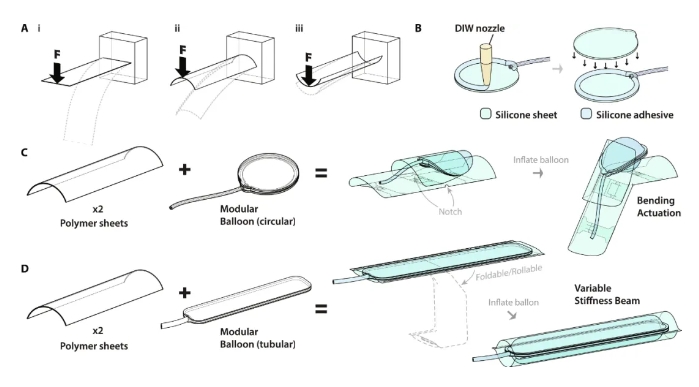
In terms of design, the FiBa actuator adopts a modular design approach, including the FiBa bending module and the FiBa variable stiffness beam module. Through modular design, researchers can quickly prototype the actuator and perform iterative optimization. Different modules can be combined into actuators of various shapes and functions to meet the needs of different application scenarios. This rapid prototyping capability not only accelerates the product development cycle, but also reduces cost risks.
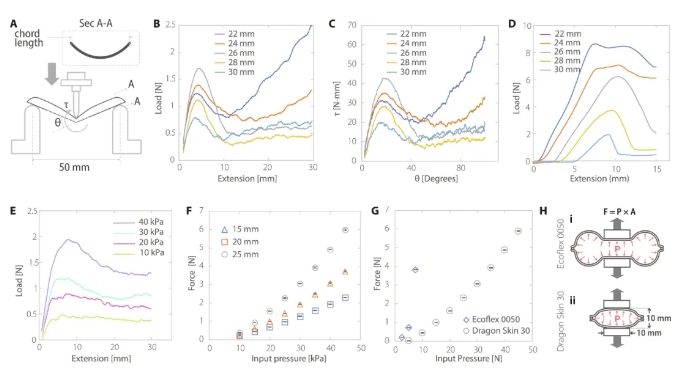
The modular structure of the FiBa actuator is also highly customizable. By adjusting the number, arrangement and size parameters of the modules, researchers can customize the actuator to adapt to different environments and tasks. For example, in a climbing robot, the climbing ability and stability of the robot can be improved by increasing the number and layout of the grasping modules and bending modules.
In order to achieve unrestrained operation, the FiBa actuator also integrates electronic components such as pneumatic pumps, valves, batteries and control boards. When selecting electronic components, the researchers focus on their lightness and high efficiency. For example, the use of micro pneumatic pumps and valves can reduce the overall weight of the system, and the use of high-performance batteries and control boards can improve the energy efficiency and stability of the system. Lightweight electronic components enable the FiBa actuator to operate stably for a long time in an unrestrained environment.
In terms of integration, the researchers reduce signal interference and energy loss by optimizing the layout and connection of electronic components, and improve the reliability and safety of the system by adding redundant design and fault diagnosis functions.
▍Discussion on four forms of FiBa soft robots and landing scenarios
To verify the performance and versatility of FiBa actuators, the research team successfully demonstrated four unfettered bionic motion modes, namely crawling inspired by turtles, climbing inspired by inchworms, perching inspired by bats, and flying inspired by ladybugs.
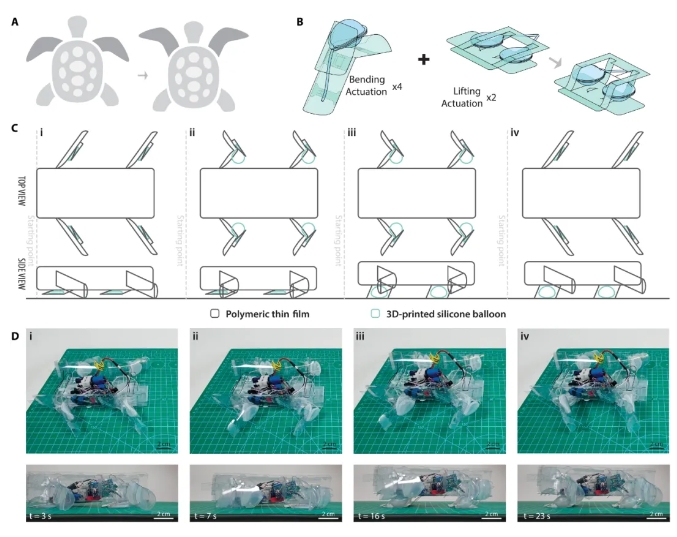
The turtle-inspired crawling robot uses four FiBa bending modules as "fins" to simulate the turtle's forelimbs to propel the robot forward by simulating the turtle's movement on land. These modules are combined with 3D-printed pneumatic balloons through transversely curved polymer films to achieve lightweight and efficient bending movements. The robot is also equipped with a lifting actuator module to adjust the fuselage height when necessary to adapt to different terrain conditions.
In terms of application scenarios, after natural disasters such as earthquakes and tsunamis, there are often a lot of narrow gaps in the ruins, which are difficult for traditional rigid robots to enter. However, this crawling robot can easily pass through these gaps, carry equipment such as life detectors, search for trapped people, and transmit the on-site situation to rescuers in real time through wireless communication, greatly improving the rescue efficiency.
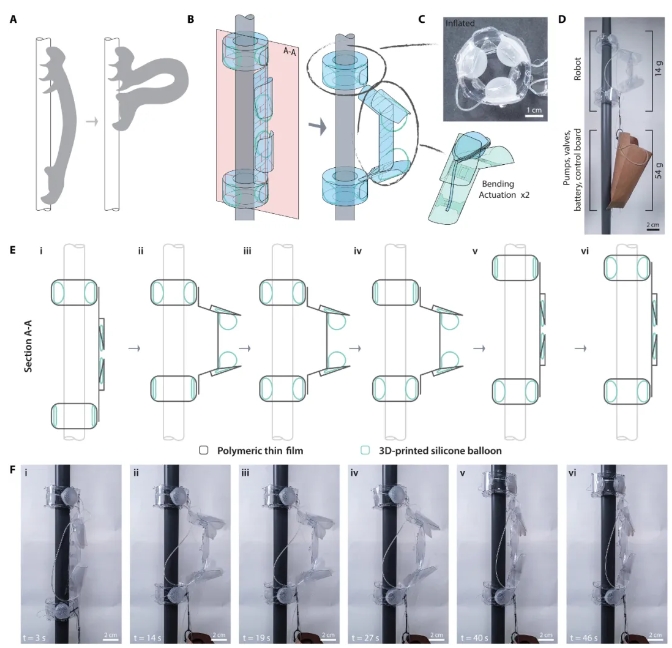
The climbing robot inspired by the inchworm uses the FiBa bending module and the grasping module to achieve vertical climbing by simulating the creeping movement of the inchworm. The grasping module is tightly wrapped around the climbing surface through an inflated silicone balloon to provide sufficient support. At the same time, the FiBa bending module drives the robot to move along the climbing surface to achieve stable climbing.
In the industrial field, this climbing robot can be used for the inspection and maintenance of vertical pipelines, bridges, and exterior walls of high-rise buildings. The robot is equipped with high-definition cameras, infrared thermal imagers and other equipment to conduct detailed inspections of the surface of the structure, promptly detect potential safety hazards, and reduce the risks and costs of manual inspections. This climbing robot also performs well in the inspection of infrastructure such as power lines and communication towers. It can quickly rise along utility poles or communication towers to inspect line insulators, tower body connectors, etc., improving inspection efficiency and accuracy.
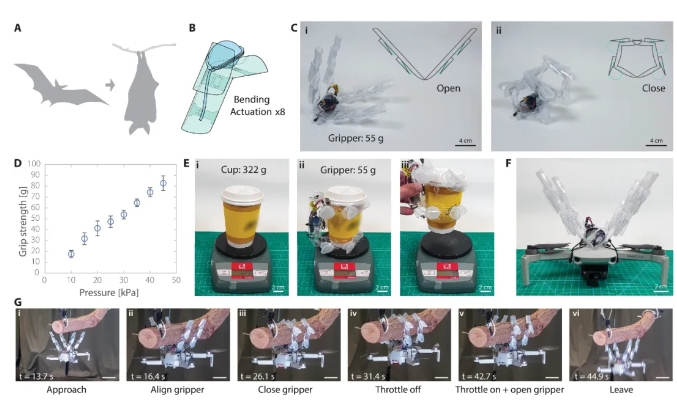
The bat-inspired perching robot uses FiBa modules to build a lightweight four-finger gripper that simulates the way bats perch upside down on branches. The pneumatic structure inside the gripper generates a strong gripping force after inflation, allowing the robot to perch stably on supports such as branches and poles.
In terms of application, installing this perching robot on a drone can significantly extend the flight time of the drone. During the mission, the drone can perch on a support to save energy and take off again when the mission continues, thereby reducing energy costs and expanding the application field. In field operations such as geological exploration and forestry surveys, the perching robot can be used as a temporary support platform. After completing the mission, the drone can perch nearby to charge or wait for further instructions, improving operational efficiency and safety.
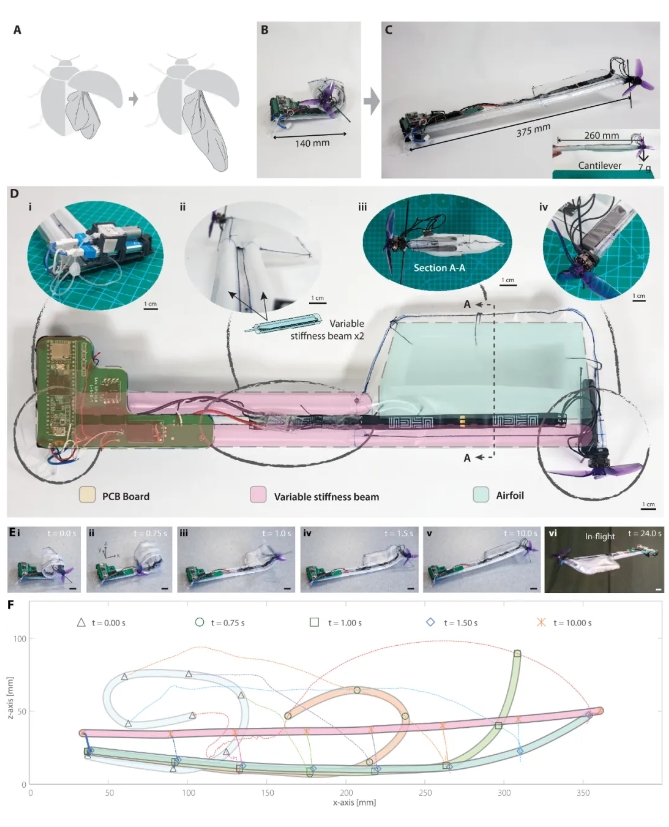
The ladybug-inspired flying robot uses FiBa variable stiffness beam modules as the main structural components of the wing. These modules generate sufficient stiffness and strength to support flight when inflated, and can be easily folded and rolled up in the uninflated state for easy transportation and storage. The robot is also equipped with a thrust device and a control system to achieve autonomous flight and attitude adjustment. In emergency situations such as natural disasters, this flying robot can respond quickly and accurately deliver urgently needed supplies such as food and medicine to the disaster area. Its foldable wing design allows the robot to occupy a small space during transportation, facilitating large-scale deployment; while the autonomous flight capability ensures the accuracy and timeliness of material delivery. In the field of environmental monitoring, the flying robot can carry a variety of sensors and equipment to conduct comprehensive monitoring and data collection of air quality, water quality, etc. Its flexible flight capability and wide monitoring range enable the robot to quickly cover large areas and provide accurate data support. In addition, it can also be used in the agricultural field for pest and disease monitoring and crop growth status assessment.
▍Conclusion and the future
The emergence of FiBa soft actuators marks a major breakthrough in soft robotics technology. Through the selection of lightweight materials and the application of modular design, the FiBa actuator has lightweight and multifunctional characteristics. This design not only solves the weight problem of traditional soft robots, but also has extremely high generalization in practical scenarios. In the future, researchers will continue to optimize the design and technical solutions of the FiBa actuator to improve its performance and reliability. In addition, with the development of intelligent control and autonomous navigation technology, the FiBa soft robot is expected to perform more intelligently in the future.