What is GRP tubes?
A GRP tube is a pipe made of glass fibers embedded in a thermoset resin matrix. GRP stands for Glass Reinforced Plastic, and the same products are also labelled FRP; a general overview of glass-reinforced plastic covers the wider material family. RTP (Reinforced Thermoplastic Pipe) uses a thermoplastic liner and a different construction, so it is treated separately here. This guide explains what GRP tubes are made of, how manufacturers form them, why they perform the way they do, and where they are commonly used.
Key Takeaways
A GRP tube is a strong, lightweight pipe made of glass fibers and resin, a point revisited in six myths about GRP pipes.
GRP tubes resist corrosion and chemicals in many service conditions where metal pipes break down.
Choose the resin for the fluid: polyester for water, vinyl ester for chemicals, epoxy for higher heat.
GRP tubes typically weigh about one-quarter as much as steel pipes, so crews handle them more easily; a related structural comparison appears in GRP sections versus steel and aluminum.
Use the correct joint type for the pipe system to limit leak risk.
Suppliers commonly design GRP tubes for a 50 to 60 year service life, subject to correct installation and resin selection.
Check that a supplier tests to recognized standards such as ASTM D3517 for water pipes.
GRP tubes serve water, chemical, marine, and underground applications.
What Is a GRP Tube Made Of
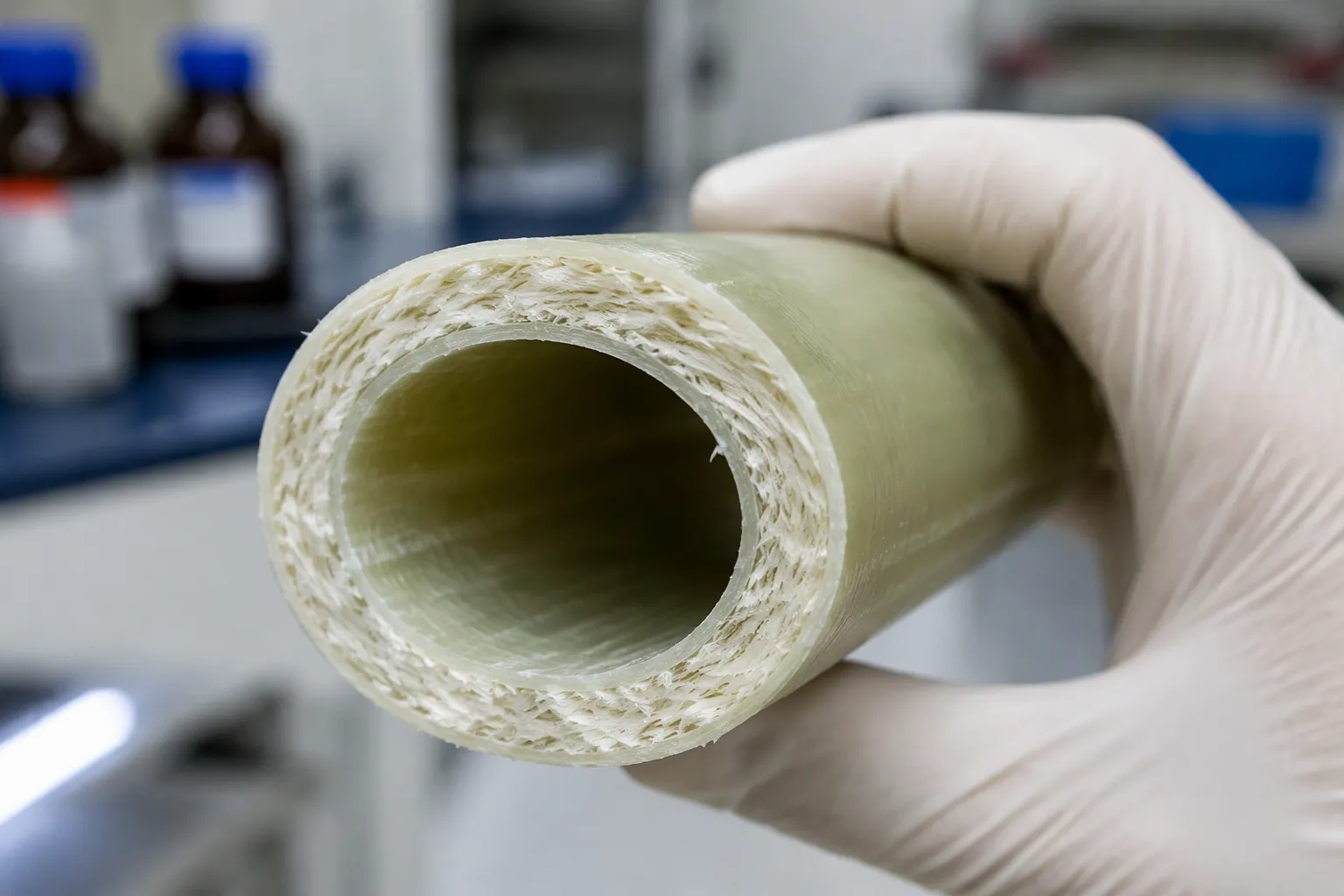
A GRP tube is a composite structure, the same fiber-and-resin build described in what GRP tubes are. Glass fibers give it tensile strength, and the resin matrix holds them together and protects them. Additives adjust performance for specific service conditions. Each part has its own job, and how they balance determines how the finished tube acts under load, in chemical exposure, and across temperature swings.
Glass Fiber Reinforcement
Glass fibers carry the mechanical load in a GRP tube, a role covered in how GRP is made. They resist pulling forces, add stiffness, and hold their shape under stress. Manufacturers mix short-cut glass fibers into the resin matrix to give the tube high axial compressive strength, as described in what GRP tubes are. According to manufacturer documentation, this internal reinforcement improves resistance to high pressures. It also supports demanding structural uses such as pipe jacking and tunnel boring, where the tube must keep its integrity underground.
E-Glass and ECR-Glass
E-glass is a widely used reinforcement fiber. It offers a balance of strength, electrical insulation, and cost. ECR-glass improves resistance to acids and corrosive environments. Both fiber types work well in pultruded and wound tubes, and the choice depends on the chemical exposure the tube will face.
Fiber Orientation and Strength
Fiber direction shapes how a tube performs. Engineers line up fibers to match the loads a tube will meet in service. The following orientations serve different structural goals:
Axial (0°) for bending and tensile strength performance
Hoop (90°) for crush and burst resistance
±45° for torsional rigidity
Balanced and multi-axis constructions for combined loads
Custom layup lets engineers tailor axial, hoop, and torsional properties to specific load and performance requests, according to supplier-published guidance. Filament winding gives similar control. Continuous fiber runs around the circumference for hoop strength and along the length for axial strength. By layering different angles within the same wall, manufacturers build one tube that resists pressure, bending, crushing, and twisting at once. The material behaves anisotropically, so its mechanical properties vary with direction.
| Application | Fiber orientation relevance |
|---|---|
| Cryogenic supports and transfer systems | Fiber angles can be tailored to axial, hoop, and combined loads. |
| High-voltage insulation | Filament winding gives more control over fiber direction. |
| Pressure-bearing tubes and vessels | Continuous fibers can be positioned to resist hoop and axial stress efficiently. |
| Axially loaded structural tubes | Continuous lengthwise reinforcement gives high axial strength and stiffness. |
| Tubes under combined or multidirectional loads | Multiple winding angles can be combined to handle axial, hoop, radial, and torsional demands within the same wall. |
Resin Matrix Systems
The resin matrix holds the fibers together and transfers load between them. It also shields them from moisture and chemicals. Resin selection drives chemical resistance, temperature tolerance, and UV performance. Common matrix systems include polyester, vinyl ester, and acrylic, and each one suits a different service profile.
Polyester, Vinyl Ester, and Acrylic
Polyester is the general-purpose option. It costs less and handles many standard water and structural duties. Vinyl ester resists strong acids, strong alkalis, oxidizing chemicals, many organic solvents at moderate temperatures, hydrogen sulfide, sewer gas, and brine solutions, according to supplier-published resin comparisons. Acrylic and epoxy resins offer better UV resistance than standard polyester grades. Epoxy generally provides higher mechanical properties, better adhesion, and lower shrinkage than standard polyester, although results depend on the formulation and cure schedule.
Resin Choice and Chemical Resistance
Chemical service demands a careful resin match. One supplier comparison ranks general chemical resistance as epoxy above vinyl ester, vinyl ester above isophthalic polyester, and isophthalic polyester above orthophthalic polyester. The same source reports that a brominated epoxy vinyl ester with a C-glass veil retained 71% flexural strength after exposure to 10% sodium hypochlorite at 65°C, while the same resin with a polyester veil retained 29%. Isophthalic polyester is rated NR (not recommended) for sodium hypochlorite service in that comparison. Supplier price lists commonly place vinyl ester at 2–3 times the cost of polyester per kilogram, so engineers weigh that premium against the service life the application requires. These figures come from a single supplier test and price list, not from an industry-wide standard.
| Property | Polyester | Vinyl ester | Epoxy |
|---|---|---|---|
| Flexibility | Lower | Higher | Lower (brittle if over-applied) |
| Stress crack resistance | Moderate | Better | Variable |
| Thermal cycling performance | Adequate | Good | Application-dependent |
| Typical HDT (isophthalic/product-specific) | ~220°F | Varies by grade | Varies by system |
Additives and Liners
Additives fine-tune the resin system. Fillers add bulk, reduce shrinkage, and can improve fire performance. UV stabilizers slow surface degradation from sunlight exposure. These small additions extend service life in outdoor and industrial settings without changing the core composite structure.
Fillers and UV Stabilizers
Fillers lower cost and control shrinkage during cure. UV stabilizers protect the resin surface from sunlight, which matters for above-ground runs and exposed installations. Together they help the tube hold its appearance and mechanical properties over time.
Abrasion-Resistant Inner Liners
Many GRP tubes carry a resin-rich inner liner. The liner creates a smooth bore and adds a protective layer against abrasive slurries, aggressive fluids, and permeation. A proper liner also reduces friction loss and supports consistent flow performance across the tube's service life.
How a GRP Tube Is Made
Manufacturers make GRP tubes in three main ways, each described in what GRP tubes are. Each method builds the fiber-and-resin structure in a different way, and each one fits a different product profile.
Pultrusion Process
Pultruded fiberglass tubes come from the main continuous process for GRP tubes, which is also covered in a general description of the pultrusion process. Long glass fiber strands go through a resin bath and then a heated die. The die shapes the profile and cures the resin in one steady pull. The result has high fiber content, even reinforcement, a smooth outer surface, and consistent bending and torsion performance.
Fiber Pulling and Resin Bath
Fiber strands pull nonstop from creels into an open resin bath. Resin viscosity matters here: one pultrusion equipment supplier reports a target of 200–500 cP for polyester and vinyl ester systems. An injection box can take the place of the open bath, and it runs at 2–10 bar. Pull speed depends on wall thickness, as the supplier-published data below shows. These are process window figures for specific production lines, not universal settings.

| Profile Thickness | Recommended Pull Speed | Die Residence Time | Exit Temperature |
|---|---|---|---|
| 2-3 mm | 800-1,200 mm/min | 45-75 sec | 140-155°C |
| 4-6 mm | 400-700 mm/min | 80-135 sec | 145-165°C |
| 8-10 mm | 200-400 mm/min | 135-270 sec | 150-175°C |
| 12+ mm | 100-250 mm/min | 220+ sec | 155-180°C |
Heated Die and Curing
The die runs a three-zone temperature profile. A preheat zone lowers resin viscosity, a gelation zone starts crosslinking, and a cure zone finishes polymerization. One equipment supplier notes that dies usually measure 0.6 to 1.2 m long, and that the gel point should fall near the middle of the die. Pull too fast and the profile cures poorly; pull too slow and it over-cures. The same source cites a Barcol hardness reading of 45–55 on the 934-1 impressor as an indicator of crosslink density. Both figures are equipment-supplier guidance and should be checked against the resin data sheet.
Filament Winding and Casting
Filament winding lays continuous fiber onto a spinning mandrel at controlled angles. Supplier-published comparisons report fiber volume fractions of 50–80% with wind angle precision of ±1°. Centrifugal casting spins resin and fiber inside a heated mold, and the rotation packs material against the mold wall.
Winding Angles and Pressure Rating
Winding angle sets the strength balance. Supplier guidance states that a low winding angle gives greater tensile strength, while a higher angle gives the structure more circumferential strength. The same source lists hoop winding at 85–90° for hoop strength, with a 2.5:1 hoop-to-axial ratio, and helical winding from 15–85° for customizable properties. Wound tubes can reach pressure ratings up to 10,000 psi (700 bar) in that supplier's product range.
The same comparison rates filament winding as strong against internal pressure failure risk, at 700+ bar. Such values are product-line specific and should be confirmed on the manufacturer's datasheet.
Centrifugal Casting Basics
Centrifugal casting fits large-diameter tubes with a smooth inner bore. The spinning action drives resin outward and makes a dense wall. This method fits gravity-flow lines and custom diameters better than high-pressure service.
Hand Lay-Up Methods
Hand lay-up places resin and glass mat or cloth into a mold by hand. Workers build the wall in layers, wetting out each layer as they go.
When Manual Lay-Up Fits
Manual lay-up fits short runs, one-off fittings, and complex shapes that a die cannot form. It also serves field repairs and prototype work. The method gives lower and less consistent fiber content than pultrusion, so engineers reserve it for low-pressure and non-structural duties.
Need a Tube Specification for a Specific Service?
Review pultruded tube dimensions, technical data, and request a quotation against a written specification.
Key Properties and Performance
Strength-to-Weight Ratio
A GRP tube gives a high level of strength at low weight, a comparison also drawn in GRP sections versus steel and aluminum. The glass fibers carry the load, and the resin keeps the wall thin and light. This mix makes the tube easier to move and lift on site.
Density and Pressure Ratings
Supplier-published figures put density at about 0.065 lbs/in³, while steel is 0.283 lbs/in³. A tube of the same size weighs about a quarter of a steel one. Pressure ratings go from 70 to 4,000 PSI and depend on diameter and wall thickness. Datasheet values, rather than these general ranges, should govern a purchase; the profile technical data page lists the measured properties for pultruded sections.
| Parameter | Range | Notes |
|---|---|---|
| Pressure rating | 70–4,000 PSI | Depends on diameter and wall thickness |
| Density | 0.065 lbs/in³ | Steel is 0.283 lbs/in³ |
Corrosion and Chemical Resistance
The corrosion resistance discussed in GRP engineering solutions for industrial infrastructure comes from the resin matrix, which seals the fibers from moisture, salts, and reactive fluids. Chemical plants, wastewater facilities, and marine settings depend on this barrier where metal pipes would break down.
Harsh Service Environments
Vinyl ester grades resist strong acids, alkalis, and brine solutions. Outdoor runs also hold up against weather and UV exposure when the resin has stabilizers. The tube keeps its wall thickness and smooth bore over time, so flow performance stays steady.
Temperature and Flow Performance
Service temperature depends on the resin system. Flow performance depends on the bore finish. Both factors shape where a given tube fits.
Service Temperature Ranges
Supplier-published tables list continuous service limits by resin type. Unsaturated polyester reaches about 70–80°C (158–176°F). Vinyl ester handles 100–120°C (212–248°F). Epoxy reaches 120–150°C (248–302°F). These are general ranges across product families; a specific grade may sit above or below them.
| Resin Type | Continuous Service Temperature |
|---|---|
| Unsaturated polyester (UP) | ~70–80°C (158–176°F) |
| Vinyl ester | 100–120°C (212–248°F) |
| Epoxy | 120–150°C (248–302°F) |
Smooth Bore and Friction Loss
A resin-rich liner makes a smooth bore with low roughness. Published roughness tables list fiberglass (FRP/GRP) at 0.005 mm, close to drawn tubing at 0.0015 mm and far below uncoated cast iron at 0.26 mm. A hydraulic reference reports a Hazen-Williams C factor of 150 for plastic pipe, against 100 for unlined cast iron. The chart below, sourced from that reference, compares C values across materials. Both sets of values are reference figures, so project calculations should use the coefficient specified by the design standard.
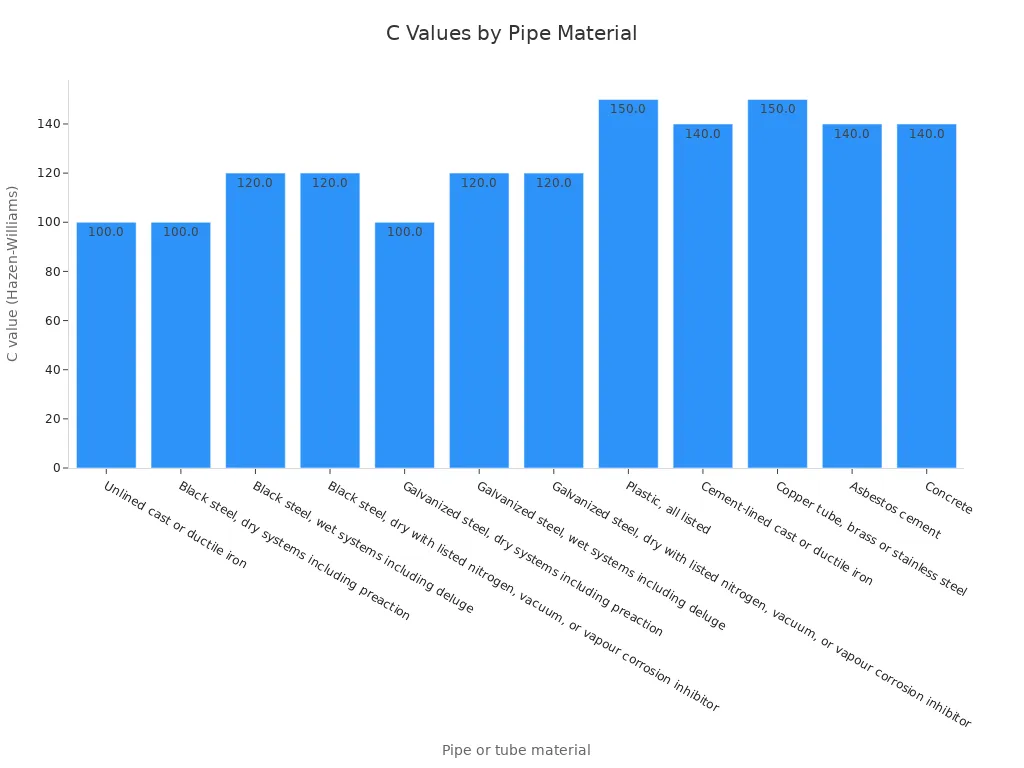
Lower roughness cuts friction loss and pumping energy. Unlike steel, the bore stays smooth because the wall does not corrode or scale. Light weight adds a practical gain: fewer lifting tools, faster installation, and lower labor cost.
GRP Tube Types and Standards
GRP, GRE, and GRV
GRP is the general name for glass-reinforced plastic pipe, as set out in what GRP tubes are. Two common types have their own labels, and the resin matrix is what sets them apart. Published product descriptions list GRP with isophthalic resin, GRE with epoxy resin, and GRV (also written GRVE) with vinyl ester resin. The fiber reinforcement is mostly the same in all three. The resin choice sets what each pipe can handle.
Epoxy-Based GRE
GRE uses an epoxy matrix. Supplier-published application notes report GRE at temperatures up to 110°C and list offshore platforms, oil and gas pipelines, and refinery systems as typical duties. Epoxy also gives flexibility and high temperature tolerance, per the same source. That profile fits high-pressure and oilfield duty. The main difference between GRP and GRE is the resin matrix, so buyers should check which matrix a quote actually names. This 110°C figure is product-line specific and differs from the wider epoxy range shown earlier.
Vinyl Ester GRV
GRV pairs vinyl ester resin with glass fiber. Supplier-published notes place GRV in chemical processing plants, desalination facilities, and wastewater treatment systems. Vinyl ester resists harsh chemicals, which explains that fit. A buyer facing strong acids or brine should ask for GRV by name instead of accepting a general GRP label.
| Pipe Type | Resin Matrix | Typical Applications |
|---|---|---|
| GRP | Isophthalic or polyester resin | Municipal water, sewage, irrigation |
| GRE | Epoxy resin | Offshore platforms, oil and gas, refineries |
| GRV | Vinyl ester resin | Chemical plants, desalination, wastewater |
Pressure Classes and Sizes
A GRP tube comes in a wide range of diameters and lengths. Standard lengths include 5 meters, and makers customize dimensions to project needs; why GRP pipes are used in industrial systems sets out the service conditions that drive the specification. Pressure class follows wall thickness and diameter, so buyers should state both the bore and the working pressure in the inquiry. The current edition of ASTM D3517 covers machine-made fiberglass pressure pipe from 8 in. (200 mm) through 156 in. (4000 mm), rated for internal gage pressures of 450 psi (3103 kPa) or less. That range gives a useful reference point for water conveyance work. The original article cited the 2019 edition, which has since been superseded.
Key Standards
ASTM and ISO References
Buyers should check that a supplier tests to recognized standards, and a supplier can show its qualifications and standards documentation on request. ASTM D3517 sets requirements for stiffness, hoop-tensile strength, joint tightness, beam strength, and longitudinal compressive and tensile strength. The current edition of ASTM D3839 guides underground installation, covering trenching, pipe placement, joining, backfill compaction, and deflection monitoring; its stated diameter range is 1 in. to 13 ft (25 mm to 4000 mm). On the ISO side, ISO 10468 determines long-term ring creep stiffness under wet conditions, and ISO 11296-4 addresses cured-in-place lining of non-pressure drainage and sewerage networks. A short standards list on the datasheet tells a buyer whether the product has been checked against a known benchmark. The original article cited the withdrawn 2002 edition of D3839 and a 3600 mm upper diameter; both have been corrected here.
The tube families above are also available as standard pultruded profiles. Two product listings show the round tube options side by side.

Pultruded Fiberglass Tube
A constant-section round tube formed by pulling continuous glass fibers through a resin bath and heated die.
View Product
GRP/FRP Tubes
A category of pultruded GRP and FRP round tube profiles grouped by diameter and section.
View ProductMatch the Resin and Class to the Application
NHC (Nanjing Hypro Composites Co., Ltd.) supplies pultruded GRP tubes and can quote against a written specification that names the resin, liner, pressure class, and jointing method.
Installation and Jointing
Joining Techniques
The right joint depends on the pipe system and how it will be used. Installation guidance recommends following the approved maker's instructions for that specific FRP pipe system. The table below shows where each joint type is typically used.
| Joint type | Typical use | Key installation check |
|---|---|---|
| Bell-and-spigot with gasket | Many buried or pressure pipe systems | Clean the socket and spigot, use the right lubricant, and check insertion depth and gasket position |
| Adhesive-bonded | Systems made for a bonded socket or coupling | Prepare surfaces and control adhesive mixing, working time, and cure conditions |
| Flanged | Valves, equipment, and connections you may remove | Align faces, use the right gasket, and tighten bolts in the approved order |
| Butt-and-wrap | Field joints in systems made for laminate joining | Control surface prep, laminate order, resin mix, cure, and final inspection |
Field crews can cross-check these steps against common FRP installation mistakes before a joint is closed.
Bell-and-Spigot Joints
A bell-and-spigot joint pushes the spigot end into the bell end. A rubber gasket seals the connection. Workers clean both surfaces, apply the right lubricant, and check how deep the pipe goes in. This joint works well for buried and pressure lines because it goes together fast.
Butt-and-Strap and Flanged Joints
A butt-and-strap joint wraps layers of glass reinforcement soaked in resin around the pipe ends. This lamination keeps the joint strong in both hoop and axial directions. It works for field changes and repairs, and it gives high strength. The job needs skilled workers and careful control of surface prep, resin mixing, and curing.
Flanged joints bolt two flanges together with a rubber gasket between them. They connect GRP tubes to steel pipes, valves, and pumps, and they let you take the joint apart later. Workers line up the faces first and avoid using the bolts to pull a misaligned pipe into place. Bolt torque depends on pipe size, pressure, and use.
Burial and Handling
Where GRP pipes outperform traditional materials often comes down to weight: a GRP tube weighs about a quarter of the same size steel pipe, so crews need less lifting gear and fewer workers on site. The light weight also speeds up placing the pipe in the trench and lowers labor cost.
Bedding and Backfill
The trench bottom needs a stable, prepared bedding layer. Workers set the tube evenly on the bedding and avoid point loads. Backfill goes in layers and is packed to the set density. Thrust restraint at bends and tees keeps joints from pulling apart under pressure.
Field Testing
Hydrostatic Testing
Hydrostatic testing fills the system with water and adds pressure to check for leaks. Published installation guidance lays out the standard steps:
Check all joints and fittings for visible damage before the test.
Fill the system with water and remove trapped air, with gauges in the right spots.
Raise pressure slowly to the test level to avoid shock.
Watch pressure the whole time and check joints and fittings for leaks.
Hold the test pressure for 15–30 minutes, depending on industry standards.
Release pressure slowly and write down any findings.
Finish a report covering test conditions, results, and corrective actions.
A visual defect check before startup catches gasket misalignment and incomplete cure. Both checks together confirm the line is ready for service.
GRP Tube Applications by Industry

Water and Wastewater
Water and wastewater service is a major use for glass-reinforced plastic pipe, and it is central to why GRP pipes are used in industrial systems. Supplier literature lists sewer lines, industrial wastewater lines, potable water lines, clean water lines, and rainwater lines as standard jobs. The material also works for drainage lines and irrigation network lines. Published application notes add that city water and sewage networks need careful trenching, proper bedding, and full resin coverage, which helps the pipe resist corrosion while it carries soil pressure and traffic loads. The smooth bore resists scaling and biofouling, and installation does not require welding.
Potable Water and Sewer Mains
Potable water and sewer mains each have their own demands. Supplier literature describes GRP pressure pipe as increasingly specified for water, wastewater, irrigation, and industrial process piping, and notes that GRP resists hydrogen sulfide in sewers while concrete breaks down in that atmosphere. Buyers should confirm the resin grade against the service fluid before ordering. A short list of standards covers this ground:
EN 1796 and ASTM D3517 for water supply
ISO 10639 and AWWA C950 for clean water applications
EN 14364, ASTM D3262, ASTM D3754, and ISO 10467 for wastewater
ASTM D3839, ISO 10465, and AWWA M45 for installation and design
Oil, Gas, and Chemical
Chemical plants, refineries, and oilfield lines expose pipe to fluids that attack metal. Vinyl ester and epoxy matrices give the wall a barrier that holds up in these settings. The tube keeps its bore and wall thickness where steel would pit or scale.
Corrosive Fluids and Brine Lines
Brine lines, acid transfer, and produced water service reward a careful resin match. A vinyl ester grade handles strong acids, alkalis, and brine solutions at moderate temperatures. Epoxy-based GRE fits high-pressure oilfield duty and offshore work. Engineers should state the fluid, concentration, and temperature in the inquiry, because resin selection drives service life more than wall thickness does.
Marine, Agriculture, and Infrastructure
Salt water, soil contact, and outdoor exposure test any pipe material. GRP tubes carry seawater intake and discharge lines, power plant circulation lines, and irrigation networks, which is one of the cases set out in where GRP pipes outperform traditional materials. The smooth bore keeps pumping energy low, and the resin surface resists marine growth and salt attack. Construction, transportation, and infrastructure projects are a growing application area, and these tubes increasingly replace traditional materials in those works.
Seawater, Irrigation, and Cooling Lines
Seawater lines, diffusers, and cooling water circuits suit the material well. Supplier literature lists subsea piping, water intake and discharge lines, diffusers, and circulation lines of power plants as standard uses. Polyester-resin pipe serves municipal water distribution, sewage systems, and irrigation networks, per published application notes, and handles temperatures below 80°C and pressures up to 25 bar in those product lines. A buyer sourcing for a visible site can note that smaller diameters come in white and black, while larger sizes run from grey to white.
Pipe Jacking and Tunnel Boring
Pipe jacking and tunnel boring are demanding applications for this product. The jacking force pushes the whole string through the ground, so the wall must carry heavy axial compression without buckling. Short-cut glass fibers blended into the resin matrix give the tube that high axial compressive strength. Microtunneling also cuts trenching cost and surface disruption in urban areas or at sensitive sites such as water mains and city sewage systems, according to published application notes. A GRP tube built for jacking keeps its round shape under that load, which protects the joint and the bore.
GRP vs. Steel, Iron, and Plastic
GRP vs. Steel and Ductile Iron
Weight, Corrosion, and Maintenance
Weight and corrosion are the main differences between these materials. A GRP tube weighs about one-quarter as much as a steel pipe of the same diameter and pressure class, according to manufacturer-published figures cited in where GRP pipes outperform traditional materials. That means smaller cranes and crews can handle the same run. Steel and ductile iron still have clear advantages for very high pressure, abrasive slurry, or small jobs.
Corrosion resistance is a common reason to choose non-metallic piping. The resin-rich barrier blocks attack from the fluid inside and the soil outside. In standard buried and chemical service, coatings, linings, and cathodic protection are generally not required, subject to the project specification. Those three countermeasures take up much of a steel maintenance budget, so GRP can avoid the coating and lining renewal cycles that steel and iron require.
| Condition | GRP Performance | Specification Relevance |
|---|---|---|
| Corrosive fluids (acids, alkalis, salts) | Resistant by resin selection, no chemical erosion of the barrier layer | Supports selection for aggressive fluids |
| Corrosive or acidic soils | Resists soil acidity, no cathodic protection required | Supports buried-service specification |
| Maintenance burden | Low routine maintenance, 50+ year design life | Lowers lifetime cost against coated steel |
| Installation | About one-quarter the weight of steel pipe | Cuts transport and lifting cost |
GRP vs. PVC and HDPE
Pressure, Temperature, and Stiffness
Thermoplastics and thermosets work in different duty ranges. A published pipe-materials comparison reports that PVC and HDPE top out near 60°C, while GRE/GRP reaches 130°C. GRP also reaches far higher pressures in that comparison, up to 240 bar in small diameters, compared with 15 bar for PVC and 25 bar for HDPE. These are comparison-table values for specific product classes, not design limits.
Stiffness separates them further. GRP is stiffer than HDPE and is graded by ring-stiffness (SN) classes, which makes it more self-supporting and suited to deep gravity sewers. HDPE is a flexible pipe whose load capacity comes from pipe-soil interaction, so its bedding matters more. HDPE still fits trenchless work, abrasive service, and leak-critical lines.
| Property | PVC | HDPE | GRE/GRP |
|---|---|---|---|
| Max temp (°C) | 60 | 60 | 130 |
| Max pressure (bar, typical) | 15 | 25 | 240 |
| Chemical resistance | Good | Good | Excellent |
| Relative cost | Low | Low | High |
Cost, Sustainability, and Selection
Installed Cost and Service Life
Installed cost depends on the whole project, not just the pipe price. Manufacturer-published comparisons cited in why GRP pipes are used in industrial systems report that GRP pipes can cut sewage system costs by up to 40% compared with ductile iron; such savings depend on local labor, bedding, and transport conditions. Suppliers commonly design GRP pipes for a working life of 50 to 60 years. Buyers should weigh maintenance savings and pumping energy against the higher unit price, and treat any longer life estimate as unverified unless it comes with a project-specific design basis.
Sourcing Checklist
A sound purchase starts with a clear specification. Match resin type, liner, pressure class, and jointing method to the application. Then verify that a GRP tube manufacturer meets the relevant standards. A good GRP tube supplier will confirm the resin system in writing before quoting.
A GRP tube is made by combining glass fibers with a resin matrix. Manufacturers form it through pultrusion, winding, or casting into a pipe that is lightweight and resists corrosion.
Choosing the right tube follows a clear logic. Engineers match the resin type, liner, pressure class, and jointing method to the service conditions. They then confirm the supplier meets the relevant standards before placing an order.
Buyers can compare suppliers against the same written specification, including resin system, liner, pressure class, jointing method, and test standards.
Ready to Specify a GRP Tube?
Request a quotation, browse the full pultruded product range, or review the certifications behind a specification.
FAQ
What does GRP stand for, and is it the same as FRP?
GRP stands for Glass Reinforced Plastic. FRP means Fiber Reinforced Plastic, and RTP means Reinforced Thermoplastic Pipe. GRP and FRP often describe the same glass-and-resin product. RTP uses a thermoplastic liner and a different construction, so buyers should confirm the exact build before comparing quotes. Product listings for FRP fiberglass reinforced panels show one family sold under the FRP label.
Which resin should a buyer choose for a chemical line?
The service fluid decides the resin. Vinyl ester suits strong acids, alkalis, and brine. Epoxy fits high-pressure oilfield duty. Polyester works for standard water and sewage. Buyers should state the fluid, its concentration, and the operating temperature in the inquiry, because the resin drives service life.
Do GRP tubes degrade in sunlight?
Standard polyester grades can break down at the surface after long sun exposure. UV stabilizers slow that process down. Acrylic and epoxy resins resist UV better than standard polyester. Above-ground runs do better with a UV-stabilized grade or a protective coating, especially in hot, sunny climates.
What pressure and temperature can a GRP tube handle?
Pressure ratings run from about 70 to 4,000 PSI, set by diameter and wall thickness. Temperature limits follow the resin: polyester reaches roughly 70–80°C, vinyl ester 100–120°C, and epoxy 120–150°C. Buyers should treat these as general ranges and confirm the rated values on the datasheet.
Which joint type suits a buried pressure line?
A gasket bell-and-spigot joint goes together fast and fits many buried pressure lines. Butt-and-strap lamination gives a strong field joint for repairs and changes. Flanged joints connect to valves, pumps, and steel pipe, and they allow later disassembly. Thrust restraint at bends keeps joints from pulling apart.
Can GRP tubes handle pipe jacking?
Yes. Short-cut glass fibers blended into the resin matrix give the wall high axial compressive strength. That strength lets the tube carry jacking force without buckling. The tube also keeps its round shape under load, which protects the joint and the bore during installation.
Which standards should a buyer verify?
For water supply, check EN 1796, ASTM D3517, ISO 10639, and AWWA C950. For wastewater, check EN 14364, ASTM D3262, ASTM D3754, and ISO 10467. For installation, check ASTM D3839, ISO 10465, and AWWA M45. A datasheet that names these standards shows the product has been tested against a known benchmark. Confirm the current edition of each standard before specifying it.
How long does a GRP tube last in service?
Manufacturers commonly design these tubes for a working life of 50–60 years. The resin barrier resists corrosion inside and out, so the wall keeps its thickness and smooth bore. Actual life depends on the resin match, the service fluid, and correct installation.
References and Notes
Current ASTM D3517 specification for fiberglass pressure pipe — scope, diameter range, and pressure ceiling (astm.org, accessed 2026-11-09). The 2019 edition cited in the original article has been superseded.
Current ASTM D3839 guide for underground installation — trenching, bedding, backfill, deflection monitoring, and the 25 mm to 4000 mm diameter range (astm.org, accessed 2026-11-09). The 2002 edition cited originally is withdrawn.
General overview of glass-reinforced plastic — background on the GRP and FRP terms (en.wikipedia.org, accessed 2026-11-09).
General description of the pultrusion process — background on the continuous forming method (en.wikipedia.org, accessed 2026-11-09).
Data notes: the pultrusion parameter table, Barcol hardness window, 50–80% fiber volume fraction, winding angles and pressure limits, 0.065 lbs/in³ density, 70–4,000 PSI rating, resin-specific service temperatures, roughness and Hazen-Williams C values, the 110°C GRE figure, the 130°C comparison-table figure, the 50–60 year design life, the 40% installed-cost figure, and the PVC/HDPE/GRE-GRP comparison table are supplier-published or comparison-table values for specific product lines, not industry-wide standards. Some temperature figures use different bases and are not directly interchangeable; the product datasheet governs. Unverifiable longer-life estimates, an unverifiable personal social-media endorsement, and all links to competing manufacturers and suppliers were removed. Table values are reproduced as published.
Internal links: every original link pointing to nhcfrp.com is preserved; anchor text was rewritten so each one describes its own target page. Publisher: NHC (Nanjing Hypro Composites Co., Ltd.).
Next: How Are FRP Pultruded Tubes Made? A Step-by-Step Guide