


How Are FRP Pultruded Tubes Made? A Step-by-Step Guide
FRP pultruded tubes come from a steady, automated process called pultrusion. This method pulls continuous fibers through a resin bath, then through a heated die. The result is a product with a high strength-to-weight ratio, corrosion resistance, and stable cross-section. Global demand reflects this value.
The table below shows one published estimate of the pultruded FRP market. Note that market figures vary by research firm and definition; figures here are estimates, not guarantees.
| Metric | Value |
|---|---|
| Pultruded FRP Profiles market size (2024) | ≈ USD 2.5 billion (estimate) |
| Projected market size (2033) | ≈ USD 4.1 billion (estimate) |
| Compound annual growth rate (CAGR) | ≈ 5.7% |
This guide follows the full path from raw materials to finished tube. Leading manufacturers such as NHC use digitally controlled pultrusion lines that keep precision and steady quality throughout the process.
Key Takeaways
Pultrusion pulls fibers through resin and a heated die to make strong tubes.
Fiberglass and carbon fibers provide the strength, while resin binds them together.
Digital control systems monitor temperature and speed to keep quality consistent.
Quality checks include pulling tests, surface inspection, and dimensional checks.
Custom sizes, wall thicknesses, and resin choices can be tailored to project needs.
FRP tubes do not rust, are lighter than steel, and resist electricity and heat.
Advanced production lines and ISO certifications support dependable products and service.
Raw Materials for Your FRP Pultruded Tube
The pultrusion process starts by selecting the right raw materials. Each component has a specific role in how the final tube performs. Manufacturers such as NHC offer various resin systems and reinforcements to match different performance needs. The materials chosen directly affect properties such as chemical resistance, thermal insulation, and fire retardancy.
Reinforcing Fibers: The Backbone
Reinforcing fibers give a pultruded FRP square tube its structural strength. These fibers carry the mechanical loads and determine how much weight the tube can support. Without them, resin alone would not be stiff enough for demanding applications.
Fiberglass Rovings
Fiberglass rovings are the most common reinforcement in pultrusion. These continuous glass fiber strands offer strong tensile strength at a reasonable cost. E-glass, the standard type, provides good dimensional stability and impact resistance. The table below compares common fiber options (typical published ranges):
| Fiber Type | Tensile Strength (MPa) | Elastic Modulus (GPa) |
|---|---|---|
| E-glass (pultruded profile) | 200–500 | 17–45 |
| E-glass (unidirectional laminate) | 400–900 | 17–45 |
| Carbon (unidirectional laminate) | 1,000–2,500 | Not specified |
Fiberglass remains the most cost-effective choice for most applications. It weighs more than carbon fiber but delivers steady performance at a lower price.
Carbon and Aramid Fibers
Carbon fiber offers higher tensile strength and much lower weight than glass, suiting applications where weight reduction matters most. However, carbon fiber is more brittle than glass under impact and can promote galvanic corrosion when it contacts metals. Aramid fiber, known by the trade name Kevlar, offers outstanding impact resistance with higher elongation than carbon. Each fiber type brings its own trade-offs to the pultrusion process.
Polymer Resins: The Binding Matrix
Resins bind the fibers together and transfer loads between them. The resin system also shields fibers from environmental damage. NHC offers several resin options, including ISO polyester, vinyl ester, epoxy, and phthalic acid systems.
Polyester and Vinyl Ester
Polyester resin is the most economical option for standard applications, offering decent mechanical properties and chemical resistance for many industrial jobs. Vinyl ester resin balances cost and corrosion resistance, handling a wider range of chemicals than standard polyester.
Epoxy and Specialty Resins
Epoxy resin delivers high performance among common options, providing strong chemical resistance, thermal stability, and toughness. Its glass transition temperature typically ranges from 80°C to 180°C depending on the formulation. Specialty resins can be formulated for needs such as improved fire resistance or electrical insulation.
Additives and Fillers
Additives and fillers modify the tube's properties without altering its basic structure. They improve surface finish, fire safety, weatherability, and processing efficiency.
UV Stabilizers and Pigments
UV stabilizers protect the tube from sunlight damage, slowing color fading and surface cracking over time. Pigments provide color and opacity, letting makers match specific looks; carbon black acts as both a pigment and a UV stabilizer.
Fire Retardants and Fillers
Fire retardants such as alumina trihydrate (ATH) suppress flames and reduce smoke. Calcium sulfate also provides flame and smoke retardant properties. Fillers like calcium carbonate lower cost while improving dimensional stability; talc improves surface finish, and fumed silica acts as a thixotrope to control resin viscosity. These additives work together to help a tube meet safety standards without sacrificing structural strength.
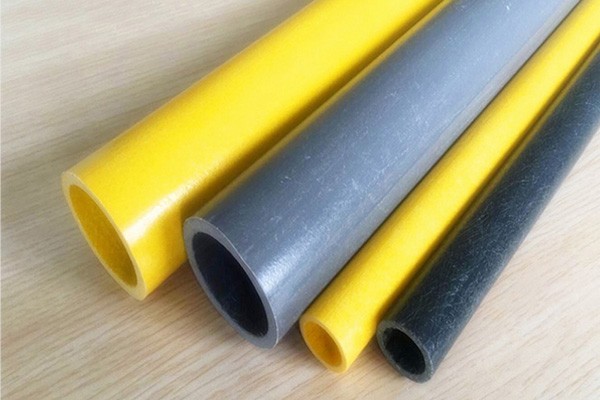
The Pultrusion Machine: A Process Overview
The pultrusion machine is the core of the manufacturing process. It turns raw fibers and liquid resin into a solid, continuous profile. The machine runs continuously, allowing high-volume production with steady quality. Each station along the line has a specific job; together they work in sync to create an FRP pultruded tube with precise dimensions and dependable mechanical properties.
The basic mechanics of pultrusion involve several key parts, including the fiber delivery system, resin bath, and heated die. As fibers enter the resin bath, they are saturated with thermosetting (or thermoplastic) resin, which then hardens inside the heated die to form solid, continuous lengths of composite material. This process raises physical properties and improves production efficiency.
NHC uses digitally controlled pultrusion lines that manage tension, speed, and temperature. A single-station hydraulic pultrusion line uses high-precision digital PID modules to control separate thermal zones, with real-time current monitoring. If a heating element fails, the PLC immediately identifies the exact zone, preventing a temperature drop across the 0–250°C range and supporting consistent curing quality.
The Creel and Fiber Guidance System
The creel is the starting point of the pultrusion process. It holds the fiber supply and controls unwinding tension. For complex profiles, the creel can combine direct rovings with continuous strand mat, woven fabric, or stitched multiaxial layers. A well-designed creel ensures consistent fiber placement and reduces the risk of tangling or tension variation.
Tension control directly affects the mechanical properties of the final part. Minimizing tension differences between individual fiber ends often matters more than the absolute tension value—a single tow under excess tension can compromise the entire profile. Poor guiding, such as sharp angles, rough surfaces, or excessive tension, can damage filaments and create defects or downtime.
The Resin Impregnation Bath
After leaving the creel, fibers enter the resin impregnation bath, where every strand is saturated with liquid polymer resin. Complete saturation, known as wet-out, removes air bubbles and voids that would otherwise weaken the product. The bath holds a carefully mixed resin formula at controlled temperature and viscosity to ensure even coating. Pre-forming guides then compress and shape the resin-soaked fibers, removing excess resin and preventing voids.
The Heated Die and Puller
The pre-formed fibers move into the heated steel die, which maintains temperatures between 140–180°C in the cure zone. The heat triggers the chemical reaction that hardens the resin, locking the shape permanently and setting the final dimensions and surface finish.
Pull speed and die temperature work together as a matched pair. Typical pull speeds range from 0.2–2.0 m/min, and the two values must be set together for each resin system and profile geometry. Raising die temperature accelerates the thermoset reaction, but the hottest setting is not always best—one industrial vinyl ester study found the best mechanical performance at an intermediate temperature. The profile heats from its edges inward, so the center and surface follow different temperature histories.
The pulling mechanism uses grippers or caterpillar tracks to draw the profile at a steady speed, and a flying cutoff saw syncs with the pulling speed to cut the cured profile to length without stopping production. Digital systems monitor the entire process, including real-time pulling force, speed profiles, die temperatures, and energy use.
| Monitoring Function | Manufacturing Benefit |
|---|---|
| Temperature monitoring | Keeps stable curing conditions, ensuring consistent profile quality |
| Speed control | Ensures uniform production output, reducing dimensional variations |
| Equipment status tracking | Cuts unexpected downtime, improving overall efficiency |
| Production data recording | Supports quality management and traceability for process optimization |
The pultrusion process is highly efficient: a single continuous line can produce hundreds of meters of tube per day. Automation reduces labor needs, and digital control removes the variability of manual adjustment. This combination of speed, precision, and consistency makes pultrusion the preferred method for manufacturing composite tubes at scale.
Step-by-Step Pultrusion Process
Pultrusion turns raw fibers and liquid resin into a solid, continuous profile. Each step builds on the last to make an FRP pultruded tube with consistent sizes and reliable mechanical properties. The table below shows the six main stages and how they contribute to product quality:
| Step | Contribution to Quality |
|---|---|
| Fiber arrangement | Prevents tangling, ensures uniform distribution |
| Resin impregnation | Complete wet-out eliminates dry spots |
| Preforming | Maintains fiber alignment, reduces voids |
| Curing | Determines degree of cure and dimensional accuracy |
| Pulling | Ensures constant speed and profile straightness |
| Cutting | Provides accurate length and clean edges |
Step 1: Fiber Pulling and Tensioning
The process begins at the creel, where continuous fiberglass rovings sit on a yarn rack. The machine pulls fibers from the creel under controlled tension, and forming guides align and tension the rovings before the resin bath. Proper tension prevents tangling and keeps each strand aligned; too much tension harms the fibers, while too little causes slack and misalignment. This step directly affects the final strength of the pultruded FRP square tube.
Step 2: Resin Wet-Out and Saturation
The aligned fibers move into the resin impregnation bath for complete saturation (wet-out). Operators control resin viscosity, typically between 200 and 400 cP, by adjusting bath temperature. Vacuum-assisted impregnation at 0.2 to 0.5 bar actively draws air from fiber bundles and can reduce void content from roughly 4–5% to below 1% under controlled conditions. Resin degassing, reduced pull speed, and a surface veil further help eliminate pores and voids, while pre-drying fillers prevents bubbles during cure. These methods work together to ensure consistent laminate quality.
Step 3: Preforming and Shaping
After impregnation, the wet fibers pass through preforming guides that gradually shape the material from a flat bundle into the desired profile. Good arrangement prevents resin-rich areas and uneven fiber spread at the die entrance. Guides and rollers also compress the wet fibers to remove excess resin, control the resin-to-fiber ratio, and improve the final surface finish.
Step 4: Curing in the Heated Die
The preformed material enters the heated steel die, which sets the final geometry. The die contains heating zones matched to the resin exotherm and is typically 600 to 1200 mm long; cooling at the die inlet prevents early cure. For polyester resins, the first zone runs around 150°C and the second around 190°C. The curing process aims to achieve at least 95% cure at the die exit while keeping the maximum material temperature below 190°C to avoid thermal degradation.
The pull speed, typically between 0.75 and 1.25 m/min, works with the die temperature to control cure time, ensuring consistent quality across the entire tube length.
Step 5: Pulling and Cutting
The pulling mechanism—either a crawler or reciprocating puller—advances the cured profile without stopping, maintaining steady line speed and pulling force. A steady force indicates even friction, stable cure behavior, and consistent material delivery; rising or shaking forces prompt a check. A flying cutoff saw matches the pulling speed and cuts the profile to the required length without halting production, giving accurate lengths and clean edges that meet customer specifications.
Quality Control in the Manufacturing Process
Quality control is a key part of making pultruded products. NHC reports holding certifications for ISO 9001, ISO 14001, ISO 45001, and IATF16949, which support quality management at every step. The company also states it holds numerous national invention patents reflecting a focus on process improvement.
In-Line Monitoring and Testing
In-line monitoring systems track process details continuously. Sensors measure temperature, tension, and resin flow along the production line, and IoT-connected data can feed adjustment systems that help prevent defects such as voids or uneven curing. The industry association literature reports that an increasing share of advanced composite manufacturers now use machine-vision or predictive-quality tools to improve output stability and reduce waste.[2]
| Monitoring Function | Manufacturing Benefit |
|---|---|
| Temperature monitoring | Keeps stable curing conditions, ensuring consistent profile quality |
| Speed control | Ensures uniform production output, reducing dimensional variations |
| Equipment status tracking | Cuts unexpected downtime, improving overall efficiency |
| Production data recording | Supports quality management and traceability for process optimization |
Dimensional and Mechanical Verification
Quality checks confirm dimensional consistency, strength, and surface finish. Testing follows established ASTM, ISO, and EN standards: tensile testing per ASTM D3039, flexural testing per ASTM D790, compressive testing per ASTM D6109, interlaminar shear testing per ASTM D2344, Barcol hardness testing per ASTM D2583, and fiber content determination per ISO 1172.
Full-scale testing includes four-point bending on large-diameter tubes, with reported ultimate bending strengths in the range of 50 to 70 ksi; coupon tests cut from full-size tubes yield maximum tensile stresses of roughly 95 to 107 ksi. Fatigue testing typically subjects tubes to cycles at 40 percent of ultimate static bending stress. The EN 13706 series defines pultruded FRP profiles, structural grades, and quality assurance for European applications.
Surface Inspection and Finishing
Surface inspection follows established visual defect classification practices for composite and pultruded products, which define defect types (such as cracks, blisters, and delamination) and provide acceptance levels for different applications. The Barcol hardness test (ASTM D2583) measures indentation hardness to assess cure degree, and a solvent wipe test with acetone indicates incomplete cure if the surface remains tacky after about 30 seconds.
The fingernail impression test is a simple on-site check: pressing a fingernail into the surface; if an impression remains, the profile is not fully cured and should be rejected.
Finishing methods improve surface quality. Adding a surface veil or mat creates a resin-rich cosmetic layer that eliminates fiber show-through. Die maintenance follows a strict schedule—daily wiping with acetone, weekly polishing with 600 to 1000 grit, monthly dimension checks, and annual hardness and chrome layer inspections. Troubleshooting follows a decision flowchart: for cracks, check the die temperature gradient; for blisters, check moisture and initiator levels; for rough surfaces, add a veil; for dimensional issues, check the die and cure conditions.
Need Custom FRP Pultruded Tubes?
NHC offers custom FRP pultruded round and square tubes in custom sizes, wall thicknesses, and resin systems, backed by digitally controlled production lines and ISO-certified quality management. Contact our team for specifications, samples, and a quotation.
Request a QuoteCustomization and Finishing Options
The pultrusion process is highly flexible. Makers can change sizes, materials, and surface features without redesigning the whole line, making pultruded products useful in many fields from construction to transportation.
Custom Sizes and Wall Thicknesses
Pultrusion can produce many tube shapes. Round tubes usually range from 0.5 inches to 14 inches across, with wall thicknesses from 0.080 inches to 1 inch. Square tubes range from 1 inch to 7.25 inches per side, and rectangular tubes can be up to 4 inches by 12 inches. Common standard sizes include a 0.75-inch diameter with 0.125-inch walls, 1 inch with 0.075-inch walls, and 2 inches with 0.109-inch walls.
The inside diameter of a pultruded tube depends on a mandrel that shapes the inner surface during curing. Makers design mandrels for easy swapping, so changing a mandrel changes the wall thickness quickly—allowing different wall thicknesses without much downtime or retooling. High-precision steel molds set the final shape and keep tight dimensional accuracy throughout the run.
Resin and Fiber Combinations
Material choice is key to tube performance. Polyester resins provide low-cost general use; vinyl ester resins offer better corrosion resistance for chemical and marine settings; epoxy systems give stronger mechanical performance for heavy loads. Additives such as fire retardants, UV blockers, and pigments can be mixed directly into the resin.
Fiber structure also affects final properties. By changing fiber content and direction, engineers tune tubes for bending, compression, or combined loads. The table below shows common resin and fiber combinations:
| Resin | Fiber/Reinforcement | Application/Performance Impact |
|---|---|---|
| Polyurethane | Glass fiber | High impact and fatigue resistance, low shrinkage |
| Thermoplastics | Glass fiber | Better surface slip, heat shape resistance, wear resistance |
| Phenolic | Glass fiber | Best for heat insulation and fire resistance |
| Epoxy | Glass fiber | Low shrinkage, strong high-heat performance, good corrosion resistance |
| Vinyl ester | Glass fiber | Good moisture and corrosion resistance for marine products |
| Unsaturated polyester | Glass fiber | Flexible for general uses |
| Methacrylate | Glass fiber | High filler loading for fire safety, low shrinkage, fast pultrusion speed |
Surface Treatments and Cutting Services
Surface treatments make tubes last longer and look better. A surface veil creates a resin-rich outer layer that hides fibers; UV stabilizers protect against sun damage; fire retardants improve safety ratings for demanding environments. Cutting services give finished lengths ready to install, with a flying cutoff saw matching pull speed during production for clean, accurate cuts.
Applications and Benefits of Pultruded Tubes
FRP pultruded tubes offer a combination of properties that make them valuable where steel and aluminum fail early. The pultrusion process produces a uniform product with steady quality over long runs, making the FRP pultruded tube a strong choice in many fields.
Key Advantages of FRP Tubes
The benefits of FRP tubes go beyond simple material substitution; they address real issues plant managers and engineers face daily. The table below compares FRP pultrusion with steel on key performance points:
| Property | FRP Pultrusion | Steel |
|---|---|---|
| Weight | About 75% lighter than steel (density ≈ 1/4 of steel) | Baseline |
| Conductivity | Non-conductive (thermal & electrical) | Conductive |
| Corrosion Resistance | Highly corrosion-resistant in most environments | Requires painting/galvanizing |
| Strength | Comparable or higher strength per unit weight (direction-dependent) | Baseline |
| Maintenance | Low-maintenance, no coatings needed | Requires regular maintenance |
Corrosion and Chemical Resistance
Corrosion degrades steel structures in chemical plants and marine settings. FRP tubes resist these attacks across a broad range of industrial chemicals without rusting. A steel structure in a corrosive area may last 15–25 years with repainting every 5–10 years; a well-designed FRP structure can offer a long service life with little upkeep, removing the need for painting or sandblasting. The savings from lower maintenance often pay back the initial cost within 3–10 years.
High Strength-to-Weight Ratio
FRP pultrusion typically weighs about one-quarter of steel, cutting shipping and labor costs. Workers can often install it with simple hand tools. The material also has useful elasticity and returns to shape after moderate flexing. Pound-for-pound, FRP matches or exceeds steel's strength along the fiber direction: tensile strength along the fiber reaches roughly 300–600 MPa for glass reinforcement, comparable to structural steel's 400–600 MPa range.
Electrical and Thermal Insulation
Steel conducts electricity and heat, creating safety risks and energy losses. FRP tubes act as natural insulators: electrical resistivity can exceed 10¹⁴ Ω·cm, and thermal conductivity is only about 0.3–0.5 W/m·K versus steel's 43–50 W/m·K. These properties make FRP useful for electrical supports and locations where thermal bridging must be avoided.
Common Industrial Applications
Escalators and Push Rods
Escalator systems need parts that resist wear and corrosion. FRP tubes provide structural support without adding excessive weight. Push rods and tool handles benefit from the material's strength and non-conductive nature; the pultruded FRP square tube works well here because it holds its shape. FRP tubes are also used for telescoping poles, umbrella poles, and high jump poles, which need light, tough materials that withstand repeated use.
Infrastructure and Offshore Platforms
Water treatment plants use FRP tubes for walkways, covers, and structural supports. Coastal structures rely on the material's corrosion resistance in saltwater, and offshore platforms benefit from FRP's non-sparking property when cut or drilled. Bridges use FRP components for pedestrian structures; utilities and telecom companies use non-conductive supports for crossarms and equipment. The material also serves in metal processing, pulp and paper, petrochemical, and mining industries.
The combination of low upkeep, long service life, and safety makes FRP tubes a sound investment, translating directly into lower total ownership costs over the product's lifetime.
Why Choose NHC for Your FRP Pultruded Tube Needs
Over 20 Years of Manufacturing Expertise
NHC states it has manufactured pultruded products for over 20 years, with experience across materials, machines, and quality checks. The company reports holding numerous national invention patents and describes itself as a national high-tech enterprise and a Nanjing Gazelle Enterprise.
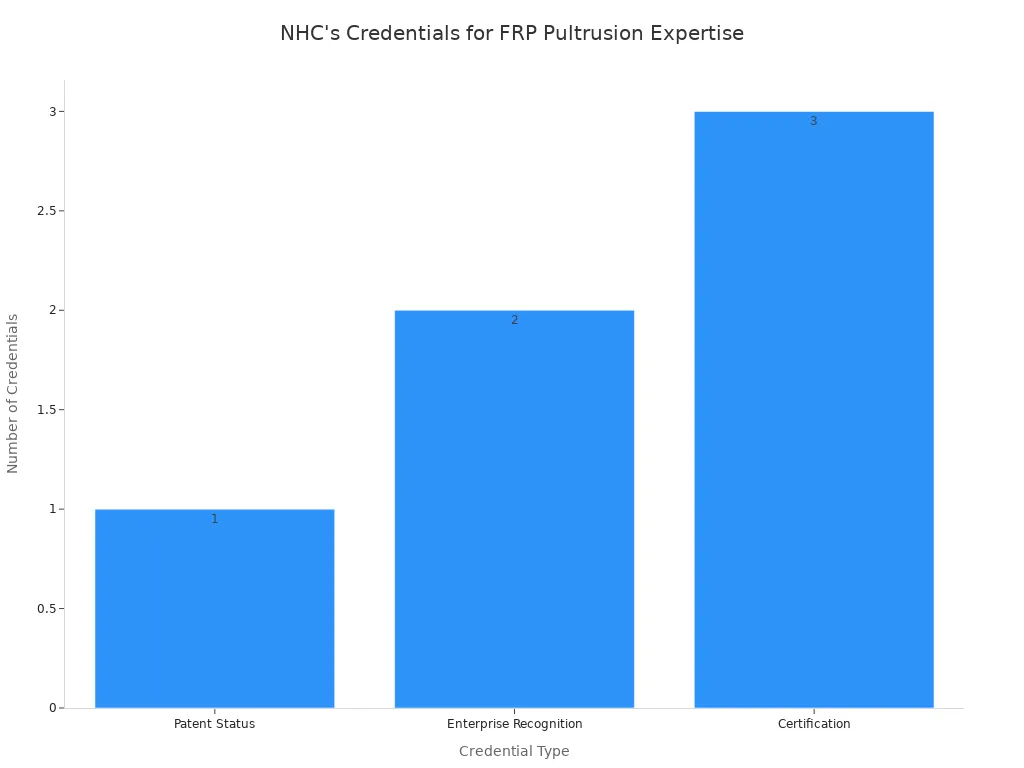
| Credential Type | Specific Credential |
|---|---|
| Patent Status | Holds numerous national invention patents |
| Enterprise Recognition | National high-tech enterprise |
| Enterprise Recognition | Nanjing Gazelle Enterprise |
| Certification | ISO 9001-2015 |
| Certification | ISO 14001-2015 |
| Certification | ISO 45001-2018 |
These certifications cover quality, environmental care, and worker safety. Each standard requires regular audits and continuous improvement, which gives customers confidence in every FRP pultruded tube they buy.
Advanced Digital Control Pultrusion Lines
NHC uses digitally controlled pultrusion lines that manage tension, speed, and temperature with high precision, removing guesswork from the process. Sensors monitor each step, and if a heating element fails, the system identifies the exact zone immediately. The digital systems also track production data for quality management and traceability, supporting consistent output over long runs and quick changeovers between profiles or material mixes.
Commitment to Quality and Customer Satisfaction
Quality at NHC goes beyond the factory floor. The company follows ISO 9001 standards, a quality management system that emphasizes continuous improvement, customer satisfaction, and a process-based approach involving management and employees.
NHC also offers custom solutions—specific sizes, wall thicknesses, or material mixes for a pultruded FRP square tube or round profile—along with professional setup services and full after-sales support. The team works closely with clients from the design phase through final delivery, and the after-sales team remains available for questions after the sale.
The pultrusion process transforms raw fibers and liquid resin into strong, consistent composite tubes. This continuous method delivers high efficiency and precision. FRP pultruded tubes offer corrosion resistance, high strength, low maintenance, and safety benefits, making them valuable across many industries. For durable, lightweight, and corrosion-resistant tube solutions, manufacturers like NHC stand ready to help.
FAQ
How long does the pultrusion process take for one tube?
The pultrusion process runs continuously. Pull speeds usually range from 0.2 to 2.0 meters per minute, and a single production line can make hundreds of meters of tube each day. The exact speed depends on the resin system and profile shape.
What is the difference between polyester and vinyl ester resin?
Polyester resin is the most economical choice for standard uses. Vinyl ester resin resists corrosion better and handles more chemicals. Both work for general industrial jobs; epoxy resin performs best but costs more.
Can manufacturers customize the dimensions of an FRP tube?
Yes. Round tubes come in sizes from 0.5 to 14 inches across, and wall thickness ranges from 0.080 to 1 inch. Swapping the mandrel inside the die changes the inner diameter quickly, letting makers match exact project needs without heavy retooling.
How does NHC ensure consistent quality during production?
NHC uses digitally controlled pultrusion lines with high-precision PID modules. These systems monitor temperature zones, pulling force, and speed in real time. If a heating element fails, the PLC identifies the exact zone immediately, preventing temperature drops and keeping curing quality steady.
What makes FRP tubes resistant to corrosion?
The resin matrix fully wraps the reinforcing fibers, keeping moisture, chemicals, and saltwater away from the glass strands. Unlike steel, FRP does not rust or need painting. A well-designed tube can provide decades of service in corrosive environments with little upkeep.
Are FRP pultruded tubes safe for electrical applications?
Yes. FRP tubes act as natural insulators with electrical resistivity above 10¹⁴ Ω·cm, so they do not conduct electricity, making them suitable for utility crossarms and electrical supports. The material also resists heat transfer, with thermal conductivity of only 0.3–0.5 W/m·K.
What certifications does NHC hold for quality management?
NHC reports holding ISO 9001 for quality management, ISO 14001 for environmental care, ISO 45001 for worker safety, and IATF16949 for automotive applications. These standards require regular audits and continuous improvement.
How does the pulling mechanism work in the pultrusion line?
Caterpillar pullers or reciprocating grippers move the cured profile at a steady speed. Pulling force indicates process stability—a steady force means even friction and proper curing. A flying cutoff saw then matches the pulling speed to cut the profile to length without halting production.
References & Sources
DataHorizzon Research. "Global Pultruded Fiber Reinforced Polymer Market Report." https://datahorizzonresearch.com/global-pultruded-fiber-reinforced-polymer-market-48896
American Composites Manufacturers Association (ACMA). Industry resources on composites manufacturing and process quality. https://acmanet.org/
ASTM International. "ASTM D3917: Standard Specification for Dimensional Tolerance of Thermosetting Glass-Reinforced Plastic Pultruded Shapes." https://www.astm.org/d3917-23.html