Where GRP Pipes Outperform Traditional Piping Materials
GRP pipes outperform traditional materials under specific, definable conditions. Corrosion resistance, strength-to-weight ratio, and long service life define those conditions. No universal superiority exists, and no single material wins everywhere.
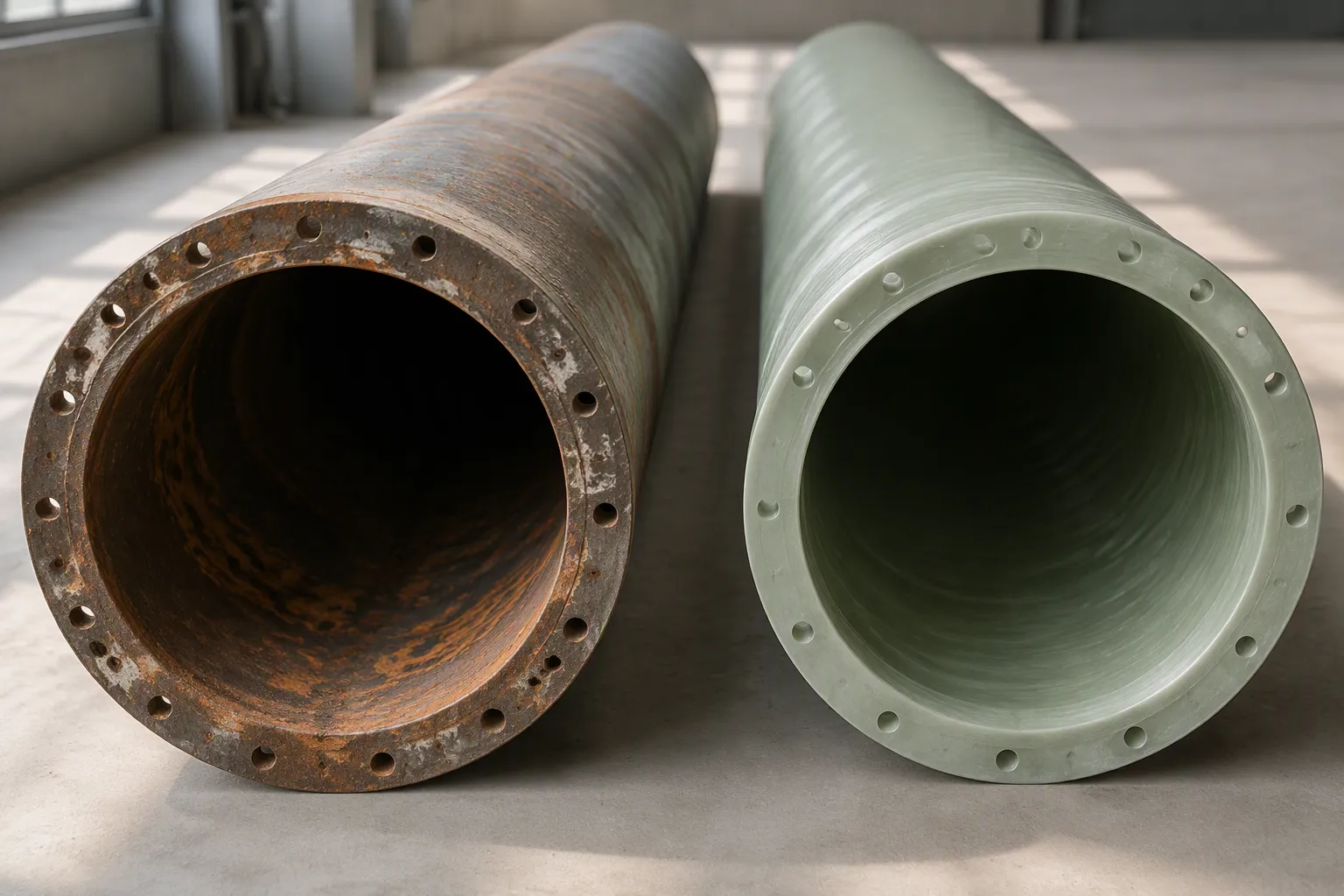
The comparison set is steel, ductile iron, PVC, and HDPE. Each remains the right choice somewhere. Steel suits very high pressure and temperature service. Ductile iron fits many buried water mains. PVC and HDPE serve smaller-diameter and trenchless work well. In aggressive acid duty, properly specified GRP pipe is commonly reported to deliver 30–40 years of service, against 5–10 years for steel systems with inadequate protection.
By the end, readers will know the exact applications and conditions where specifying GRP is the stronger engineering and economic decision.
Key Takeaways
GRP pipes resist corrosion inside and out, so they avoid the coating and lining renewal cycles that steel and iron require.
GRP pipe typically weighs about one-quarter as much as steel pipe of equal diameter and pressure class, which lowers lifting and handling cost.
GRP pipe handles aggressive chemicals and saline water across a wide range of resin grades, reducing maintenance expenditure.
GRP produces a smaller surge pressure rise than rigid steel pipe for the same change in flow, because the composite has a lower modulus.
GRP suits large-diameter water lines, chemical plants, and coastal sites with aggressive soils.
Steel, ductile iron, PVC, and HDPE still hold clear advantages for very high pressure, trenchless work, abrasive slurry, or small jobs.
Confirm the governing standard, resin grade, and test records before assuming GRP will perform to its published envelope.
What Are GRP Pipes?
Composition and Structure
GRP pipes belong to the composite family. Two materials work together: strong fibers and a binding resin. The fibers carry load, and the resin holds them in place and shields them from the service environment.
| Component | Role | Typical Materials |
|---|---|---|
| Glass fibers | Carry load and provide strength and stiffness | Molten glass drawn into thin filaments |
| Resin matrix | Binds and encases the fibers, spreads stress | Epoxy, polyester, or vinyl ester |
Glass Fiber Reinforcement
Manufacturers draw molten glass into fine filaments, then bundle them into strands or mats. These filaments deliver high tensile strength and dimensional stability. The amount, length, and orientation of the glass all shape the final pipe performance.
Resin Matrix Options
The resin matrix is the polymer that surrounds and bonds the fibers. Polyester, vinyl ester, and epoxy each resist different chemicals and temperatures. Resin choice therefore decides which fluids a fiberglass reinforced plastic pipe can safely carry.
GRP Pipes vs. FRP Pipes: What's the Difference
The difference of GRP pipes to FRP pipes is mostly terminology, not chemistry. Both describe fiber-reinforced thermoset composites. Regional convention drives the label: North America favors FRP, while the UK, Europe, and much of Asia say GRP.
| Term | Full Form | Scope |
|---|---|---|
| FRP | Fiber Reinforced Plastic | Any fiber-reinforced polymer (glass, carbon, basalt, aramid) |
| GRP | Glass Reinforced Plastic | The subset using glass fibers only |
Overlapping Terms, Shared Chemistry
All GRP is FRP, but not all FRP is GRP. Buyers comparing GRE, GRP, and FRP pipes often meet a third label, GRE, which means glass-reinforced epoxy. The difference between GRE and GRP lies in the resin: epoxy versus polyester or vinyl ester. Specifiers should confirm the resin type, because it governs chemical resistance and the qualified temperature range.
How the Composite Delivers Performance
Anisotropic Design Flexibility
Anisotropic means properties change with direction. Glass fiber reinforced plastic is strongest along the fibers and weaker across them. Designers orient the winding angle to match the dominant loads, a freedom isotropic steel does not offer.
This flexibility demands discipline. GRP design generally applies higher safety factors than steel design and requires careful joint detailing. Published GRP design guides replace isotropic steel methods rather than adapting them.
The Corrosion Barrier Advantage
The resin-rich inner layer forms a sealed barrier against the carried fluid. FRP pipes resist attack from aggressive water, chemicals, and soil on both faces. A fiberglass pipe therefore needs no internal lining or external coating. That built-in protection separates GRP and FRP pipes from metals that depend on coatings for durability.
GRP Performance vs. Traditional Materials
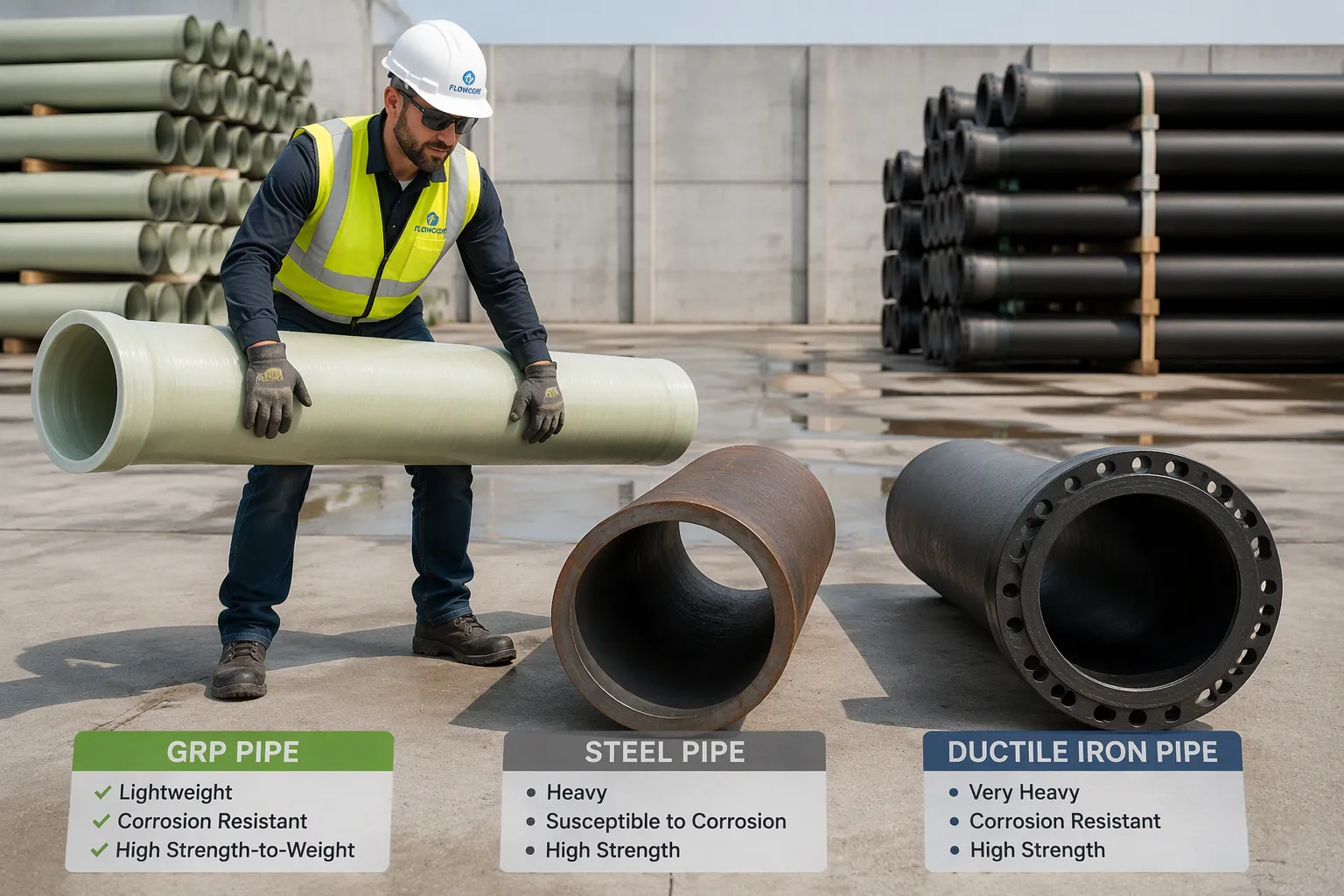
A fair GRP advantages and disadvantages review starts with the strengths. GRP pipes resist corrosion on both faces, carry high strength per unit of weight, produce a lower surge rise than steel, and deliver a design life near 50 years with minimal upkeep. Honest limitations exist too. Some GRP configurations show lower stiffness than steel, above-ground runs need UV protection, and jointing demands care. Each limitation has a workaround, and each competing material keeps a domain where it wins.
Strength-to-Weight and Pressure Capability
Weight tells the clearest story, but the ratio matters more than the absolute figure. Weight per metre rises with diameter, pressure class, and stiffness class, so quoted values should always be read against those parameters. The consistent relationship is this: a GRP pipe typically weighs about one-quarter as much as a steel pipe of equal diameter and pressure class. That gap lowers crane capacity, truck loads, and crew size on every installation.
Strength is directional. Hoop tensile strength for filament-wound GRP commonly falls in the 250–400 MPa range (roughly 36,000–58,000 psi), while axial tensile strength is far lower, often 50–100 MPa (7,000–14,500 psi), because the winding angle favors hoop load. For reference, carbon steel is normally specified by yield strength of 50,000–70,000 psi (345–485 MPa), and PVC by tensile strength of 7,000–10,000 psi (48–69 MPa). The figures are not directly interchangeable: GRP values are ultimate strengths, steel values are usually minimum yield.
Comparison with Steel and Ductile Iron
Wall thickness and safety factor separate the three materials on a 24-inch line at 150 psi working pressure. The table below reproduces indicative values published in manufacturer comparisons; project values depend on the governing product standard, grade, and design method.
| Parameter | Steel pipe | Ductile iron pipe |
|---|---|---|
| Safety factor | 1.33–2.0 (depending on the percentage of yield strength used) | 2.0 |
| Indicative wall thickness, 24-in line at 150 psi | 0.086 in (50% yield) to 0.095 in (75% yield) | 0.157 in |
| Pressure rating (24-in example) | 150 psi | 350 psi |
| Actual internal diameter (example) | 22.94 in | 24.95 in |
Steel remains the better fit for very high pressure and temperature service. Ductile iron holds a strong position in buried water mains, where its stiffness and established joint systems suit the duty. GRP competes where moderate pressure meets aggressive service conditions.
Corrosion and Chemical Resistance
Corrosion resistance is the strongest argument for non-metallic piping materials. The resin-rich barrier blocks attack from the fluid inside and the soil outside. In normal buried and chemical service, no coating, lining, or cathodic protection system is required — the three countermeasures that dominate steel maintenance budgets and that follow established corrosion-control practice[3].
Corrosion resistance stands out as one of the most important features of GRP pipe. Unlike steel or concrete, GRP does not rust or crack when exposed to harsh chemicals, saline water, or corrosive soils.
Where Steel, Iron, and PVC Fall Short
Steel rusts in water, salt, and acids, so it depends on protective systems that age and fail. Ductile iron shares that exposure. PVC offers good corrosion resistance, yet it turns brittle and may crack under stress in harsh conditions. GRP delivers strong chemical and corrosion resistance across a wider band of fluids, and resin selection tunes it further. Polyester resins give moderate resistance, vinyl ester resins add protection against acids, alkalis, and solvents, and epoxy resins handle more aggressive chemical streams. A corrosion resistant grade therefore exists for most process duties, though not for every one.
Thermal Stability, Surge Resistance, and Longevity
Surge events destroy pipes quietly. The pressure rise from a sudden flow change depends on how fast the pressure wave travels through the pipe, and wave speed falls as the wall material becomes less stiff. Because GRP has a much lower modulus than steel, the wave travels more slowly and the surge rise is correspondingly smaller for the same velocity change. Steel and HDPE sit at different points on the same spectrum. The benefit is real but system-specific, so a transient analysis to AWWA M45 or ISO 14692 practice is still required and the result must be checked against the qualified pressure rating.
Thermal behaviour follows similar logic. The axial expansion coefficient of GRP is comparable to steel, but the lower modulus means restrained thermal stress is markedly smaller, which reduces anchor and guide loads on above-ground runs.
Temperature and Pressure Envelopes vs. HDPE and PVC
Thermoplastics lose strength as heat rises and need pressure derating. The envelope table shows the practical gap between commodity thermoplastics and thermoset composites.
| Pipe Material | Max Temp (°C) | Min Temp (°C) | Max Pressure (bar, typical) |
|---|---|---|---|
| PVC | 60 | 0 | 15 |
| HDPE | 60 | -40 | 25 |
| GRE / GRP | 130 | -40 | 240 |
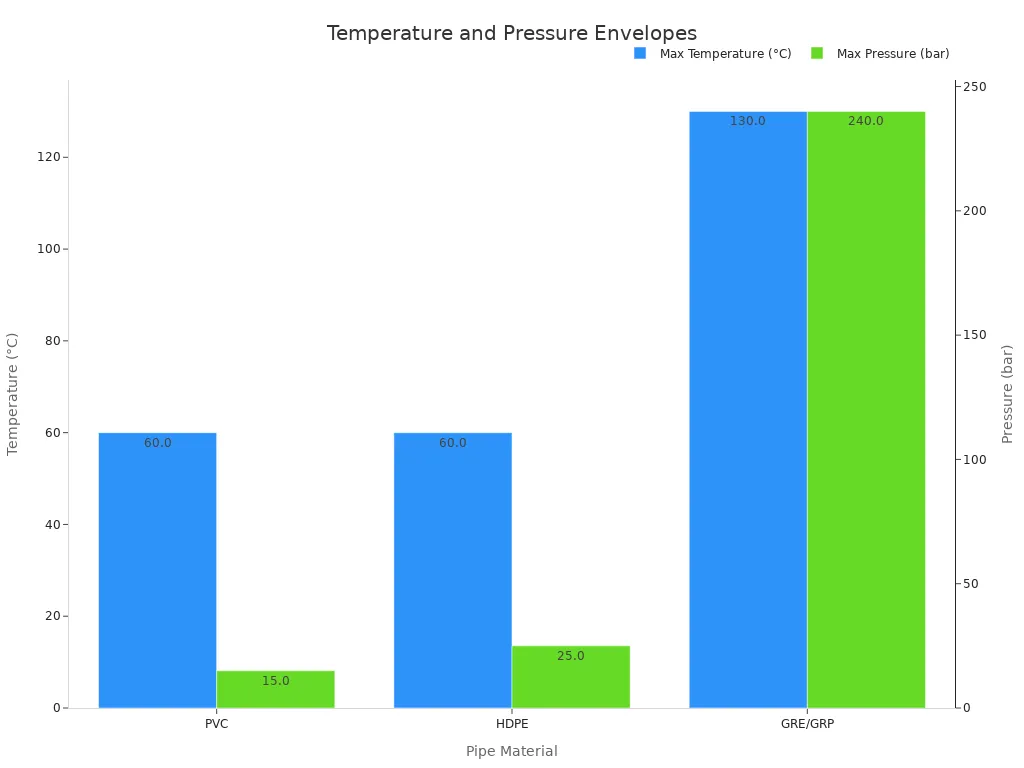
Resin type sets the operating pressure and temperature window. Epoxy and phenolic glass systems reach 149°C, while vinyl ester, furan, and polyester systems reach 93°C. Under ISO 14692, each manufacturer qualifies its own envelope through long-term hydrostatic regression testing. HDPE still wins for flexibility and small-diameter trenchless work, and PVC suits drainage and light-duty service. Designers commonly plan a 50–60 year working life for GRP, and some producers publish projections beyond 100 years based on extrapolated regression data. That longevity, combined with strong corrosion resistance, explains why the material needs so little maintenance across its service life.
Specifying GRP for a Corrosive Duty?
Send the fluid list, design pressure, design temperature, and pipe diameter. The engineering team reviews resin grade, pressure class, and stiffness class against the governing standard, and returns a specification proposal.
Get a QuoteView Product RangeManufacturing and Classification
Production Methods
Three production routes dominate the market, and each shapes the finished pipe differently.
Filament Winding, Centrifugal Casting, and Continuous Winding
| Production Method | Category | Key Process Characteristics |
|---|---|---|
| Reciprocating filament winding | Fixed-length method | Resin bath reciprocates along a rotating mandrel; glass filaments lay at a controlled winding angle; layers build to design wall thickness; resin cures before mandrel extraction |
| Continuous filament winding | Continuous method | Pipe advances through a stationary feed station supplying resin-preimpregnated roving, chopped glass fiber, and a resin-sand mixture; the pipe forms on a core mold |
| Centrifugal casting | Fixed-length method | Chopped glass fiber and sand feed into a rotating steel mold; catalyzed resin injects at one end; centrifugal force expels air and yields a dense, pore-free wall with a smooth resin-rich inner surface |
Reciprocating filament winding remains among the most widely used methods worldwide, thanks to its broad application range. Continuous winding suits high-volume output, and a sand-filler layer can raise stiffness at modest cost. Centrifugal casting produces a smooth bore that suits potable water service.
Pultruded FRP round tubes occupy a separate niche. These small-diameter profiles serve cable trays, handrails, and structural framing, not large-diameter transmission duty.
Classification Systems
Pressure Classes, Stiffness Classes, and Standards
A GRP pipe carries two independent ratings. The pressure class sets the internal hydraulic duty. The stiffness class sets resistance to external soil and live loads. Buyers specify both, plus a joint system.
Recognized standards govern each rating. AWWA, ASTM, and ISO documents define pressure classes, ring stiffness classes, and test methods for fiberglass reinforced plastic pipe. For pressure duty, AWWA C950 and the ASTM specification for filament-wound glass-fiber-reinforced thermosetting-resin pressure pipe[2] are the common reference points; for gravity sewer service, the corresponding ASTM specification for filament-wound sewer pipe[1] applies, while the sewer and industrial pressure case is covered by ASTM D3754. A higher stiffness class, such as SN5000 or SN10000, resists heavier external loads in poor soil.
Matching Pipe Class to Service Conditions
Buried vs. Above-Ground Service
The service environment drives class selection. Buried service supports a 50-year design life with no routine maintenance, and soil and load conditions set the stiffness class. Poor soil calls for a higher stiffness grade.
Above-ground service shifts the priority. UV exposure and thermal behaviour govern the specification, not soil-load stiffness. Both environments demand careful jointing and proper bedding. Hydraulic design sets the pressure class in every case, and the joint system must match the installation method.
Installation and Lifecycle Economics
Installation Techniques and Speed
Lightweight Handling and Jointing Methods
Light weight changes the installation economics directly. A GRP pipe weighs a fraction of a steel pipe of equal diameter, so smaller cranes, lighter trucks, and smaller crews handle the same run. Contractors move more pipe per shift and spend less on lifting equipment.
Joint selection drives speed as much as weight does. Each joint type suits a different duty.
| Joint Type | Installation Technique | Speed and Flexibility Notes |
|---|---|---|
| Rubber ring joint | Socket and spigot ends join with elastomeric rings in circumferential grooves | Fast to assemble; allows angular deflection for gradient changes; thrust blocks needed at bends |
| Tapered glue joint | Matching tapered ends bond with two-component epoxy adhesive | Rigid, no deflection; resists longitudinal forces, so no thrust blocks |
| Lock joint | Rubber ring seal plus a shear-resistant plastic locking strip | Combines glue and flexible joint benefits; eliminates thrust blocks; removable |
Trenchless methods add another speed advantage. UV-cured GRP liners install through existing manholes or vaults, with no saw cutting and no jackhammering. Curing proceeds at rates measured in feet per minute, depending on liner type and diameter, which cuts crew hours and support vehicle needs.
System Components That Support a GRP Piping Installation
Pipe performance depends on what surrounds it. Supports, fasteners, and cable management are usually specified alongside the pipe, and they need the same corrosion resistance if the assembly is to deliver its design life.

Pultruded GRP Round Tubes
Corrosion-resistant round sections used for pipe supports, sleeves, and structural framing in wet or chemical environments.
View Product
GRP Fasteners and Fittings
Non-conductive bolts, nuts, threaded rods, and fittings for clamp assemblies and support steelwork near pipelines.
View Product
FRP Cable Tray
Tray and ladder systems for routing instrument and power cable along pipe racks without adding a grounding path.
View ProductCost Comparison Across the Lifecycle
Installation, Maintenance, and Replacement Savings
Upfront price rarely decides a pipeline budget. Lifecycle cost does. Faster curing shortens shutdowns and lowers labour tied to extended outages. Tight dimensional control reduces refitting and grouting expense, and factory-made joints reduce field fabrication hours.
Corrosion resistance removes recurring costs that metals carry. Steel needs coatings, linings, and cathodic protection, and those systems age. GRP needs none of them in normal service, which supports a low maintenance cost profile across a design life near 50 years. That longevity delays rehabilitation projects and avoids replacement cycles. A higher initial price per metre can therefore produce significant savings over the full project lifecycle.
Environmental and Sustainability Factors
Energy Use, Service Life, and Corrosion-Free Longevity
Production energy favors composites. Published life-cycle comparisons generally place the embodied energy of pultruded GRP below that of steel for equivalent structural duty, and because GRP components weigh roughly one-quarter as much, transport-related energy falls with the weight. Manufacturing emissions also compare favourably with steel and aluminium on a per-kilogram basis.
Durability carries the larger environmental benefit. Thermosetting resins give most GRP products a lifespan exceeding 50 years. That long service life means fewer replacement cycles, less replacement material, and lower transport emissions. Corrosion resistance protects the asset in aggressive soil and fluids, so performance holds across decades. End-of-life options exist too: cement kilns can use GRP as an alternative fuel and raw material, recovering part of its embodied energy.
Best-Fit Applications for GRP Pipes
Water and Wastewater Infrastructure
Transmission Mains and Sewer Force Mains
Large-diameter potable water transmission ranks among the strongest use cases for GRP pipe. Smooth bores keep friction low, and the resin barrier protects water quality without linings. Coastal districts with aggressive soils gain the most, because a fiberglass reinforced plastic pipe ignores soil chemistry that attacks coated steel.
Sewer force mains demand more caution. Early GRP pipes, sold as Techite, failed in force main service when tensile strain combined with chemical attack from wastewater. That mechanism — strain corrosion in glass-reinforced pipe under sustained deflection[4] — is now characterised by standard test methods, and designers must account for it in every pressure wastewater design.
Early GRP pipes marketed as Techite experienced several failures in force main service because the combination of tensile strain and chemical attack from wastewater caused strain corrosion in the polymeric resin. This risk must be understood and accounted for in pressure wastewater design.
Modern corrosion resistant resin grades address the mechanism, and seawater and sewage transport applications now rely on GRP across many municipal networks. The table below summarizes the trade-offs.
| Pipe Material | Key Advantages | Key Limitations | Best-Fit Applications |
|---|---|---|---|
| Fiberglass Reinforced Pipe (FRP/GRP) | Very high corrosion resistance; lightweight; very smooth interior surface | Higher upfront material cost; needs specialised installation and handling to avoid damage | Highly corrosive environments, e.g. industrial wastewater or coastal areas with aggressive soils |
Industrial and Energy Applications
Chemical Processing, Desalination, and Cooling Towers
Chemical plants select GRP because it withstands aggressive substances in containment systems and process equipment. Its non-conductive nature suits electrically hazardous areas. Tanks, pipes, and vessels store and move chemicals safely, and the long service life supports regulatory compliance.
Desalination and power generation extend the same logic. Seawater intake and outfall lines, cooling water systems, and firefighting water mains all face salt or thermal duty. The application map below shows the spread.
| Application Category | Specific GRP Uses |
|---|---|
| Industrial Applications | Chemical Processing; Slurry Handling in Mining; Paper and Textile Effluent Systems |
| Marine and Offshore | Seawater Intake/Outfall Systems; Desalination Plant Piping; Shipboard Non-Critical Systems |
| Power Generation Facilities | Cooling Water Systems; Firefighting Water Systems; Blowdown and Service Water Pipelines |
| Municipal Water & Sewer Systems | Wastewater Collection; Potable Water Transmission; Stormwater Drainage; Pumping Station Piping |
Oil, Gas, and Marine Environments
Offshore Platforms, Firewater, and Corrosive Soils
Offshore topsides reward low weight. GRP carries a specific gravity near 1.8–1.9 against roughly 7.85 for steel, which cuts lifting and transport costs where topside weight is critical. Risers, flowlines, and process piping handle high-salinity service without coatings or cathodic protection.
Firewater systems need graded materials. IMO Resolution A.753(18) defines three fire endurance levels, L1 being the most demanding and L3 the least. Standard GRP usually qualifies only at L3, which limits its use to wet firefighting systems; dry mains generally require a higher-rated or jet-fire-qualified system. Underground gathering lines resist stray currents and soil chemicals, and seawater systems with the correct resin grade are commonly specified for design lives of 50 years and beyond.
Reviewing Material Options for a Pipeline Project?
Share the service fluid, design envelope, and installation method. A comparison against steel, ductile iron, PVC, and HDPE can be prepared against the same duty conditions.
Contact UsSee Project CasesSelecting GRP for Optimal Performance
When a GRP Pipe Is the Right Specification
Corrosive Soils, Aggressive Fluids, and High Surge Risk
A short decision heuristic settles most material debates. Specify a GRP pipe when the service combines corrosive media, large diameters, a long design life, and low-maintenance priorities. Choose an alternative when another material's strengths dominate the duty.
Aggressive fluids top the list. Industry case reports describe chemical plants that replaced carbon steel lines after repeated failures in highly corrosive service. The root cause was material selection rather than installation, operating pressure, or workmanship. FRP lines specified for the same duty showed no visible corrosion and fewer maintenance shutdowns.
| Condition | GRP Performance | Specification Relevance |
|---|---|---|
| Corrosive fluids (acids, alkalis, salts) | Resistant by resin selection, no chemical erosion of the barrier layer | Supports selection for aggressive fluids |
| Corrosive or acidic soils | Resists soil acidity, no cathodic protection required | Supports buried-service specification |
| Maintenance burden | Low routine maintenance, 50+ year design life | Lowers lifetime cost against coated steel |
| Installation | About one-quarter the weight of steel pipe | Cuts transport and lifting cost |
Chlor-alkali media rank among the most corrosive streams. Wet chlorine gas, sodium hypochlorite, and concentrated hydrochloric acid attack metal walls through pitting. A PTFE liner handles the full pH range from 0 to 14, and the FRP shell carries the mechanical load at pressures up to tens of bars. Both layers stay non-conductive, which removes stray currents and grounding needs.
High surge risk also favors the material, for the reason set out earlier: a lower modulus slows the pressure wave and reduces the surge rise for a given velocity change. Designers must still plan for the cautions. FRP is rigid, so thermal stress can open joints without proper flexibility analysis. Stagnant no-flow conditions belong in the specification, because solar radiation raises temperature and can cause leaks. UV protection matters above ground.
When Other Materials Fit Better
Steel, Ductile Iron, PVC, and HDPE Use Cases
Honest selection means naming the domains where competitors win. Steel remains the choice for very high pressure and temperature service. Ductile iron holds buried water mains where stiffness and established joint systems suit the duty. PVC serves drainage and light-duty lines at modest cost.
HDPE claims several clear niches. Fused strings suit trenchless installation by horizontal directional drilling, pipe bursting, and sliplining, and jointed GRP lengths cannot match that continuity. Leak-critical mains in high water tables favor homogeneous fusion joints with no gasket paths. Abrasive slurry service in mining and dredging rewards a ductile bore, because high-velocity grit erodes GRP and exposes glass fiber. Seismic or settling ground suits ductile behaviour, and impact-prone sites penalise brittle pipe. Small-to-mid diameters also fit HDPE better.
Specification Checklist and Supplier Evaluation
Standards Compliance and Manufacturer Capability
A sound specification cites recognized standards and verifies that the manufacturer meets them. The checklist below covers the core documents.
| Category | Item |
|---|---|
| Standards compliance | ASTM D3262, D3517, D3754, D2996 |
| Standards compliance | AWWA C950 and AWWA M45 design verification |
| Standards compliance | ISO 10467 and ISO 10639 |
| Standards compliance | ISO 7685 / ASTM D2412 stiffness determination |
| Manufacturer capability | 50-year design life basis and strain corrosion data per ASTM D3681 |
| Manufacturer capability | Strain corrosion tests at 100 h and 1,000 h |
| Manufacturer capability | Resin-rich liner near 1.0 mm with C-glass or ECR veil |
Buyers should confirm a certified quality system such as ISO 9001, plus documented test records for stiffness, deflection, and joint performance. A qualified fiberglass reinforced plastic pipe supplier also matches resin grade to the actual fluid list. Nanjing Hypro Composites Co., Ltd. (NHC) supplies certified, application-matched GRP and FRP components for teams that want a compliant starting point.
Corrosion resistance decides the material family, and the checklist decides the supplier. Together they protect the low maintenance cost profile that justified the specification in the first place.
Conclusion
GRP pipes offer measurable advantages on five fronts: immunity to corrosion inside and out, high strength per unit of weight, a lower surge rise than rigid steel, fast installation, and lower lifecycle cost. None of these strengths makes the material universal.
Material selection stays application-driven. Specify GRP when corrosive media, large diameters, a long design life, and low maintenance define the duty. Choose steel, ductile iron, PVC, or HDPE when their strengths dominate instead.
Readers seeking a reliable GRP pipe manufacturer can assess NHC against the checklist above for compliant, application-matched solutions.
Need a Specification Review Before Tendering?
Submit the duty conditions and the current draft specification. The response covers standard compliance, resin grade, pressure class, and joint system for the stated service.
Get a QuoteView QualificationsFAQ
How long does a GRP pipe last in service?
Designers commonly plan a 50–60 year working life, and some producers publish projections beyond 100 years based on extrapolated regression data. The resin-rich barrier resists attack from both the carried fluid and the surrounding soil, so the asset holds performance across decades without coatings, linings, or cathodic protection. Actual service life depends on resin grade, pressure and temperature duty, bedding quality, and joint integrity.
Which standards should a specification cite?
Core documents include ASTM D3262, D3517, D3754, and D2996, plus AWWA C950 with AWWA M45 design verification. ISO 10467 and ISO 10639 cover similar ground internationally. Stiffness determination follows ISO 7685 or ASTM D2412. Buyers should also request 100-hour and 1,000-hour strain corrosion test records to ASTM D3681, which is the method used to demonstrate resistance under sustained deflection in a chemical environment.
Can GRP handle high surge pressure?
GRP generally produces a smaller surge rise than steel for the same change in flow, because the lower modulus of the composite slows the pressure wave. The magnitude of that benefit is system-specific, so a transient analysis to AWWA M45 or ISO 14692 practice is still required, and the resulting surge envelope must be checked against the qualified pressure rating of the selected resin system.
What temperature and pressure range suits GRP?
Resin type sets the window. Epoxy and phenolic glass systems are commonly rated to about 149°C, while vinyl ester, furan, and polyester systems are typically rated to about 93°C. A typical GRE or GRP envelope spans -40°C to 130°C at pressures up to roughly 240 bar. Each manufacturer qualifies its own limits through ISO 14692 long-term hydrostatic regression testing.
Where does GRP lose to other materials?
Steel remains the choice for very high pressure and temperature duty. Ductile iron suits buried water mains. HDPE wins for trenchless work, leak-critical fused joints, abrasive slurry, and seismic ground. PVC fits drainage and light-duty lines. Material selection stays application-driven, and each option keeps a domain where it performs best.
How does installation cost compare over the lifecycle?
A GRP pipe typically weighs about one-quarter as much as a steel pipe of equal diameter and pressure class, so smaller cranes and crews handle the same run. Corrosion resistance removes coating, lining, and cathodic protection budgets. That combination supports a low maintenance profile across a design life near 50 years.
What should buyers check in a supplier?
Confirm a certified quality system such as ISO 9001, documented stiffness and deflection test records, strain corrosion data at 100 and 1,000 hours, and a resin grade matched to the actual fluid list. Third-party test reports carry more weight than catalogue statements, and the pressure and stiffness classes should be traceable to a named standard.
References and Notes
ASTM D3262, Standard Specification for “Fiberglass” (Glass-Fiber-Reinforced Thermosetting-Resin) Sewer Pipe — astm.org/d3262-20.html
ASTM D3517, Standard Specification for “Fiberglass” (Glass-Fiber-Reinforced Thermosetting-Resin) Pressure Pipe — astm.org/d3517-19.html
Association for Materials Protection and Performance, corrosion basics reference — ampp.org/technical-resources/corrosion-basics
Springer Nature, Failure of GRP in Corrosive Environments — link.springer.com/chapter/10.1007/978-94-009-8120-1_8
Standards referenced in the text but not linked here include AWWA C950, AWWA M45, ISO 10467, ISO 10639, ISO 7685, ISO 14692, ASTM D3754, ASTM D2996, ASTM D2412, ASTM D3681, and IMO Resolution A.753(18). Table values marked “indicative” are drawn from published manufacturer comparisons and industry ranges; they are not a substitute for project-specific calculation.