


How strong is a fiberglass I-beam?
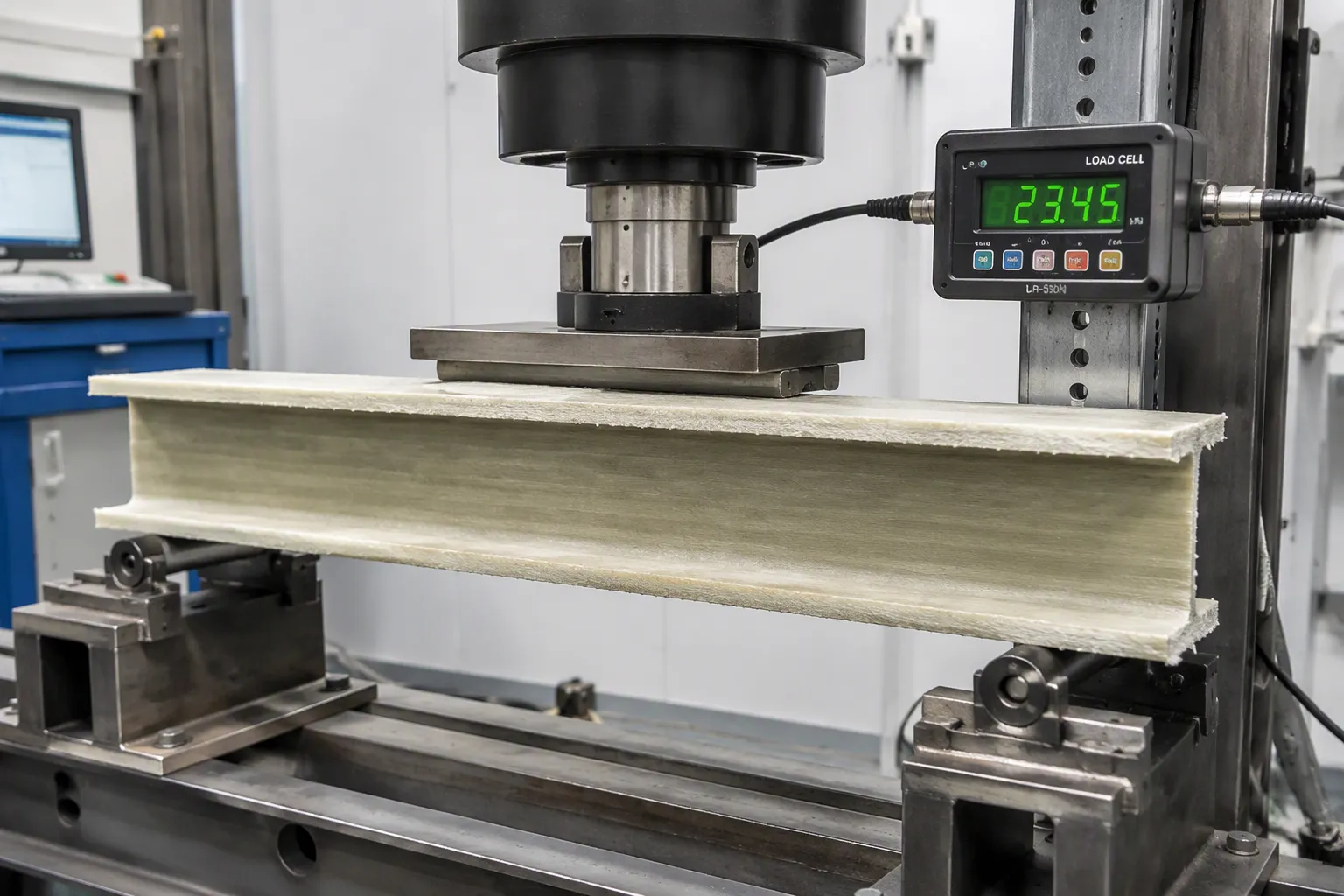
A fiberglass I-beam reaches a tensile strength of up to about 30,000 psi in standard pultruded E-glass construction, and it carries substantial loads at a fraction of steel's weight. Engineers now specify these beams as a corrosion-resistant alternative to steel and wood in bridges, roof trusses, floor supports, and industrial equipment. Exact load capacity varies with profile size, fiber content, resin type, span, and support conditions. A builder who understands these variables can size a beam with confidence. The sections below explain the strength metrics, the factors that change capacity, and the practical steps for safe selection and installation.
Key Takeaways
Fiberglass I-beams reach tensile strength up to about 30,000 psi and carry heavy loads at roughly a quarter of steel's weight.
Load capacity depends on profile size, fiber content, resin type, span, and support conditions.
Deflection often controls beam selection because fiberglass has lower stiffness than steel.
Fiberglass resists corrosion and commonly lasts 30–50+ years, while steel needs coating and often lasts 20–30 years.
Steel still wins for large spans, heavy loads, and high-impact applications due to its higher stiffness.
Always check manufacturer load tables and use safety factors; consult an engineer for critical or dynamic loads.
Proper installation with full bearing, correct fasteners, and avoiding stress concentrations preserves capacity.
Regular inspection for cracks and delamination, plus UV protection, keeps fiberglass beams strong for decades.
Core Strength Metrics of a Fiberglass I-beam
Tensile and Flexural Strength
Typical PSI and MPa Ratings
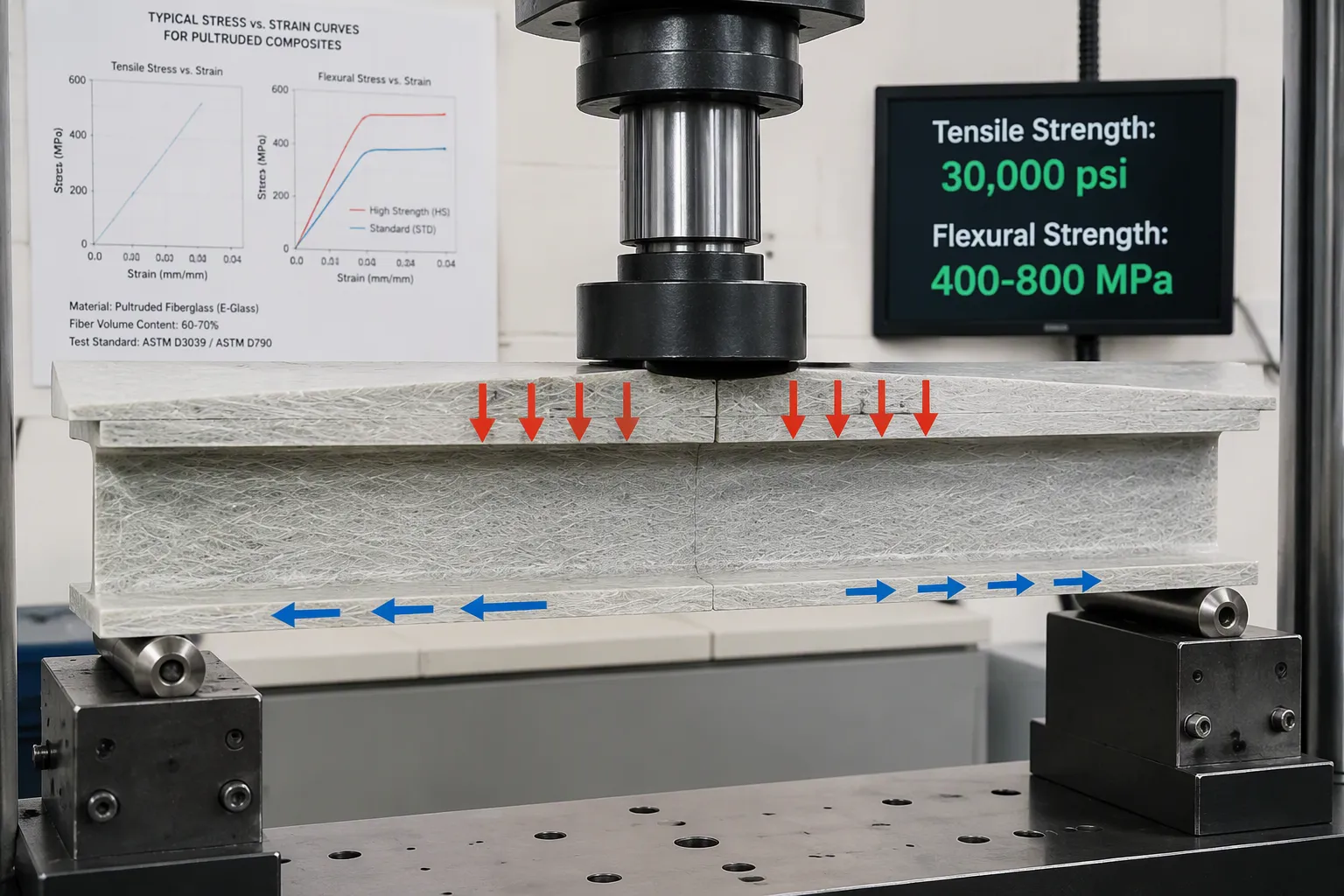
A fiberglass I-beam reaches a tensile strength of up to about 30,000 psi, which is roughly 200 MPa. Standard pultruded profiles commonly range from about 200 to 400 MPa (30,000–60,000 psi) depending on fiber content and formulation, and high-strength versions can go higher. The spread is wide because the material is not a single substance. Glass content, strand alignment, and cure quality all shift the final number. A buyer who compares two data sheets should check the test method behind each rating before treating the values as equal. Tensile and flexural testing are commonly performed to standardized methods such as ASTM D3039 and ASTM D790.
Flexural strength follows the same pattern but is reported separately. A beam bends under load, and the top flange goes into compression while the bottom flange stretches in tension. Standard E-glass profiles typically show flexural values in the 30,000–40,000 psi range (about 200–275 MPa), and high-strength formulations can reach higher values. The glass filaments carry the tensile stress along the length of the beam. The resin bonds those filaments together and adds compressive strength. This division of labor is why the I-shape works so well.
Resin's Role in Load Distribution
Resin does more than glue. It transfers stress between filaments, protects the glass from moisture and chemicals, and carries a share of the compressive load in the upper flange. A tougher resin system resists cracking under repeated flexing. A stiffer resin system holds the beam's shape under sustained load. Manufacturers tune this balance for each application, so two beams with identical dimensions can behave differently in service.
From Strength to Load Capacity
Strength alone does not tell a builder how much a beam will hold. Bending stiffness is governed by the product of elastic modulus and moment of inertia, and the moment-curvature relationship links bending moment to curvature through that product. Because the moment of inertia depends strongly on how far material sits from the neutral axis, profiles that place material away from the center produce a much stiffer beam for the same amount of material. The I-shape does exactly this. It moves material into the flanges, far from the neutral axis, and raises the moment of inertia dramatically. Increasing beam depth raises that value even more, scaling roughly with depth cubed for many shapes.
Longitudinally aligned continuous fibers give pultruded profiles a high elastic modulus along the length. Custom profiles let a designer tailor the moment of inertia to the job. Combining a high modulus with an optimized section delivers an excellent stiffness-to-weight ratio.
In indeterminate structures, stiffer members attract a greater share of the bending moment, which directly shapes how loads are distributed among members.
Uniform vs. Point Loads
A uniform load spreads evenly across the span, such as snow on a roof or a filled platform. A point load concentrates at one spot, such as a hoist or a support bracket. The same beam handles far less total weight as a point load than as a uniform load. Designers must also account for where the point load sits, since a load at midspan produces the worst bending moment.
Deflection and Stiffness Limits
Deflection frequently governs beam selection in fiber-reinforced polymer design rather than ultimate strength. FRP beams have a lower elastic modulus than steel, so stiffness control becomes critical. Common limits appear below.
| Application | Typical Deflection Limit |
|---|---|
| Walkways and platforms | L/200 to L/250 |
| Industrial flooring | L/180 to L/200 |
| Cable trays | L/150 to L/180 |
Proper span-to-depth ratio selection improves service performance and user comfort. A correctly sized fiberglass I-beam performs reliably across long spans while reducing dead load. Maximum load therefore depends on material, shape, span, and support type together, and a beam load calculator can estimate it once those inputs are known.
Factors Affecting Load Capacity
Composition and Fiber Orientation
E-Glass and Resin Variables
Manufacturers adjust fiber content and resin type at the production stage to meet different strength targets. Higher glass content or a stronger resin raises capacity. Flexural strength for fiberglass I-beams commonly falls in the 30,000–40,000 PSI range for standard E-glass profiles, and that value shifts with both resin selection and fiber orientation. A buyer who needs more capacity should ask the supplier which resin system and glass loading the profile uses.
Density gives useful context for strength-to-weight performance. Pultruded H-beams show a density of about 1.5–2.0 g/cm³, and one manufacturer lists about 1.9 g/cm³ for its I-beam profile, measured per EN ISO 1183. These values sit far below steel, so a beam delivers solid capacity without heavy dead load.
Continuous Strand Matting
Fiber orientation directly determines how much load a beam carries. FRP profiles are anisotropic: longitudinal strength and stiffness commonly run 3–5 times greater than transverse values. Continuous strand matting and aligned roving place the primary fiber direction along the beam axis, where bending stress is highest.
The profile must therefore be oriented so the main fiber direction aligns with the dominant load direction. A beam installed sideways loses much of its rated capacity. Installers should confirm the marked axis before lifting the member into place.
Dimensions and Span
Depth, Width, and Flange Thickness
Depth drives stiffness more than any other dimension. A deeper beam moves material farther from the neutral axis and resists bending far better. Flange width and thickness control how much load the compression side carries before local buckling. A wider flange also spreads bearing stress at supports.
Moment of Inertia Explained
Moment of inertia measures how a section distributes area around its neutral axis. The I-shape concentrates material in the flanges, so it produces a high value for modest weight. Span works against capacity: doubling the clear span raises bending demand sharply and increases deflection. Longer spans therefore need deeper profiles or closer supports.
Environmental Influences
Temperature and UV Exposure
Resin systems soften at elevated service temperatures, and sustained heat reduces stiffness over time. Direct sunlight degrades unprotected resin through UV attack. A UV-resistant surface veil or a suitable coating preserves the outer layer and keeps capacity stable.
Chemical and Moisture Resistance
Fiberglass I-beams stay sturdy against harsh chemicals, moisture, and UV rays while maintaining load-bearing capability. Unlike steel, the material does not rust in wet service. Chemical exposure still deserves review, because some solvents attack specific resin types. Matching the resin to the chemical environment protects long-term performance.
Fiberglass vs. Steel vs. Wood
Strength-to-Weight Ratio
Weight per Foot Comparison
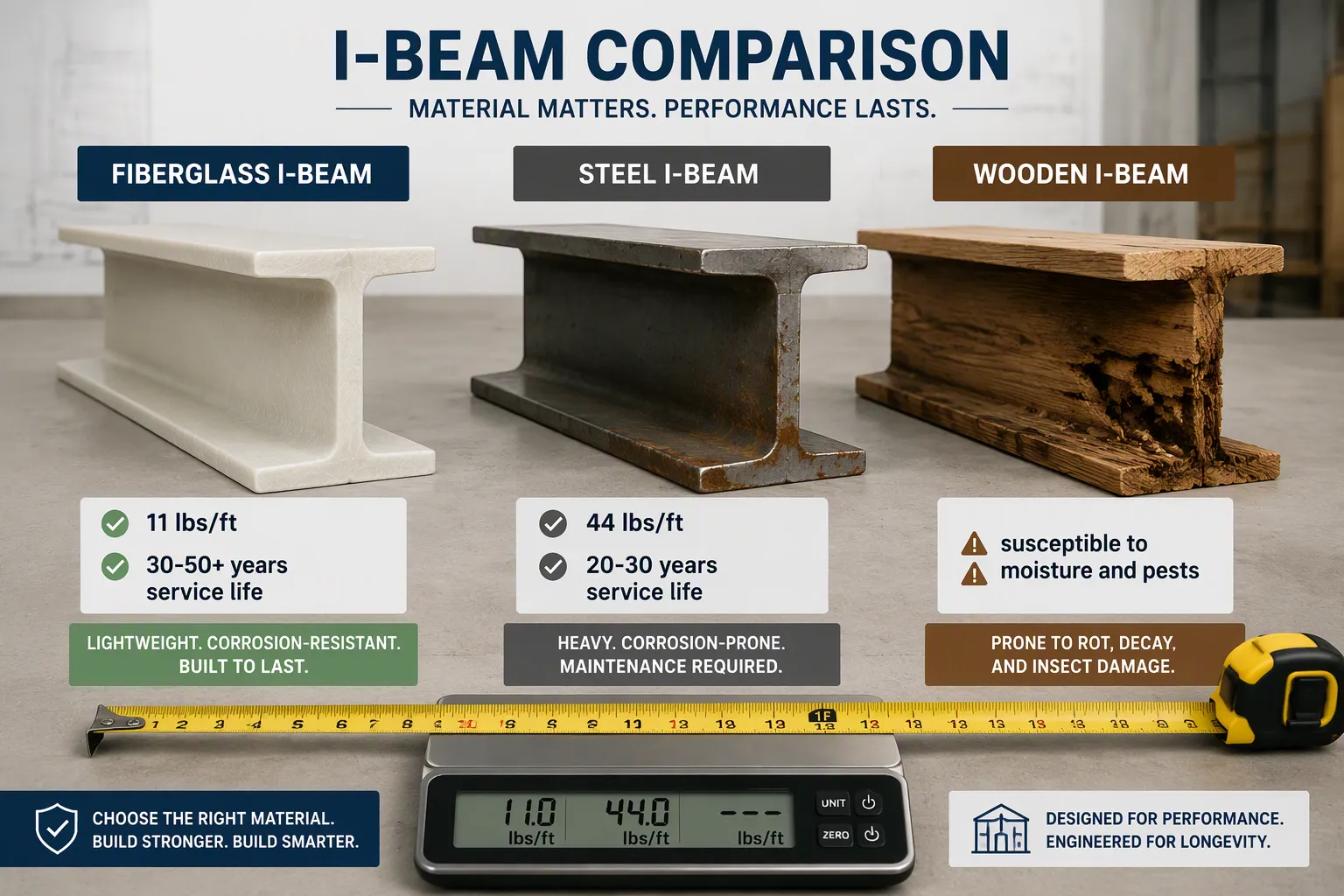
A fiberglass I-beam weighs far less than the steel equivalent. The fiberglass member therefore sheds most of the dead load before it carries a single pound of live load. That saving compounds across a bridge deck or a long roof run, where every support and foundation element shrinks in response.
Industry figures confirm the pattern. Fiberglass structural shapes typically run about 30% lighter than aluminum and about 75% lighter than steel. A crew can often position these members by hand, which cuts crane time and lifting risk on site.
Load Performance vs. Wood
Wood remains a familiar benchmark for many builders. Fiberglass outperforms it on strength and durability. The composite will not rot, deform, or suffer insect damage. A wet basement or a coastal deck exposes wood to all three threats, and treated lumber still loses section over time. Fiberglass holds its shape and its rated capacity in the same conditions.
Each material has applicable scenarios and limitations. Wood suits short spans, light loads, and tight budgets. Fiberglass suits wet, chemical, or long-life installations where replacement access is costly.
Corrosion and Service Life
Performance in Harsh Environments
Corrosion separates these materials most sharply. Steel needs coating, and that coating needs renewal. Fiberglass resists oxidation, moisture, and many chemicals without a protective layer. The service life gap appears below.
| Material | Typical Service Life |
|---|---|
| Steel I-Beam (Coated) | 20–30 years |
| FRP (Fiberglass) I-Beam | 30–50+ years |
FRP I-beams offer predictable long-term performance with minimal maintenance. Steel service life depends heavily on maintenance quality and environmental exposure. Marine work shows the extreme case. FRP dock pilings and framing have demonstrated service life exceeding 50 years in submerged or semi-submerged marine conditions, resisting both oxidation and marine organisms.
When Steel Still Wins
Steel keeps real advantages in specific structural roles. Its elastic modulus reaches about 200 GPa, while fiberglass flanges sit at about 40–50 GPa. That stiffness gap matters under certain demands.
Large spans
Heavy loads
High impacts
Rigidity requirements
Examples: main beams in high-rises, bridges, and load-bearing piles
The property table below frames the trade-off honestly. Values are typical ranges for standard pultruded E-glass profiles; high-strength formulations can perform better.
| Property | Steel Beam | Fiberglass Flange Beam |
|---|---|---|
| Modulus of Elasticity (GPa) | ~200 | 40–50 |
| Tensile Strength (MPa) | 400–550 | 200–400 (standard pultruded) |
| Density (kg/m³) | 7850 | 1800–2000 |
Notice the tensile column. In standard pultruded construction, fiberglass and steel are comparable on ultimate tensile strength, and high-strength composite formulations can exceed steel. Steel wins on stiffness, not necessarily on raw tensile capacity. A designer who needs minimal deflection over a long span should weigh that distinction carefully.
Choosing the Right Beam for Your Load
Reading Manufacturer Load Tables
Published load tables give the starting point for any selection. A supplier lists capacity for each profile at a given span and support condition. The reader matches the actual span to the table row and checks the load type. A simply supported beam and a fixed-end beam carry different loads, so the table must match the real installation. Tables also separate uniform loads from point loads, because the same profile holds far less weight at a single spot. A reader should note the assumed load duration as well, since long-term loads behave differently from short bursts. A table built for one resin system may not apply to another.
Safety Factors Explained
Load tables build in a safety factor. That margin covers variation in material, manufacturing, and service conditions. A table value is a working load, not a failure load. Buyers should confirm the factor the supplier applied before comparing two products. A higher factor means a more conservative rating, and a lower factor demands closer review of the test data behind it. The factor should also reflect the environment, because moisture and chemicals can reduce capacity over time.
Using Deflection Charts
Deflection often controls the choice. A chart plots sag against span for each profile. The reader checks the result against the limit for the application, such as L/200 for a walkway. A beam that passes the strength check can still fail the deflection check. When both checks pass, the profile is suitable for the job. A chart that ignores the actual support stiffness will overstate performance, so the reader should confirm the chart's assumptions.
When to Consult an Engineer
Critical and Dynamic Loads
Critical loads carry consequences beyond property damage. Dynamic loads change with time, such as moving equipment or foot traffic. These cases need a licensed engineer's review. A static table cannot capture vibration, fatigue, or impact. The engineer models the real load history and confirms the beam's response under repeated cycles. Safety-critical work also demands a check of the connections, because a strong beam with a weak joint still fails.
DIY Calculation Limits
A beam load calculator handles simple cases well. The user enters span, load, and support type, and the tool returns a result. That result is an estimate. Complex framing, combined loads, and unusual connections fall outside the tool's scope. A reader who plans to buy a fiberglass I-beam for a critical structure should treat the calculator as a first pass, not a final answer. A qualified supplier can confirm the profile against the real load case before the order ships, and that review protects both the budget and the schedule. Documentation of the check also supports later inspection.
Installation and Safety
Support and Connection Methods
Bolting and Bonding Best Practices
Proper support conditions preserve the rated load capacity of a fiberglass I-beam. Each beam needs full bearing at both ends, and the support surface should sit flat against the flange. A gap at the bearing point concentrates force on a small area and invites cracking. Installers should confirm the beam axis matches the marked fiber direction before tightening any fastener.
Bolted connections need oversized washers or backing plates to spread clamp load across the flange. Torque values should follow the manufacturer's table, because over-tightening crushes the resin and under-tightening allows slip. Adhesive bonding suits joints that must transfer shear smoothly. The bond line needs a clean, abraded surface and a controlled gap. A bonded joint plus a mechanical fastener often gives the most reliable result.
Avoiding Stress Concentrations
Drilled holes, notches, and sharp corners create stress concentrations. Each cut interrupts the continuous fibers that carry tensile load. Installers should place holes away from the flange edges and keep them small. Where a design allows, rounding the corner of a cut spreads stress over a wider area. Field cutting should use a fine-tooth blade at low speed to limit heat damage to the resin.
Inspection and Maintenance
Spotting Cracks and Delamination
Routine inspection catches damage before it reduces capacity. Visual inspection is the simplest first step. It reveals surface cracks, delamination, or resin content variations with the naked eye or optical aids. Inspectors should use 10x to 30x magnification to detect microcracks in the resin. Matrix cracks appear as fine lines, often following the fiber direction. Fiber fracture shows as whitening and surface irregularities that a fingernail can feel. Delamination appears as a visible separation between layers, sometimes with bulging. Tap testing helps here: a dull sound signals damage, while a sharp sound signals intact material.
Advanced methods confirm what the eye cannot see. Ultrasonic testing sends high-frequency sound waves through the section, and reflections mark voids, delaminations, or cracks. Acoustic emission monitoring captures the sound of active damage during load events. Infrared thermography spots subsurface defects through thermal anomalies. Digital radiography exposes internal cracks and voids through thick sections.
Preserving Long-Term Capacity
UV exposure and chemical attack wear the outer layer over time. A UV-resistant veil or coating keeps the resin from chalking and cracking. Inspectors should check coated surfaces each year and renew any worn film. Chemical service demands a periodic review of the resin against the actual exposure. Prompt repair of small cracks stops moisture from reaching the fibers. With these steps, a beam holds its rated capacity through decades of service. These practices follow composites industry guidance on inspection and maintenance of pultruded FRP structures.
Replacing Steel with a Fiberglass I-beam
Practical Load Equivalencies
Matching Steel Profiles to Fiberglass
Fiberglass I-beams have successfully replaced metal beams in bridges, building structures, and industrial equipment. They provide sufficient load-bearing capacity while cutting structural weight and construction costs. A substitution starts with the load case, not the profile drawing. The designer matches span, support type, and deflection limit first, then selects the fiberglass depth that meets them. A deeper composite section often matches a shallower steel member because depth drives stiffness so strongly.
The earlier comparison still applies here. Steel holds a stiffness edge with a 200 GPa modulus against 40–50 GPa for fiberglass flanges. A direct swap therefore needs a deeper or heavier composite profile in stiffness-critical work. In strength-limited work, the fiberglass member often matches or beats the steel original.
Cost and Lifespan Trade-offs
Material cost commonly runs 30–80% higher than steel per kilogram. Installation cost runs 40–60% lower, so the total installed premium typically lands at 15–30% over steel. In corrosive service, maintenance savings can recover that premium in 3–10 years. These figures are typical industry planning ranges, not fixed prices.
| Metric | Fiberglass (FRP) I-Beams | Steel Beams |
|---|---|---|
| Material cost per kg | 30–80% higher than steel | Baseline |
| Installation cost | 40–60% lower than steel | Baseline |
| Total installed cost premium | 15–30% over steel | Baseline |
| Chemical plant lifespan | 30+ years | 7–10 years between treatments |
| Marine/coastal lifespan | 50+ years | 15–20 years with treatment |
A chemical plant shows the pattern clearly. Steel structures there typically need repainting every 5–10 years and replacement within 15–20 years. Vinyl ester FRP profiles in the same environment can last beyond 30 years without any coating.
Fiberglass I-beams are more resistant to corrosion and are non-conductive, but they are not as stiff as steel beams and can cost more to produce. Steel beams are strong and durable, but they are prone to corrosion and conduct electricity. The best choice depends on the specific requirements and conditions of the project.
Best-Fit Applications
Bridges and Walkways
Pedestrian bridges, boardwalks, industrial catwalks, and golf course crossings suit fiberglass well. Long spans, light weight, and load-bearing capacity match bridge requirements, including aesthetics. Corrosion resistance adds value near water and salt.
Roof Trusses and Floor Supports
Support trusses benefit from lightweight, long-span capability, and the ability to hold heavy loads. Floor joists suit basements and moisture-prone areas because they will not rot or warp. Roof trusses and rafters reduce foundation load while withstanding heavy snow or wind. Selection should weigh engineering requirements, budget, and environmental conditions together.
Conclusion
A fiberglass I-beam delivers tensile strength up to about 30,000 psi (roughly 200 MPa) in standard pultruded construction and solid load capacity at roughly a quarter of steel's weight. It also resists corrosion far better than steel or wood. These traits make it a practical choice for bridges, roof trusses, floor supports, and industrial equipment.
Exact capacity still depends on the profile, the composition, the span, and the support conditions. Readers should confirm every selection against manufacturer load data or a licensed engineer's review before construction begins.
For reliable, custom profiles backed by a professional technical team, buyers can turn to NHC.
Looking for a Reliable Fiberglass I-Beam Supplier?
NHC manufactures pultruded GRP/FRP I-beams and structural profiles with custom dimensions, resin systems, and documentation for engineering review. Buyers can request load data, samples, and technical support before ordering.
Send an InquiryView GRP/FRP I-Beams →FAQ
No single number answers this question. Capacity depends on profile depth, span, support type, and load placement. A short, deep beam on solid supports carries far more than a long, shallow one. Manufacturers publish load tables for each profile. Readers should match their span and load case to those tables before ordering.
Yes. A longer span raises bending demand and increases deflection. Doubling the clear span weakens the beam's effective capacity sharply. Designers add depth or add supports to compensate. Deflection limits often control the final choice, especially on walkways and platforms.
Yes, with the right tools. A fine-tooth blade at low speed limits heat damage to the resin. Workers should avoid notches and sharp corners, because each cut interrupts the fibers that carry tensile load. Sealing exposed cut edges protects the core from moisture.
Bolted joints need oversized washers or backing plates. These spread clamp load across the flange and prevent crushing. Torque values should follow the manufacturer's table. Adhesive bonding suits joints that must transfer shear smoothly. A bonded joint plus a mechanical fastener often gives the most reliable result.
Service life depends on the environment. Coated steel beams typically last 20–30 years. Fiberglass beams commonly reach 30–50+ years, and marine installations can exceed 50 years. UV-resistant coatings and prompt crack repair preserve capacity over decades.
No. Steel holds a stiffness edge with a 200 GPa modulus against 40–50 GPa for fiberglass flanges. Large spans, heavy loads, and high-impact work still favor steel. Fiberglass wins in corrosive, wet, or long-life installations where maintenance access is costly.
Walkways commonly use L/200 to L/250, where L is the span. Industrial flooring often allows L/180 to L/200. A beam that passes the strength check can still fail the deflection check. Designers should confirm both before finalizing the profile.
Yes. Inspectors should check for surface cracks, delamination, and worn coatings each year. Magnification of 10x to 30x helps detect microcracks in the resin. Tap testing reveals hidden damage through a dull sound. Prompt repair stops moisture from reaching the fibers.
References and Notes
ASTM International — standardized test methods referenced for composite strength data (tensile per ASTM D3039, flexural per ASTM D790) (astm.org)
International Organization for Standardization — EN ISO 1183, the density measurement method cited by the profile manufacturer (iso.org)
American Composites Manufacturers Association — industry guidance on inspection and maintenance of FRP structures (acmanet.org)
Correction note: the original article stated tensile strength of "30,000 psi, or roughly 400 to 800 MPa." 30,000 psi equals approximately 200 MPa, not 400–800 MPa. This version separates the two: tensile strength about 30,000 psi (≈200 MPa, standard pultruded E-glass, up to 400 MPa for higher fiber contents) and flexural strength about 30,000–40,000 psi (≈200–275 MPa) for standard profiles, with high-strength formulations reaching higher values.
Service life, cost-ratio, weight-ratio, and deflection-limit figures are typical industry planning ranges and vary with environment, specification, and project; company product and process claims are stated according to the company (nhcfrp.com)
Images — Pexels (free-license stock photography)
Internal links — all links under nhcfrp.com are the site's own pages and are preserved in full