What Are FRP Structural Profiles and Their Types, Properties, and Engineering Uses
Structural Composites
Pultruded fiberglass shapes — angles, beams, channels, tubes — that carry load where steel would corrode, weigh too much, or conduct current. What the types are, what the numbers mean, and how the material compares with steel.
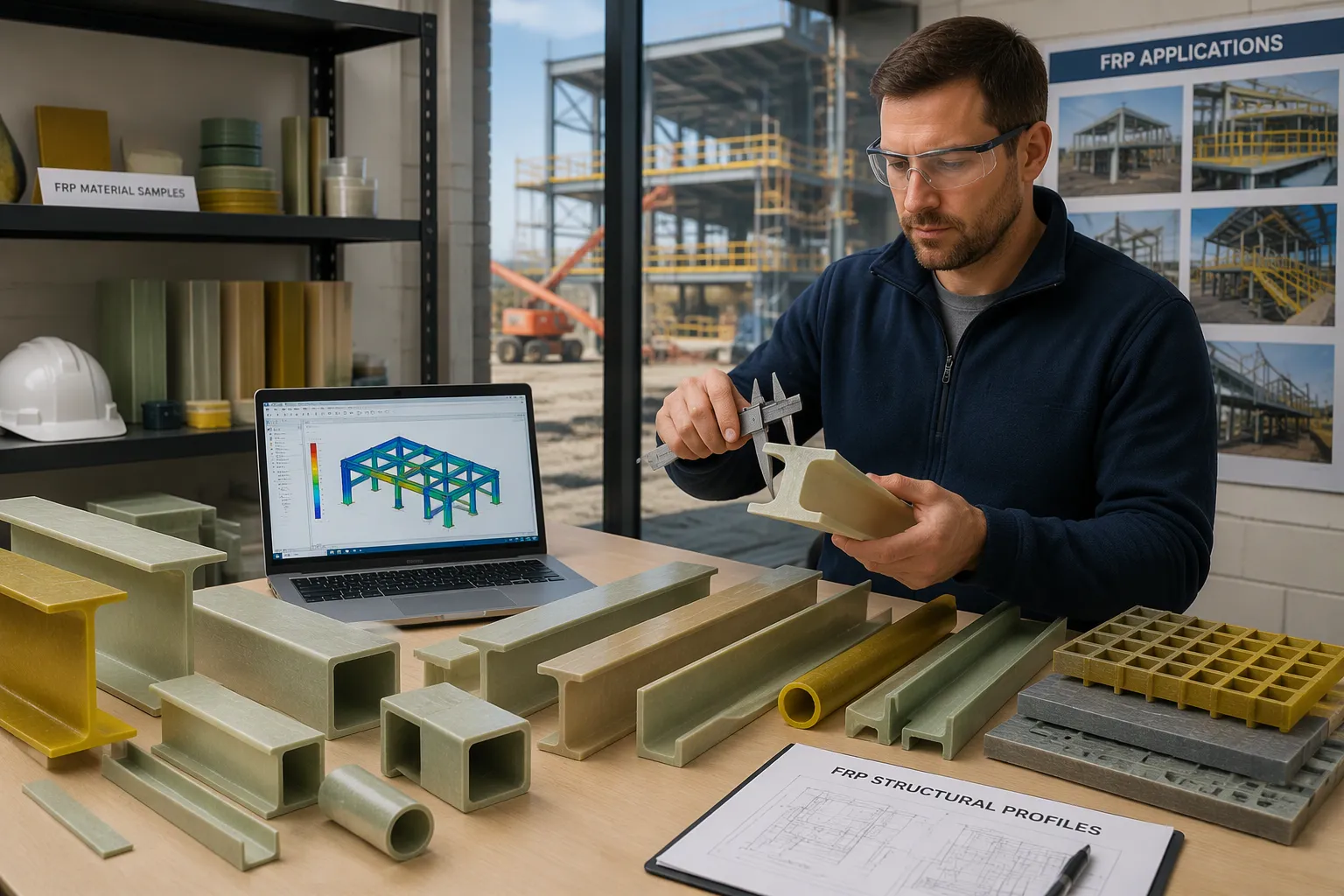
FRP structural profiles are pultruded fiber-reinforced polymer shapes, like angles, beams, and tubes. They act as load-bearing members in buildings, platforms, and industrial structures. This article explains the standard types, the mechanical and physical properties, the resin and fiber systems behind them, common engineering uses, and how FRP compares with steel.
These profiles combine glass or carbon fibers with a polymer resin. The fiber carries the load, and the resin binds the fibers and seals them against the environment. Three advantages stand out in plain terms: the material resists corrosion, it carries high strength relative to its weight, and it does not conduct electricity.
Key Takeaways
FRP structural profiles are strong, lightweight shapes made from fiber and resin.
They resist rust and chemicals, so they last longer than coated steel in harsh places.
Common shapes include angles, channels, I-beams, boxes, tubes, rods, and flat sheet.
FRP profiles are strong for their weight, which means a crew can often lift and set a member by hand.
They do not carry electricity, so they suit cable trays, ladders, and work near live circuits.
Design is often controlled by deflection, because FRP bends more than steel under the same load.
FRP costs more up front, but the saving on coating, repainting, and replacement accumulates over the service life.
Custom profiles can be pultruded to any constant cross-section a die can define.
What Are FRP Structural Profiles
Definition and Makeup
FRP structural profiles are pultruded shapes made from fiber-reinforced polymer composites. They carry loads as beams, columns, and bracing in a finished structure. EN 13706, the European product standard for pultruded profiles, sets the tolerances, test methods, and minimum mechanical properties, and it defines the structural grades E17 and E23 — the number is the full-section modulus in GPa. Those rules separate structural-grade profiles from decorative trim, and they let a buyer compare products on a common basis.
The grade label is more than a catalogue code. On a published data sheet for E17 and E23 material, longitudinal tensile strength reads 200 and 300 MPa, and the corresponding modulus 17 and 23 GPa. Across the profile, the same sheet gives 45 and 55 MPa. That five-to-one gap between the two directions is the defining feature of the material, and every design decision later in this article follows from it.
Two materials share the work inside every profile. Continuous longitudinal fibers, usually glass, carry the tensile load along the length of the member. The polymer matrix holds those fibers in place and spreads stress between them. It also shields them from moisture and chemicals. This division of labor explains why fiberglass-reinforced plastic behaves differently from a solid metal bar.
The pultrusion process pulls dry fiber rovings through a resin bath and then through a heated die. The die sets the final cross-section, and the material cures as it travels. Die temperature and pull speed are matched to the resin system, so the line runs continuously and a single run produces long, constant-section lengths with repeatable quality. A second pass or added layers can build hybrid shapes when a project needs them.
FRP vs. Traditional Materials
Each material fits a different set of conditions. The comparison below sets pultruded FRP against galvanized steel, aluminum, and treated wood on the four figures a designer reaches for first.
Table 1. Pultruded FRP against three competing structural materials. Ranges cover common commercial grades; specific strength is computed as tensile strength ÷ density.
| Property | FRP (pultruded) | Steel (galvanized) | Aluminum | Wood (treated) |
|---|---|---|---|---|
| Tensile strength (MPa) | 200–450 | 370–550 | 90–190 | 40–120 |
| Tensile modulus (GPa) | 17–25 | 200 | 70 | 9–14 |
| Specific strength (kN·m/kg) | 90–250 | 47–70 | 33–70 | 67–300 |
| Density (g/cm³) | 1.8–2.2 | 7.85 | 2.7 | 0.4–0.6 |
The specific-strength row is derived, not measured: divide the tensile strength by the density in the same column and the units fall out as kN·m/kg. Wood shows the widest band because its density ranges from about 0.4 to 0.6 g/cm³ depending on species and moisture content. A single number here says nothing about stiffness, joint strength, or how the material behaves after ten years outdoors — which is why the rest of this article keeps returning to modulus and environment.
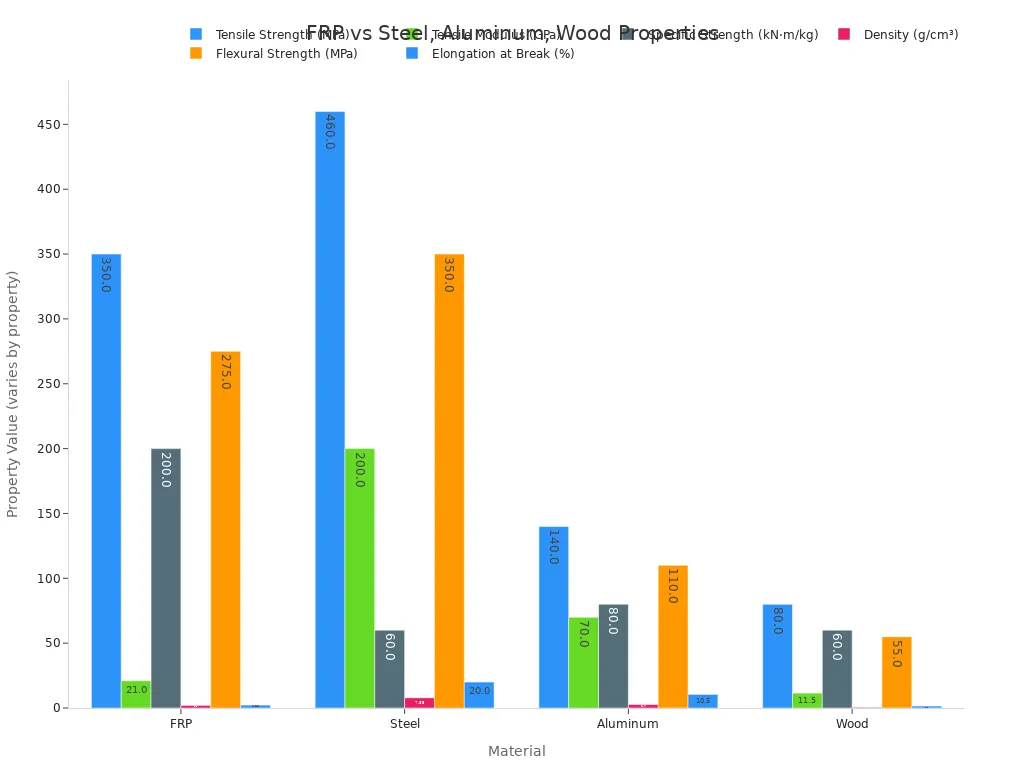
Steel wins on raw stiffness. Aluminum suits light frames with moderate loads. Wood remains a low-cost choice for dry service. FRP profiles bring the best fit where corrosion, weight, or electrical conductivity decides the design rather than pure stiffness.
Role in a Structure
FRP structural profiles serve as main members, bridge decks, columns, and cable elements. FRP beams suit small and medium spans, mainly footbridges, because their lower stiffness limits long spans. Engineers also use FRP profiles to strengthen aging bridges and to form stay-in-place deck panels.
The material stays chemically inert. It does not corrode through electrochemical mechanisms the way steel does, so a profile keeps its section through years of salt spray or chemical exposure. That trait answers the practical question behind most structural FRP enquiries: how to get long service in hostile settings without a coating maintenance program.
Selection Support
Choosing a grade before the drawings are fixed?
Send the span, the load case, and the service environment. The engineering team will match a profile family and grade, and return the section properties you need for the deflection check.
FRP Structural Shapes and Types
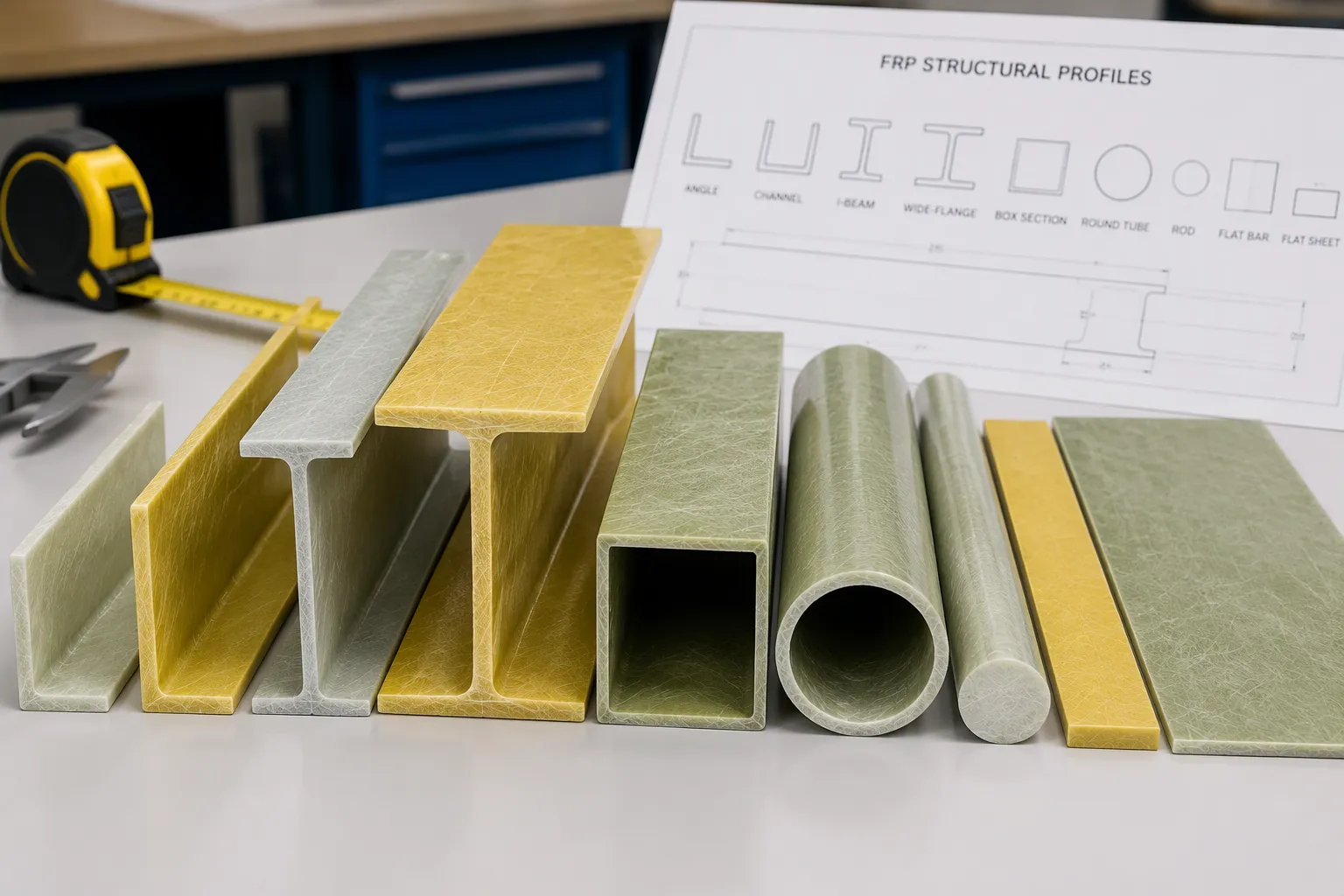
FRP structural shapes use the same naming system as steel members. So a drawing that calls for an angle, a channel, or an I-beam translates without confusion. Buyers can order common sizes from stock or commission a die for a project-specific section. That dual supply model separates a catalogue purchase from an engineered one.
Standard Fiberglass Structural Shapes
The standard family of fiberglass structural shapes covers angles, I-beams, H-beams or wide-flange sections, channels, box sections, round tubes, rods, flat bars, and flat sheets. Distributors hold popular sizes in stock for immediate shipment. The table below groups the families by the job each one does.
Table 2. Standard shape families and the structural role each one fills.
| Shape family | Typical structural role |
|---|---|
| Angles | Bracing, lintels, connection cleats, edge framing |
| Channels | Purlins, cable support, stair stringers, frame rails |
| I-beams and wide-flange | Floor and roof beams, bridge girders, column sections |
| Box sections | Columns, torsional members, moment frames |
| Round tubes | Handrails, guardrails, truss chords, poles |
| Rods and flat bars | Ties, stiffeners, splice plates |
| Flat sheets | Gussets, wear surfaces, deck plates |
Stock lists carry real specifications, not just shape names. A typical listing reads: fire-retardant isophthalic polyester channel, 4 in by 1-1/16 in, 1/8 in wall thickness, slate gray. That level of detail lets a designer check a stock item against a load case before ordering, and it shows why two suppliers quoting the same shape can be quoting different products.
FRP angles serve as bracing, lintels, and connection cleats where a light member must resist tension or compression. FRP channels carry purlins, cable trays, and stair stringers, and their open profile simplifies bolted connections. FRP beams in I and wide-flange form take floor and roof loads across short and medium spans. Designers read FRP structural shapes the same way they read steel drawings, because the geometry matches and the section properties follow familiar formulas.
Hollow FRP structural profiles close the section and raise torsional stiffness. Box sections suit columns and moment frames, while round tubes fit handrails, guardrails, and truss chords. Flat sheets form gussets, splice plates, and wear surfaces. Supplier data for these profiles usually lists them as lightweight, non-conductive, impact resistant, non-magnetic, and easy to fabricate, with dimensions and color customizable on a custom run.


Custom and Hybrid Profiles
Beyond the catalogue of fiberglass structural shapes, pultruders build to drawing. The pultrusion process sets any constant cross-section a die can define. Published capability from European pultruders puts a first custom delivery at 6 to 10 weeks with sections up to 600 by 300 mm; treat those figures as a planning range and confirm them against the actual die list, because tooling lead time, not pultrusion speed, sets the date.
Table 3. Custom profile routes and what each one covers.
| Custom profile type | Details |
|---|---|
| Custom pultruded profiles | Project-specific die, first delivery in 6–10 weeks, up to 600 × 300 mm |
| Hollow and multi-cell profiles | Drawing-led hollow, multi-cell, and edge-formed plate sections |
| Structural deck panels | Closed-profile deck sections with distinct edge geometries |
| Window and door profiles | Frame, sash, mullion, and sill lineals from 50 to 140 mm |
Three further routes appear in supplier technical guides: resin transfer molding for complex shapes with a high-quality surface finish, hybrid carbon-glass layups that raise stiffness at controlled cost, and 3D printed inserts bonded to pultruded skins for load-specific sections. These custom profiles map onto cable tray supports, cooling tower members, bridge deck panels, solar mounting, chemical plant platforms, and pedestrian bridges.
Resin and Fiber Options by Type
Resin choice applies across all fiberglass structural shapes. Orthophthalic polyester is the cost baseline; isophthalic polyester is the moderate-corrosion upgrade; vinyl ester is the usual choice for acids and chlorinated compounds and typically costs 50–100% more than polyester; epoxy is the highest-performance matrix. Fiber architecture matters as much as chemistry: 0° rovings carry axial load and make up 60–80% of fiber content, ±45° bias fabric adds shear and torsional resistance, and continuous strand mat improves transverse and interlaminar shear strength. A fiber volume fraction of 50–70% balances performance, resin flow, and cost. The next section treats these systems in full.
Properties of FRP Structural Profiles
Mechanical Properties
Designers look at mechanical data in two ways. Lengthwise values show how the profile acts along the pultrusion axis, where the rovings run. Crosswise values show how it acts across the profile, where the mat and bias fabric carry the load. Flexural strength and modulus round out the picture. On published pultrusion data, GFRP structural profiles reach a tensile strength of 200–500 MPa and an elastic modulus of 17–45 GPa along the profile axis at fiber volume fractions of 55–65%. The table below sets those numbers next to other fiber systems and steel.
Table 4. Tensile strength and modulus by fiber system. Pultruded structural grades sit at the lower end of the GFRP band.
| Property | GFRP | CFRP | AFRP | BFRP | Steel |
|---|---|---|---|---|---|
| Tensile strength (MPa) | 200–500 | 1,000–2,500 | 1,000–1,400 | 900–1,500 | 400–550 |
| Elastic modulus (GPa) | 17–45 | 80–180 | 70–125 | 45–65 | 200 |
Read the GFRP column with the grades in mind. EN 13706 E17 and E23 correspond to 17 and 23 GPa, which is the bottom half of the 17–45 GPa band; the upper end belongs to high-fiber-content or hybrid laminates. Values are measured to ASTM D638 for tension and ASTM D790 for flexure, and the tensile test method is worth asking about when two data sheets disagree — specimen preparation and strain measurement account for most of the gap.
The strength-to-weight ratio is what makes FRP stand out. On a weight-for-weight basis, FRP matches steel in strength, yet its density is about one quarter of steel's. A crew can lift and set an FRP beam by hand, while a steel member of the same capacity needs a crane. That same low density lowers the dead load a structure must carry, cuts shipping cost, and speeds installation on remote sites.
Stiffness, not strength, usually decides a member's size. An FRP beam may carry its load well below its breaking stress and still sag too much to be usable. So deflection limits often control the design of many FRP profiles. Engineers fix this in three ways: pick a deeper section, add carbon fiber to the flanges, or shorten the span. Every calculation should include a deflection check, and it often settles the final shape before the strength check does.
Schematic, not to scale. Both members are far below rupture stress; the serviceability limit arrives long before the strength limit.
Physical and Environmental Properties
FRP profiles resist corrosion very well against acids, alkalis, salt spray, seawater, and industrial air. The material stays chemically inert and does not rust through electrochemical action. This resistance holds up in chemical plants, coastal sites, and wastewater plants, where steel needs coatings and repeated repainting. The difference is structural rather than cosmetic: a coated steel member fails when the coating is breached, while an FRP member has no coating to breach.
FRP does not conduct electricity, so it works well for cable trays, ladders, and equipment enclosures near live circuits. Low thermal conductivity also cuts heat transfer through a member, which helps where temperature control matters. The material is non-magnetic as well, so it suits sensitive rooms such as MRI suites. These traits support a long-term, low-maintenance design in electrical and medical facilities.
Durability and Service Life
Durability comes from chemical and moisture resistance. FRP does not warp, rot, or decay in wet or chemical service, and it is not a food source for insects. UV exposure slowly affects the surface, and a suitable coating or surface veil limits that effect and cuts maintenance. Supplier service-life data for FRP in corrosive environments commonly claims 50+ years against about 15 years for coated steel, and marine installations often pass 50 years in service. Those figures come from manufacturers and asset owners rather than from controlled trials, so treat them as design intent and check them against reference installations in the same chemistry.
Service life is a maintenance outcome, not only a material property. Inspection schedules, surface-veil condition, and the quality of cut edges and drilled holes decide whether a profile reaches thirty years or ten. Ask a supplier for reference sites in your own chemical environment, and ask what inspection interval those sites use.
Fire-retardant resin grades further support safety where codes demand them. Phenolic systems give the lowest smoke and toxicity output; fire-retardant polyester grades cover most general construction requirements. Neither turns the material non-combustible, so the fire strategy still has to be engineered rather than assumed.
Resin and Fiber Systems
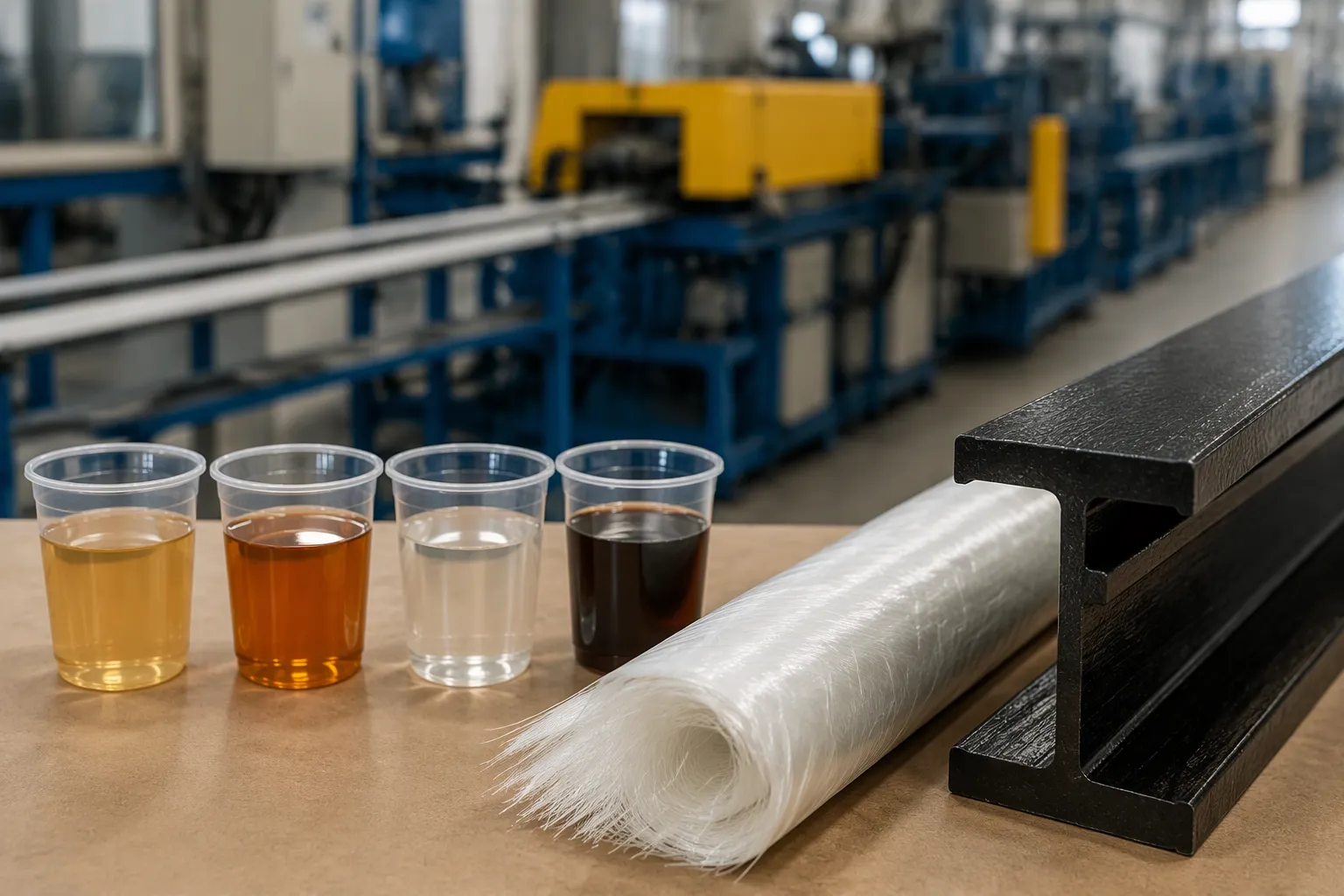
A finished profile is only as good as its two ingredients. The resin decides how the profile handles chemicals, heat, and fire. The fiber decides how much load it carries and how stiff it stays. Designers pick both together, because a strong fiber in a weak resin still fails at the surface.
Resin Matrices
The pultrusion industry relies on four main resin families. Each one trades cost against performance in a different way. The table below groups them by chemical resistance, mechanical strength, and thermal stability.
Table 5. Resin families compared. Ratings are relative within this table, not absolute values.
| Resin category | Chemical resistance | Mechanical strength | Thermal stability | Typical applications |
|---|---|---|---|---|
| Isophthalic polyester | Moderate | High | Good | Structural beams, cable trays |
| Vinyl ester | High | Very high | Good | Chemical tanks, marine grating |
| Epoxy | High | Very high | High | Aerospace, electrical rods |
| Phenolic | Good | Moderate | Highest (FST) | Subways, tunnel liners |
Unsaturated polyester resin (UPR) is the workhorse of the pultrusion process. It is the most widely used resin in the industry because it costs less and processes easily. Isophthalic polyester adds water resistance and mechanical strength, which suits outdoor infrastructure. Orthophthalic polyester covers general-purpose work where extreme corrosion is not a factor.
Vinyl ester resin (VER) is an epoxy-modified resin. It resists acidic and alkaline attack better than polyester, and it bridges the gap between the processability of polyester and the toughness of epoxy. That balance explains its use in chemical tanks and marine grating.
Epoxy resin holds the highest interfacial adhesion with glass fibers. It is reserved for high-performance aerospace and high-voltage electrical components because of its dielectric strength. Reported values for cast epoxy resin run 60–90 MPa tensile and 3–5 GPa modulus, with good chemical and moisture resistance and high temperature tolerance. Figures an order of magnitude above that, sometimes quoted as "690 MPa", describe a cured laminate rather than the resin, and should not be compared with neat-resin data. The trade-off is cost: epoxy sits at the top of the resin price range and needs a slower cure.
Polyurethane resin offers a different profile. Cast polyurethane reports 40–70 MPa tensile and 1–2 GPa modulus, both lower than epoxy, with high toughness, impact resistance, and UV resistance. That combination suits outdoor handrails and abrasion liners, where flexibility under wear matters more than raw stiffness. Phenolic resin rounds out the family. Its fire, smoke, and toxicity (FST) performance is the strongest of the four, which fits subway and tunnel liner work, at the cost of a more brittle laminate and a harder process.
Fiber Reinforcement
The fiber carries the load. Glass, carbon, and aramid each bring a different balance of strength, stiffness, and cost. Orientation matters as much as the material itself.
Glass fiber is the default reinforcement for fiberglass-reinforced polymer profiles. It offers good tensile strength at moderate cost, and it bonds well with all four resin families. Carbon fiber raises stiffness sharply. A carbon-glass hybrid layup lifts stiffness at controlled cost, which helps when deflection governs the design. Aramid fiber brings high tensile strength and low density, and it resists impact well. Each fiber type changes the profile's behavior along the pultrusion axis.
Fiber orientation sets the direction of that behavior. Longitudinal rovings run along the profile and carry axial load. Bias fabric adds shear and torsional resistance. Continuous strand mat improves transverse and interlaminar shear strength. A designer who needs a stiffer beam can add carbon to the flanges without changing the section depth.
Matching Material to Environment
Resin choice follows the service environment. The table below maps each resin system to the conditions it suits.
Table 6. Resin systems and the service conditions each one is specified for.
| Resin system | Matched environmental conditions |
|---|---|
| Polyester resin | General industrial, mild chemicals, outdoor exposure |
| Vinyl ester resin | Strong acids, wastewater, aggressive chemicals, elevated temperatures |
| Phenolic resin | Fire-retardant requirements, smoke-sensitive areas |
Temperature sets a second limit. Standard isophthalic beams are commonly quoted for service from −40 °F to 200 °F, or about −40 °C to 93 °C. Suppliers differ on the upper figure — some rate standard grades for 80 °C continuous — so the number to design against is the heat deflection temperature of the specific laminate, not a generic range. Above that, specialty resins or reduced load allowances apply.
Chemical exposure drives the third decision. Polyester resin resists weak acids and alkalis, saltwater and brine solutions, petroleum products, and most solvents. Vinyl ester resin adds resistance to strong acids such as sulfuric, hydrochloric, and nitric acid, plus chlorine and hypochlorite solutions, industrial solvents, and high-temperature chemicals. Published guidance puts properly selected FRP across the pH range from 1 to 14 with minimal degradation, but pH alone is a poor specification: concentration, temperature, and the presence of oxidisers decide the attack rate far more than the pH number does. That is why chemical resistance starts with the resin, not the fiber.
Moisture and chemical resistance also depend on the surface. A resin-rich surface veil shields the fibers from wicking, and it protects the profile in wet or splashing service. Moisture, chemicals, corrosive environments, temperature changes, and UV exposure are the five factors behind resin selection, and specially formulated systems can improve long-term durability in demanding applications.
Fire performance closes the loop. Phenolic resin delivers the strongest FST behavior, and fire-retardant polyester grades support code compliance where flame spread matters. A designer should match the resin to the fire standard the project must meet, not just to the chemical load.
Engineering Uses
Construction and Infrastructure
Infrastructure owners choose FRP when rust, weight, or hard-to-reach sites drive the choice. Walking and bike bridges show this clearly. Steel beams need new coatings, and heavy spans need cranes. FRP I-beams and girders, deck panels, grating, and handrails address both problems at once. The material stays light enough to set by hand and tough enough to skip repainting.
Decks and walkways face road salt and sea air. Closed-top deck panels and pultruded grating stand up to both, and designers check point loads, wheel loads, slip resistance, and drainage. Handrails and guardrails follow the same logic, because galvanized rails rust at welds and fixings. Standard handrail systems come in square or round tube, with checks on guard loads, anchors, and the code that applies. Noise barriers and GFRP rebar for concrete exposed to chloride round out the list.
Table 7. Infrastructure applications, the condition that drives the choice, and the parts that follow.
| Area | Conditions | Typical FRP parts |
|---|---|---|
| Pedestrian and cycle bridges | Steel needs recoating; heavy spans need cranes | I-beams, deck panels, grating, handrails |
| Decks and walkways | De-icing salt and coastal air corrode steel | Closed-top deck panels, pultruded grating |
| Handrails and guardrails | Galvanized rails corrode at welds | Square or round tube systems |
| Noise barriers | Metal panels corrode; weight drives foundations | FRP sound barrier panels with posts |
Industrial and Chemical Processing
Chemical plants pick fiberglass-reinforced plastic for one main reason: it does not rust. FRP stands up to harsh chemicals and makes equipment last longer, unlike metals that corrode. Vinyl ester FRP fits chemical processing and tank linings, while polyester FRP covers storage tanks and piping at lower cost. Cable trays, cooling tower members, and handrails all sit in splash zones where coated steel fails early.
Choosing the right product still takes care. Not every FRP mix suits high-stress settings, and chemical compatibility needs testing for each service rather than extrapolating from a resin family. Maintenance and inspection decide the outcome: a profile that is never inspected can fail from a cracked cut edge or a loose fastener long before the laminate itself is exhausted. UV damage is another factor, and protective coatings help outdoors.
Marine, Water Treatment, and Energy
Saltwater, wastewater, and renewable energy sites share one trait: repairs are costly to reach. Marine decks, handrails, dock systems, offshore walkways, and ladders are standard FRP uses, all chosen for saltwater resistance and low maintenance. Water treatment plants apply the same logic to walkways, platforms, ladders, grating, and equipment supports.
Energy uses fall into two groups. Solar projects use FRP for panel support structures, mounting parts, cable management, and maintenance walkways. Wind projects use it for turbine parts, cable support, access platforms, and safety structures. Electrical and power applications add cable trays, substation platforms, and transformer supports, where non-conductivity provides a safety margin rather than a convenience. In each case, the environment picks the material, not the other way around.
Project Enquiry
Have a structure that keeps failing on corrosion?
Send the drawings or a section list. The team will price pultruded profiles in the grade that matches the chemistry, and flag where a standard stock size will do the job.
FRP Structural Profiles vs. Steel
Technical Performance Comparison
The biggest difference between the two materials is how they carry load. Glass fiber pultruded profiles reach 200–500 MPa in tensile strength along the fiber direction, with EN 13706 E23 material sitting near 300 MPa, while structural steel reaches 400–600 MPa. Pound for pound the ranking reverses: at a quarter of the density, FRP beats steel in tension by roughly 2 to 4 times. Stiffness is a different story. Glass FRP modulus runs 17–50 GPa against steel at 200 GPa, so an FRP member bends more under the same load. Deflection control, not tensile strength, often decides the design.
A worked comparison makes the gap concrete. Glass FRP at 414 MPa tensile, 1.8 g/cm³, and 24 GPa Young's modulus sits against A709 grade 50 steel at 345 MPa, 7.8 g/cm³, and 200 GPa. Carbon FRP can beat steel on stiffness-to-weight ratio where stiffness is the binding constraint, at a price that usually keeps it out of long-span or high-volume work.
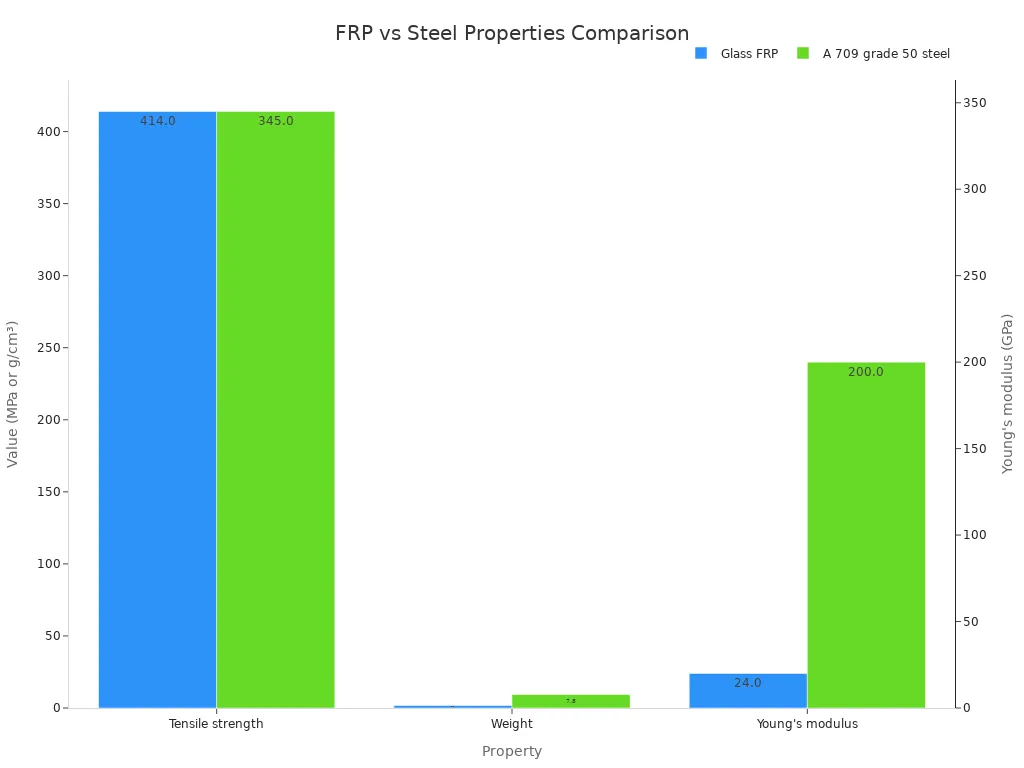
Corrosion and conductivity push the decision further apart. FRP service of 50+ years is claimed in marine settings, against 15–20 years for treated steel. FRP also blocks current, which suits cable trays and substation platforms. Steel conducts, so it needs isolation in live areas. For handling, FRP weighs about 75% less than steel at the same volume, so crews lift members by hand and skip crane time.
Cost and Lifetime Value
Upfront price favors steel. Published cost comparisons put FRP material at about 1.5 times carbon steel, with a lifetime cost factor of 0.6 against steel's 1.0. The gap comes from installation as much as material: FRP costs more per pound, yet installation of platforms, ladders, and flooring drops by 40% or more because transport and assembly are easier. Corrosion resistance then removes the repainting and coating budget for decades.
On that basis the break-even point arrives well within realistic product lifetimes. Neither option wins everywhere. Steel fits high-stiffness, compression-heavy, budget-tight frames. FRP structural profiles replace steel sections where salt, chemicals, or electrical risk would shorten a coated member's life.
Compliance and Standards
Specification starts with the product standard. EN 13706 covers pultruded structural profiles and applies directly to European projects. ASTM D3917, the dimensional tolerance standard, supports North American purchasing checks — but note what it covers: dimensional tolerance, not strength. A tolerance certificate is not a mechanical test report. Test reports should come from labs accredited to ISO/IEC 17025 and cover tensile strength, flexural strength, glass-fiber content, water absorption, dimensional tolerance, and UV resistance.
Environmental and fire rules complete the file. Buyers should check REACH, RoHS, and CE obligations by destination, and review ASTM E84 or EN 45545-2 for fire-sensitive work. ASTM E84 measures surface burning characteristics of the laminate; EN 45545-2 sets fire requirements for railway vehicles, and the two are not interchangeable. An ISO 9001 certificate confirms process control, not product certification. Assembling this file before the tender closes is what lets a buyer compare bids on equal terms.
Engineering Considerations for Structural FRP
Anisotropy and Directional Strength
Pultruded profiles do not act the same way in every direction. The rovings run along the pultrusion axis, so tensile strength and modulus are highest lengthwise. Across the profile, the mat and bias fabric carry the load, and those values are lower — often by a factor of five. Anisotropy belongs in the design brief, not in the post-mortem. A connection that pulls across the profile needs enough transverse reinforcement to resist the load.
Section orientation matters for the same reason. A channel or angle has different stiffness about each axis, so the drawing should state the actual orientation and the load direction. For localized high-torque connections, confirm sufficient transverse reinforcement before the detail is fixed.
Elastic Behavior and No Yielding
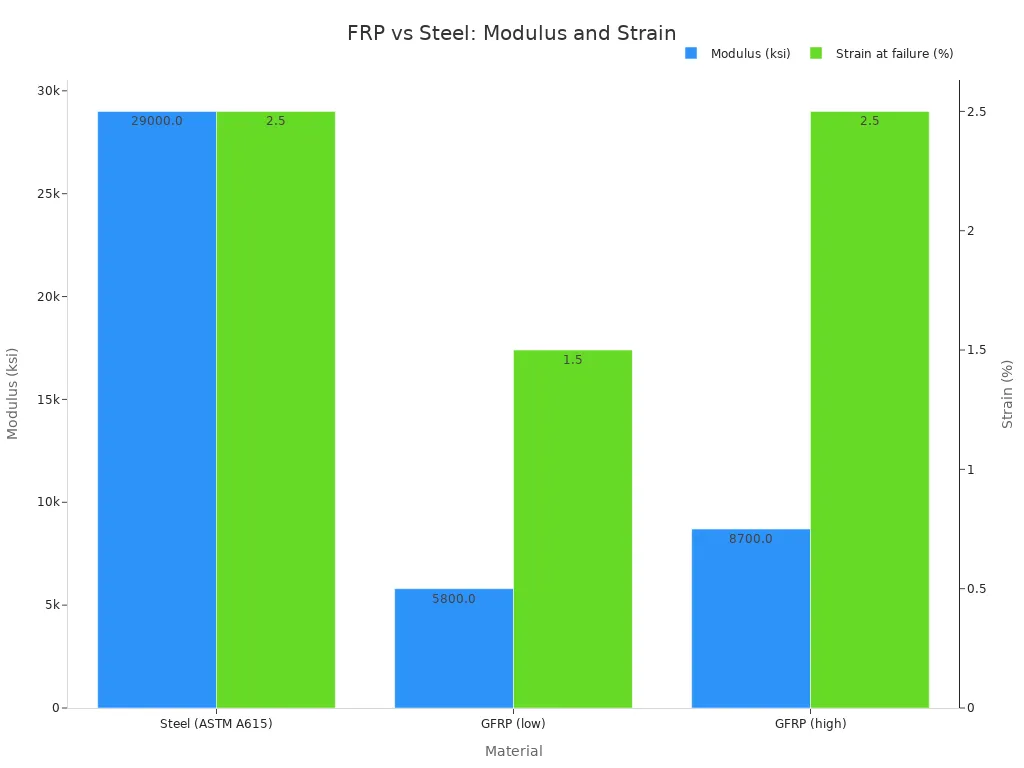
FRP deforms elastically up to rupture. It offers no yield plateau and no permanent set as a warning. In a comparison a supplier draws, steel yields with visible deformation, while FRP holds linear elasticity until sudden brittle failure. A member at 90% of capacity looks identical to one at 10%.
This behavior shapes safety factors and connections. Strength reduction factors of 0.55–0.65 are used for FRP reinforcement against 0.90 for steel, to account for the brittle mode. Those factors come from design guidance for FRP reinforcement, which covers concrete reinforced with FRP bars rather than pultruded sections — profile design uses its own partial factors under EN 13706 or the relevant national code, so do not transplant the number without checking which system it belongs to. Design also aims for compression-controlled failure where possible, because crushing gives warning that tensile rupture does not.
Selection and Design Checks
Practical selection follows a fixed sequence. Confirm the span, supports, loads, deflection criteria, section orientation, resin and environment, bearing details, holes, tolerances, and cut lengths before choosing a shape. The table below groups the checks a technical buyer should close out.
Table 8. Design checks to close before the order is placed.
| Check area | What to confirm |
|---|---|
| Geometry and loading | Span, supports, loads, deflection criteria, section orientation |
| Environment and fabrication | Resin and environment, bearing details, holes, tolerances, cut lengths |
| Connections | Hole size, location, edge distance, fasteners, bearing details on the drawing |
| Tolerances and fit | Cut lengths and assembly tolerances |
Deflection usually governs, so check it before ultimate strength. Slotted holes on long runs absorb thermal movement. Wall thickness alone does not set strength; fiber-to-resin ratio and mat orientation matter more. Finally, confirm compliance against FRP-specific design standards such as EN 13706, and record every check in the quotation drawing. Those steps keep the structural design predictable from bid to installation.
FRP structural profiles are pultruded composite shapes that carry load in bridges, platforms, and industrial plants. Standard angles, channels, I-beams, boxes, tubes, and sheets cover most designs, and custom dies handle the rest. The profiles bring high strength-to-weight ratio, corrosion resistance, and electrical insulation, and resin and fiber choices tune each one to its service environment. The material complements steel rather than replacing it everywhere, so selection should follow load, environment, deflection, and compliance needs. Buyers who need a manufacturer for a specific project can contact NHC (Nanjing Hypro Composites Co., Ltd.) for specification and selection support.
Technical Data
Need the section properties, not just a brochure?
Ask for the profile data sheet for the grade you are considering — modulus, wall thickness, tolerance, water absorption, and the fire classification — so the deflection check can be run before anything is ordered.
FAQ
What exactly are FRP structural profiles?
FRP structural profiles are pultruded composite shapes that carry load as beams, columns, and bracing. Glass or carbon fibers run along the length, and a polymer resin holds them together. The pultrusion process pulls the fibers through a heated die, so each profile cures into a constant cross-section with repeatable quality.
Which shapes are available, and do they match steel drawings?
Standard shapes include angles, channels, I-beams, wide-flange sections, box sections, round tubes, rods, flat bars, and flat sheets. The geometry matches structural steel, so a designer reads an FRP drawing the same way as a steel one. Popular sizes ship from stock, and custom dies cover project-specific sections.
How well do these profiles resist corrosion?
The material stays chemically inert and does not rust through electrochemical action. It resists acids, alkalis, salt spray, seawater, and industrial air. Properly selected profiles cover much of the pH range from 1 to 14, though concentration and temperature decide the attack rate more than pH alone. In corrosive service, published sources report service lives of 50+ years, while coated steel often needs replacement far sooner.
Why does deflection often control the design?
Glass FRP has a lower modulus than steel — 17–25 GPa for structural grades against 200 GPa — so a member bends more under the same load. A beam may sit well below its breaking stress and still sag too much to use. Designers fix this by choosing a deeper section, adding carbon fiber to the flanges, or shortening the span. Always check deflection before ultimate strength.
Can a project order custom profiles?
Yes. Pultruders build to drawing for any constant cross-section a die can define. Custom runs usually deliver in 6 to 10 weeks, with sections up to 600 by 300 mm. Hybrid layups that combine carbon and glass raise stiffness at controlled cost, which helps when deflection governs the member size.
How do FRP profiles compare with steel on cost?
Upfront, FRP material costs more than carbon steel, at roughly 1.5 times the price. Installation tells a different story. Crews lift members by hand because the material weighs about 75% less than steel, and platform and ladder installation drops by 40% or more. Lifetime cost factors favor FRP in corrosive settings.
Which standards should a buyer check?
EN 13706 covers pultruded structural profiles and sets tolerances, test methods, and minimum mechanical properties. ASTM D3917 covers dimensional tolerance for North American purchasing checks, but it is not a strength specification. Buyers should also confirm RoHS and REACH compliance, review fire test data such as ASTM E84 or EN 45545-2, and request reports from ISO/IEC 17025 accredited labs.
Where can buyers get specification support?
NHC (Nanjing Hypro Composites Co., Ltd.) makes GRP pultruded structural profiles to EN 13706 and offers material selection, custom shaping, and fitting support. The company keeps standard sizes in stock and ships to the UK and Europe. Buyers can contact NHC for help matching a profile to their load and environment.
Further reading: How Are FRP Pultruded Tubes Made? A Step-by-Step Guide
Sources
ASTM D3917, Standard Specification for Dimensional Tolerance of Thermosetting Glass-Reinforced Plastic Pultruded Shapes. Read the tolerance specification
ASTM D638, Standard Test Method for Tensile Properties of Plastics. Read the tensile method
ASTM E84, Standard Test Method for Surface Burning Characteristics of Building Materials. Read the surface burning method
American Concrete Institute, design and construction guidance for structural concrete reinforced with FRP bars. Read the design guidance