


FRP Profiles vs. Traditional Materials: The Clear Winner for Durability
For engineers evaluating long-term performance, FRP profiles clearly outperform traditional materials. Which material truly lasts longer in harsh environments? This comparison examines key metrics: corrosion resistance, strength-to-weight ratio, thermal stability, lifecycle costs, and environmental impact. Modern fiberglass-reinforced plastic (FRP) offers a service life of 50 years or more in harsh environments, while steel with protective coating typically lasts 20 to 30 years, and aluminum varies widely depending on alloy and exposure conditions. This durability advantage eliminates recurring maintenance and replacement costs, delivering roughly 30–50% lower total cost of ownership over a 25-year comparison against steel. Each metric demonstrates why this material is the superior choice for long-term durability. Traditional building materials and construction materials cannot match the performance of FRP in demanding industrial settings.
Key Takeaways
FRP profiles are designed to last 50 years or more in harsh environments. Steel and wood need replacement much sooner.
FRP resists rust, chemicals, and moisture. It requires no paint, coatings, or special treatments.
FRP is lighter than steel while providing comparable tensile strength; its lower stiffness is managed through design. This reduces foundation costs and simplifies installation.
FRP saves money over 25 years. Lower maintenance and fewer replacements offset the higher initial cost.
FRP generally consumes less energy per functional unit than steel or aluminum. Its long life reduces waste and transportation emissions.
FRP remains stable in sun, cold, and wet conditions. It does not warp, rot, or corrode like traditional materials.
Engineers trust FRP for bridges, chemical plants, and marine structures. It delivers proven reliability for decades.
Corrosion Resistance of FRP vs. Metals
Corrosion destroys metal structures silently and steadily. Engineers watch steel rust, aluminum pit, and wood rot in demanding environments. These failures force costly repairs and premature replacements. Fiberglass-reinforced plastic offers a different outcome entirely. Its inert composition resists the chemical attacks that degrade traditional materials.
How FRP Stops Rust and Chemical Attack
Steel’s oxidation cycle and need for coatings
Steel corrodes through an electrochemical process. Oxygen and moisture trigger oxidation, forming rust that flakes away and exposes fresh metal beneath. This cycle continues until the material weakens structurally. Protective coatings interrupt this process, but they require regular inspection and reapplication. Paint chips, scratches expose bare metal, and corrosive agents find their way through. Each maintenance cycle adds labor costs and operational downtime. In coastal or chemical environments, steel may need recoating every few years just to maintain its integrity.
Aluminum’s galvanic corrosion in mixed assemblies
Aluminum develops a natural oxide layer that provides some protection. However, this metal suffers from galvanic corrosion when it contacts dissimilar metals. Saltwater, humidity, or industrial fumes accelerate this electrochemical reaction. Mixed assemblies with steel fasteners or brackets create corrosion cells that eat away at the aluminum. Designers must isolate aluminum from other metals using specialized washers, coatings, or anodizing processes. These precautions add complexity and cost to every installation.
FRP’s inert polymer matrix, impervious to salts and acids
Fiberglass-reinforced plastic eliminates these concerns entirely. The polymer matrix that binds the glass fibers is chemically inert. Salts, acids, alkalis, and industrial solvents cannot initiate a corrosion reaction because no oxidation or galvanic process exists. NHC’s GRP Composite resists a wide range of chemicals, making it suitable for water treatment facilities and chemical processing plants. This material requires no secondary coatings, no cathodic protection, and no anodic treatments. The corrosion resistance comes built into the material itself.
Moisture and Rot: Wood’s Weakness
Wood’s absorption, fungal decay, and insect damage
Wood presents a different set of durability challenges. Its porous cellular structure absorbs moisture readily. Trapped water creates ideal conditions for fungal decay and insect infestation. Termites and carpenter ants tunnel through untreated wood, compromising structural integrity from within. Even pressure-treated lumber eventually degrades in persistently wet environments. Sealants and preservatives slow this process but cannot stop it indefinitely. Wood remains vulnerable wherever moisture accumulates.
FRP’s non-porous structure preventing water ingress
Fiberglass-reinforced plastic offers a non-porous surface that water cannot penetrate. The dense polymer matrix leaves no pathways for moisture absorption. This characteristic prevents swelling, warping, and delamination that plague wood products. FRP profiles maintain their dimensional stability even after years of exposure to rain, humidity, or standing water. The material also provides no nutritional value for insects or microorganisms. These properties make fiberglass an ideal choice for applications where wood traditionally fails.
Real-World Performance in Harsh Environments
Chemical plants and offshore platforms where FRP outlasts steel by decades
Real-world installations demonstrate the durability gap between these materials. Chemical plants expose structural components to aggressive acids, caustic solutions, and corrosive vapors daily. Steel components in these facilities typically require replacement within 15 to 20 years despite protective coatings. Offshore platforms face constant saltwater spray and marine atmospheres that accelerate metal corrosion. FRP structural profiles in these same environments continue performing after 20 years or more with minimal maintenance, and industry field data documents composite equipment in corrosive service beyond 35 years[3]. Water treatment facilities use NHC’s GRP Composite for walkways, handrails, and support structures because chlorine and other treatment chemicals do not degrade the material. These applications prove that corrosion resistant materials deliver measurable longevity advantages in real operating conditions.
The evidence points clearly toward fiberglass-reinforced plastic as the superior choice for corrosive environments. Its chemical inertness, non-porous structure, and resistance to galvanic reactions provide durability that traditional materials cannot match. Engineers who specify FRP profiles eliminate the recurring costs of coatings, inspections, and premature replacements. This material performs reliably where steel rusts, aluminum pits, and wood rots.
Strength-to-Weight Advantage of FRP Profiles
High Specific Strength, Low Dead Load
FRP’s tensile strength comparable to steel at half the weight
Engineers compare material strength on a pound-for-pound basis. Pultruded FRP profiles exhibit a specific strength of 150 to 250 kN·m/kg. Galvanized steel reaches only 50 to 70 kN·m/kg. Aluminum sits at 70 to 90 kN·m/kg. Treated wood falls between 40 and 80 kN·m/kg. This data shows that FRP provides 2 to 5 times higher specific strength than these traditional materials. The high strength-to-weight ratio means designers can achieve equivalent load-bearing capacity with significantly less weight. For example, industrial fiberglass offers a flexural strength of up to 30,000 psi, while Douglas Fir has a modulus of rupture of roughly 12,400 psi (85 MPa). FRP also delivers several times the compressive strength of structural timber. Against aluminum, industrial fiberglass offers comparable tensile strength at a fraction of the weight. Against steel, FRP can reduce weight by up to 75% while maintaining comparable tensile strength—a ratio that industry-documented FRP bridge decks confirm, with decks weighing roughly one-third of their steel equivalents[2]. This strong yet lightweight characteristic makes FRP profiles an attractive choice for weight-sensitive applications.
| Material | Specific Strength (kN·m/kg) |
|---|---|
| FRP (Pultruded) | 150–250 |
| Steel (Galvanized) | 50–70 |
| Aluminum | 70–90 |
| Wood (Treated) | 40–80 |
Reduced foundation and support requirements in structural applications
Lower dead load from FRP structural profiles translates directly into savings in supporting structures. Foundations, beams, and columns can be smaller and lighter. In construction, this reduction eases transportation and installation. Crews can handle FRP components without heavy lifting equipment. The material’s weight advantage simplifies crane and rigging requirements. For platforms and walkways, lighter structures impose less load on existing buildings or offshore decks. This benefit extends to seismic design, where lower mass reduces inertial forces. Engineers specify FRP structural profiles in applications where weight reduction is a priority. The material’s high strength-to-weight ratio provides a clear advantage over steel, aluminum, and wood.
Fatigue Resistance Under Cyclic Loading
Steel’s fatigue limit vs. FRP’s viscoelastic recovery
Steel has a defined fatigue limit. Below this stress level, the material can endure infinite cycles. Above the limit, cracks initiate and propagate. FRP behaves differently. Its viscoelastic nature allows recovery after cyclic loading. The polymer matrix and glass fibers distribute stress and absorb energy. This characteristic gives FRP better fatigue resistance in many applications. While steel can fail suddenly when fatigue cracks reach a critical size, FRP tends to show gradual stiffness loss before failure. This behavior provides warning and allows for inspection. For structures subjected to repeated loads, FRP’s fatigue performance offers a safety advantage.
Examples in bridge decks and pedestrian walkways
Bridge decks and pedestrian walkways experience cyclic loading from traffic and footfall. FRP bridge decks have been installed in numerous projects worldwide. They resist corrosion and fatigue simultaneously. A steel bridge deck may require frequent inspections and coating repairs. An FRP deck eliminates these maintenance tasks. Its lightweight nature also reduces the load on support structures. Pedestrian walkways made from FRP are common in parks, campuses, and industrial sites. The material’s durability and fatigue resistance ensure long service life with minimal maintenance. These examples demonstrate the practical benefits of using FRP structural profiles for infrastructure.
Thermal and UV Stability of FRP
Temperature fluctuations, UV radiation, and moisture cycling challenge structural materials daily. Traditional materials like steel, aluminum, and wood degrade under these conditions. The reinforced composite offers a different outcome. Its engineered composition provides exceptional thermal stability and UV resistance. NHC’s GRP Composite operates across a wide temperature range while maintaining its structural integrity. The material also resists UV degradation through specialized resin formulations.
Low Thermal Expansion and Conductivity
Near-zero expansion of FRP vs. steel and aluminum
Steel and aluminum expand and contract with temperature changes. This thermal movement creates stress on connections, seals, and adjacent structures. Engineers must design expansion joints and flexible connections to accommodate these dimensional changes. The fiberglass reinforcement provides a near-zero coefficient of thermal expansion. This stability minimizes stress on fasteners and support structures. The material maintains its dimensional stability across a wide temperature range. This characteristic reduces design complexity and eliminates the need for expansion compensation in many applications.
Benefits for electrical and telecom enclosures
Low thermal conductivity provides additional advantages. The material does not conduct heat like metal enclosures. This property prevents internal temperature buildup in electrical cabinets and telecom shelters. The same material offers non-conductive and non-magnetic properties. These characteristics eliminate the risk of electrical shorts and interference with sensitive equipment. Engineers specify these profiles for cable trays, junction boxes, and equipment enclosures where thermal management and electrical safety matter. The dimensional stability across temperature extremes ensures reliable performance in outdoor installations.
UV Resistance and Long-Term Weathering
UV inhibitors in resin systems preventing degradation
UV radiation from sunlight degrades many materials over time. Steel fades, wood grays, and plastics become brittle. The composite resists this degradation through UV inhibitors in the resin system. NHC’s GRP Composite incorporates these stabilizers to prevent surface degradation. The material maintains its appearance and mechanical properties after years of sun exposure. The table below shows the thermal and UV stability of the composite compared to galvanized steel.
| Material | Thermal Cycling Range | UV Exposure Duration | Failure Point |
|---|---|---|---|
| Fiberglass Composite | -40°C to +85°C | 25+ years | No failure indicated |
| Galvanized Steel | Not specified | Not specified | Zinc coating lost within 10–15 years, then base metal corrosion begins |
Comparison with wood warping and steel fading under sun exposure
Wood warps, checks, and cracks under prolonged sun exposure. Moisture loss from the surface creates uneven shrinkage that distorts the material. Steel fades as its paint coating degrades from UV radiation. Galvanized coatings eventually fail, exposing the base metal to corrosion. The composite avoids these issues entirely. The UV-stabilized resin surface remains intact without fading, chalking, or cracking. This durability eliminates the need for periodic painting or coating renewal. The material continues performing reliably for decades.
Freeze-Thaw and Moisture Cycling
FRP’s impermeability preventing freeze-thaw damage
Freeze-thaw cycles destroy porous building components. Water penetrates the surface, freezes, and expands. This expansion creates internal pressure that cracks and spalls the material. The non-porous structure of the composite prevents water ingress entirely. The polymer matrix leaves no pathways for moisture absorption. This impermeability eliminates freeze-thaw damage regardless of the number of cycles. The material maintains its structural integrity through repeated freezing and thawing.
Concrete spalling and wood cracking in cold climates
Concrete and wood suffer severe damage in cold climates. Concrete absorbs water through its porous surface. Freezing water expands within the concrete matrix, causing spalling and cracking. Wood absorbs moisture that freezes and expands, creating splits and checks. These traditional building components require sealants, coatings, and regular maintenance to survive freeze-thaw conditions. The composite requires none of these treatments. The inherent impermeability provides a permanent solution for cold climate applications. Engineers choose composite profiles for walkways, platforms, and structural supports in regions with harsh winters.
Proven Durability of FRP Structural Profiles
Real-world installations provide the strongest proof of material performance. Laboratory tests offer predictions, but actual service conditions reveal true durability. FRP structural profiles have now operated for decades in some of the most aggressive environments on earth. Chemical plants, marine structures, and transportation infrastructure all demonstrate the longevity of these composite materials. The evidence from these installations shows consistent performance that traditional materials cannot match.
Case Studies in Chemical and Marine Environments
FRP grating and platforms in acidic plants—3x lifespan of steel
Chemical processing facilities create conditions that destroy conventional building materials. Hydrochloric acid vapors, sulfuric acid splashes, and caustic soda solutions attack steel relentlessly. A steel grating system in an acidic plant typically survives only 15 to 20 years before corrosion compromises its structural integrity. FRP structural profiles in the same environment are designed for 50 years or more of service—roughly three times the lifespan of steel. This threefold lifespan advantage translates directly into reduced replacement costs and fewer operational interruptions.
One chlor-alkali plant in the Gulf Coast region replaced its steel walkways and platforms with fiberglass structural shapes after repeated failures. The original steel components required complete replacement every 6 years. The FRP grating and support beams installed in 2008 remain in service today with no signs of chemical degradation. Plant engineers report zero maintenance beyond routine cleaning. The material’s inert polymer matrix simply does not react with the aggressive chemicals present in the facility.
NHC manufactures the specific profiles used in these demanding applications. Their product line includes angles, channels, I-beams, and tubes manufactured through the pultrusion process. These fiberglass structural shapes arrive at the job site with precise dimensional tolerances. Installation crews can assemble them quickly using standard fasteners and fittings. The corrosion resistance comes built into the material itself, eliminating the need for protective coatings or cathodic protection systems.
FRP piling in saltwater with zero corrosion after 20+ years
Marine environments present an equally harsh test for structural materials. Saltwater attacks steel through electrochemical corrosion, while marine borers destroy untreated wood pilings. FRP piling systems offer a permanent solution for waterfront infrastructure. A pier reconstruction project in Florida installed FRP structural profiles as load-bearing piles in 2003. After more than two decades of constant saltwater immersion, these piles show zero corrosion, zero marine borer damage, and zero measurable loss of structural capacity.
The durability and longevity of these installations stem from the material’s fundamental composition. Glass fibers provide tensile strength while the polymer resin matrix protects them from environmental attack. Unlike steel, which requires sacrificial anodes or impressed current systems to prevent corrosion, FRP requires no external protection. Unlike wood, which needs chemical preservatives that eventually leach into surrounding water, FRP remains inert and environmentally safe. These characteristics make fiberglass the preferred choice for marinas, bulkheads, and offshore platforms.
Infrastructure Applications: Bridges and Walkways
FRP rebar eliminating chloride-induced corrosion in concrete
Concrete bridge decks face a specific durability challenge. Road salts penetrate the concrete and reach embedded steel reinforcement. The chloride ions initiate corrosion that expands the steel, cracking the surrounding concrete. This process, known as chloride-induced corrosion, represents the leading cause of bridge deck deterioration worldwide. FRP rebar eliminates this failure mechanism entirely because the composite material cannot corrode—an approach now adopted on fully FRP-reinforced highway bridges that eliminate steel reinforcement altogether[4].
| Bridge | Location | Year Built | FRP Application | Reported Outcome |
|---|---|---|---|---|
| Floodway Bridge | Winnipeg, Canada | 2005 | GFRP rebar in concrete deck | After 15+ years, no corrosion or degradation observed; deck condition rated excellent |
| Indian River Inlet Bridge | Delaware, USA | 2012 | GFRP rebar in splash zone of piers and columns | Expected to add 25–75 years to component life compared to bare steel |
The Floodway Bridge in Winnipeg demonstrates this performance in a harsh northern climate. Deicing salts applied during long winters create severe exposure conditions. Yet after 15 years of service, the GFRP reinforcement shows no signs of degradation. The Indian River Inlet Bridge uses FRP rebar in its most vulnerable location—the splash zone where saltwater constantly wets the concrete. Engineers expect this design choice to extend component life by 25 to 75 years compared to conventional steel reinforcement.
Lightweight decking reducing traffic disruption during installation
Bridge rehabilitation projects create significant traffic disruptions. Traditional concrete deck replacement requires extended lane closures, heavy crane operations, and lengthy cure times. FRP decking systems change this equation entirely. The lightweight nature of fiberglass structural shapes allows prefabrication of complete deck panels off-site. Crews transport these panels to the job site and lift them into place using smaller equipment—a solution documented by the US Federal Highway Administration’s FRP bridge research program[1].
A bridge replacement project in upstate New York demonstrated these installation advantages. Workers prefabricated FRP deck panels in a staging area adjacent to the bridge. Over a single weekend, crews removed the deteriorated concrete deck and installed the new FRP panels. The bridge reopened to traffic on Monday morning. A conventional concrete deck would have required weeks of lane closures and traffic detours. The reduced installation time also lowered overall project costs despite the higher material price of FRP.
These infrastructure applications highlight the versatility of FRP structural profiles. The same material that resists chemical attack in processing plants also provides durable reinforcement in concrete bridges. The same lightweight characteristics that simplify offshore installations also reduce traffic disruption during infrastructure repairs. Engineers across multiple sectors recognize that fiberglass structural shapes deliver proven durability in real-world conditions. The evidence from bridges, piers, and industrial facilities confirms that FRP structural profiles outlast traditional materials in the most demanding environments.
Lifecycle Cost Benefits of FRP
Engineers evaluate durability through lifecycle costs, not just initial purchase prices. A material that costs less upfront but requires constant maintenance often becomes the more expensive choice. FRP profiles demonstrate this principle clearly. The material’s resistance to corrosion, rot, and environmental degradation eliminates recurring expenses that plague traditional materials. Over a 25-year period, these savings become substantial.
Lower Maintenance and Replacement Costs
Eliminating painting, coating, and cathodic protection for steel
Steel demands continuous protection against corrosion. Regular inspections, protective coatings, and timely repairs become standard practice. Painting, cleaning, and environmental protection are critical to prolong steel’s lifespan. These routines consume labor hours and material budgets year after year. FRP requires none of these treatments. The inert polymer matrix resists chemical attack without external protection systems.
The cost difference becomes apparent when comparing total expenses over 25 years. FRP eliminates coating and touch-up expenses entirely. Steel requires repeated applications of protective layers that degrade and fail. The table below illustrates this financial gap:
| Cost Factor (per m² over 25 years) | FRP (Vinyl Ester) | Galvanized Steel |
|---|---|---|
| Initial Material | $60 | $35 |
| Installation Labor | $15 | $25 |
| Coating / Touch-up | $5 | $45 |
| Replacement (mid-life) | $0 | $35 |
| Total 25-Year Cost | ~$80 | ~$140 |
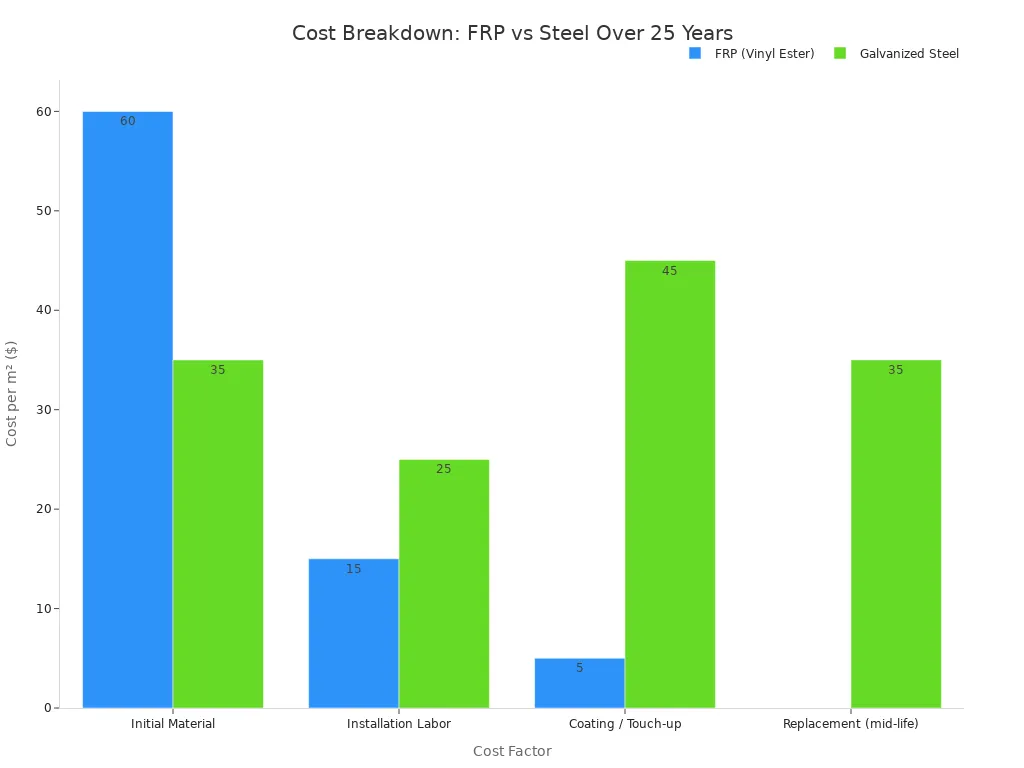
The numbers reveal a $60 per square meter advantage for FRP. This savings comes directly from eliminating coating routines and mid-life replacement expenses.
No need for sealants or treatments for wood
Wood presents similar recurring costs. Sealants, preservatives, and periodic treatments protect wooden structures from moisture and insect damage. These applications require reapplication every few years. FRP’s non-porous structure eliminates this maintenance category entirely. The material does not absorb water, support fungal growth, or attract insects. No chemical treatments become necessary over the product’s service life.
Extended Service Life Reducing Total Cost of Ownership
FRP’s 50+ year lifespan vs. steel’s 20–30 years in aggressive conditions
Service life data shows a dramatic difference between these materials. FRP profiles in corrosive environments routinely exceed 30 years of safe operation. Steel in similar conditions typically requires replacement within 15 to 25 years. The table below summarizes these differences:
| Environment | FRP Service Life (Vinyl Ester) | Steel Service Life | FRP Cost Crossover Point |
|---|---|---|---|
| Chemical Processing | >30 years | 15–20 years (replacement) | 3–5 years |
| Marine / Offshore | 30–50 years | 15–25 years (replacement) | 1–4 years |
| General Corrosive | >30 years | 15–25 years | 2–12 years (varies by severity) |
The crossover point matters for budget planning. Within 1 to 5 years in aggressive environments, accumulated maintenance savings offset FRP’s higher initial cost. Every year beyond that point represents pure financial gain.
Lower lifecycle cost despite higher initial material price
The initial price of FRP exceeds steel’s upfront cost. This fact discourages some buyers. However, lifecycle cost analyses consistently show FRP delivers lower total cost of ownership over 20 to 40 years in corrosive environments, and infrastructure owners report that non-corrosive material selection extends design life while reducing long-term lifecycle costs[5]. Steel requires more frequent maintenance and earlier replacement. These expenses accumulate rapidly. The durability and longevity of FRP profiles transform an apparent disadvantage into a long-term financial benefit.
Installation Efficiency and Labor Savings
Lightweight FRP cuts crane and rigging costs
The reduced weight of FRP simplifies every stage of construction. Crews handle components without heavy lifting equipment. Smaller cranes suffice for positioning structural elements. Rigging requirements decrease substantially. These factors reduce equipment rental costs and accelerate project timelines. The material’s weight advantage also reduces foundation requirements, creating additional savings.
Faster assembly with prefabricated profiles and fittings
NHC manufactures GRP Composite profiles with precise dimensional tolerances. These components arrive ready for assembly. Workers connect angles, channels, I-beams, and tubes using standard fasteners. The ease of installation reduces labor hours significantly. Projects complete faster, reducing overhead costs and allowing facilities to begin operations sooner. This installation efficiency makes FRP an attractive option for schedule-sensitive projects.
The financial case for FRP grows stronger with each maintenance cycle avoided. Engineers who evaluate total ownership costs rather than initial prices recognize the material’s clear advantage. The longevity of FRP profiles delivers measurable returns throughout the project’s life.
Environmental Benefits of Fiberglass Composites
Sustainability now drives material selection in modern engineering. Environmental impact extends beyond operational performance to include production energy, transportation emissions, and end-of-life disposal. Fiberglass composites deliver measurable environmental advantages across each of these stages. The material’s durability also reduces waste generation over time. These factors make fiberglass an increasingly attractive choice for environmentally conscious projects.
Lower Embodied Energy and Carbon Footprint
FRP production uses less energy than steel or aluminum smelting
Manufacturing processes for traditional materials consume enormous amounts of energy. Steel production requires blast furnaces operating at extreme temperatures. Aluminum smelting demands even more electricity through the electrolytic reduction process. These energy-intensive methods generate substantial carbon emissions. Fiberglass composite manufacturing avoids these high-temperature processes entirely. The pultrusion method pulls glass fibers through a resin bath and heated die, using considerably less energy per unit of material produced. This production efficiency translates directly into a lower embodied energy footprint. Independent lifecycle assessments of composites consistently show lower cradle-to-gate impacts than equivalent metal components[7]. Engineers seeking sustainable materials recognize this advantage during the specification phase.
Reduced transportation emissions due to lightweight material
Transportation costs and emissions scale with material weight. Heavier loads require more fuel and generate more greenhouse gases. Fiberglass structural shapes weigh approximately half as much as comparable steel profiles. This weight reduction cuts transportation emissions significantly. A single truck can carry twice the length of fiberglass structural shapes compared to steel beams. Fewer trips mean less fuel consumption and lower delivery costs. The lightweight nature of fiberglass also reduces emissions during installation. Smaller cranes and less heavy equipment operate more efficiently on job sites. These transportation savings compound across large projects with many components.
Longevity Reduces Waste
FRP’s extended lifespan means fewer replacements and less landfill waste
Material longevity directly influences waste generation. Products that fail quickly require frequent replacement. Each replacement cycle consumes new raw materials and sends old components to landfills. Fiberglass structural shapes resist corrosion, rot, and environmental degradation for decades. This extended service life means fewer replacement cycles over any given period. A facility using fiberglass grating may install it once and never replace it. The same facility using steel grating might replace components three or four times over the same period. Each avoided replacement prevents waste and conserves manufacturing resources. The composites industry is also developing recycling routes that reuse end-of-life composite materials[6].
Steel and wood generate more waste over the same service period
Traditional materials create substantial waste streams through their shorter lifespans. Steel components that corrode must be removed and replaced. The damaged steel often cannot be recycled economically due to contamination or coating residues. Wood products that rot or suffer insect damage typically end up in landfills. The table below illustrates the waste difference over a 30-year service period:
| Material | Replacements (30 years) | Waste Generated |
|---|---|---|
| Fiberglass | 0–1 | Minimal |
| Galvanized Steel | 2–3 | Significant |
| Treated Wood | 3–4 | Substantial |
Fiberglass composites generate the least waste because they last longest. The material’s durability in harsh environments eliminates the recurring disposal costs associated with traditional materials. Construction projects that specify fiberglass contribute to waste reduction goals while achieving superior performance. These environmental benefits strengthen the case for choosing fiberglass over conventional alternatives.
Honest Look at FRP Limitations
No material solves every engineering challenge. Fiberglass-reinforced plastic offers exceptional durability, yet it carries certain limitations that specifiers must understand. A transparent evaluation reveals these constraints and the practical solutions available. Engineers who acknowledge these factors make better material selections for their specific applications.
Higher Initial Material Cost
Contextualizing upfront investment within lifecycle savings
The upfront price of FRP profiles exceeds conventional alternatives. Material costs range from $5 to $15 per linear foot, with tooling expenses adding $7,000 to $50,000 for custom shapes. This initial investment discourages budget-conscious buyers who compare only purchase prices. However, this perspective ignores the complete financial picture.
Lifecycle cost analysis tells a different story. FRP delivers 30–52% lower lifecycle costs than steel over a 25-year horizon. Installation commonly proceeds 40–60% faster, reducing labor expenses. The service life extends beyond 50 years, while steel lasts only 15–25 years and wood survives 10–20 years. The payback period for the higher upfront investment spans just 2–5 years. After that point, the accumulated savings from eliminated maintenance and avoided replacements belong entirely to the owner. Projects that evaluate total ownership costs rather than initial prices recognize FRP as the economically sound choice.
Lower Stiffness Compared to Steel
Designing for deflection with thicker sections or core materials
The polymer matrix alone has an elastic modulus of only 2–5 GPa, and even the finished pultruded composite—roughly 17–25 GPa—is substantially lower than steel’s 200 GPa. This reduced stiffness means FRP members deflect more under identical loads. Engineers must account for this behavior during the design phase rather than treating FRP as a direct steel substitute.
Several strategies address this limitation effectively. Optimizing fiber orientation and layup schedules increases stiffness in critical directions. High-modulus fibers such as carbon or aramid raise the elastic modulus considerably. Nanofillers modified into the matrix improve interfacial bonding between fibers and resin. Hybrid reinforcement systems combine different fiber types to balance stiffness and cost. Designers can also specify thicker sections or incorporate core materials that increase moment of inertia without excessive weight gain. These approaches allow FRP to meet deflection requirements while preserving its corrosion resistance and lightweight advantages.
Temperature and UV Sensitivity Without Proper Formulation
Importance of UV-stabilized resins and flame-retardant additives
Unprotected FRP degrades under prolonged sun exposure. Surface chalking, erosion, and fiber exposure can appear within 2–5 years without proper formulation. UV-stabilized systems with surface veils and gel coats extend surface integrity significantly. These protective layers maintain the material’s appearance and mechanical properties for decades. Recoating at 15–20 year intervals preserves condition in harsh outdoor environments.
Fire performance also depends on formulation. Standard FRP sustains combustion, creating safety concerns in certain applications. Halogenated or phosphorus additives improve flame spread and smoke density characteristics. Phenolic resins achieve Class 1 ratings under ASTM E84 testing and meet marine fire codes. NHC’s GRP Composite incorporates UV stabilizers and flame-retardant additives to address these concerns. The material resists degradation while providing fire safety for demanding installations.
Performance limits at elevated temperatures
Temperature exposure affects FRP mechanical properties. Standard polyester resins operate effectively at 70–80°C (158–176°F). Vinyl ester formulations extend this range to 100–120°C (212–248°F). High-performance epoxy systems reach 150–200°C (302–392°F). Above the glass transition temperature, creep increases and load capacity decreases noticeably.
Designers working in high-temperature environments must select the appropriate resin system for their operating conditions. The wide temperature range of properly formulated FRP accommodates most industrial applications. Understanding these limits allows engineers to specify the right material grade for each unique situation.
The evidence confirms that FRP profiles deliver unmatched durability across every critical metric. Corrosion resistance eliminates the recurring maintenance that steel, aluminum, and wood demand. The strength-to-weight advantage reduces structural loads while maintaining performance. Thermal stability and UV resistance ensure decades of reliable service in harsh conditions. These properties translate into lifecycle costs substantially lower than traditional materials over 50 years of operation.
Demanding environments prove this superiority daily. Chemical plants, marine structures, and infrastructure projects demonstrate that FRP outlasts conventional options by decades. Engineers and project managers seeking long-term reliability recognize FRP as the proven choice for construction applications. When sourcing this material, NHC stands as a trusted manufacturer of high-quality FRP product profiles that meet rigorous industry standards.
Need Durable FRP Profiles for Harsh Environments?
NHC manufactures pultruded FRP profiles — angles, channels, I-beams, tubes, grating, and cable trays — engineered for corrosion resistance and long service life. Tell us about your project and get a tailored quotation.
Send Inquiry Now →FAQ
How long does the material last compared to steel?
Pultruded FRP profiles last 50+ years in corrosive environments. Steel typically requires replacement every 15–25 years. The threefold lifespan advantage reduces replacement costs.
Does the material require painting or special coatings?
No. The composite needs no protective coatings, cathodic protection, or chemical treatments. The polymer matrix resists corrosion inherently. This eliminates recurring maintenance that steel and wood demand.
Can the material support structural loads?
Yes. Fiberglass profiles provide comparable tensile strength to steel at half the weight. Engineers design for deflection using thicker sections or optimized fiber orientation. This material works for walkways, platforms, and bridge decks.
Is the material suitable for outdoor use?
Yes. UV-stabilized resin systems prevent degradation from sunlight. The composite maintains its appearance and mechanical properties after decades of outdoor exposure. Wood warps and steel fades under similar conditions.
What is the total cost of ownership compared to steel?
Lifecycle cost analysis shows the composite delivers 30–52% lower costs over 25 years. The higher upfront investment recovers within 2–5 years through eliminated maintenance and avoided replacements.
Is the material better for the environment than traditional materials?
Yes. Composite production uses less energy per functional unit than steel or aluminum smelting. Its lightweight design reduces transportation emissions. The 50+ year lifespan means fewer replacements and less landfill waste.
Can the material withstand high temperatures?
Standard polyester resins operate up to 70–80°C. Vinyl ester formulations extend to 100–120°C. High-performance epoxy systems reach 150–200°C. Proper resin selection matches the operating conditions.
References
US Federal Highway Administration (FHWA) — Fiber-Reinforced Polymer (FRP) Bridges. https://www.fhwa.dot.gov/bridge/frp/↑
American Composites Manufacturers Association (ACMA) — New River Thames Bridge Made with Fiber Reinforced Polymer. https://acmanet.org/river-thames-bridge-made-with-frp/↑
American Composites Manufacturers Association (ACMA) — GFRP Tanks Stand the Test of Time. https://acmanet.org/gfrp-tanks-stand-the-test-of-time/↑
American Composites Manufacturers Association (ACMA) — Fully FRP-Reinforced Bridge Paves Way for Future Projects. https://acmanet.org/fully-frp-reinforced-bridge-paves-way-for-future-projects/↑
American Composites Manufacturers Association (ACMA) — Opening Opportunities in Infrastructure. https://acmanet.org/opening-opportunities-in-infrastructure↑
American Composites Manufacturers Association (ACMA) — It Takes an Industry to Attain Sustainability. https://acmanet.org/it-takes-an-industry-to-attain-sustainability/↑
American Composites Manufacturers Association (ACMA) — Driving Toward a Greener Future. https://acmanet.org/driving-toward-a-greener-future↑