


Choosing the right cable tray material is essential for excellent corrosion resistance in harsh settings. The most popular options include steel, aluminum, stainless steel, FRP/GRP, and PVC. Each offers unique protection against corrosive environments, with FRP/GRP cable trays from NHC providing outstanding corrosion resistance and long-term durability. Market data highlights steel as the leading material by share, while aluminum is the fastest-growing segment.
✓ Key Takeaways
Selecting the right cable tray material is crucial for corrosion resistance in harsh environments.
Aluminum trays are lightweight, corrosion-resistant, and ideal for humid or coastal areas, lasting up to 20 years.
Stainless steel trays offer excellent durability, making them suitable for chemical plants and marine applications.
Galvanized steel provides cost-effective protection, but may not suffice in highly corrosive environments.
FRP/GRP trays excel in chemical resistance and are perfect for marine and industrial settings with minimal maintenance.
PVC trays are affordable and corrosion-resistant, best suited to low-impact and indoor applications.
Always verify compliance with NEMA VE 1, IEC 61537, and other relevant industry standards.
01 Aluminum Cable Tray Material
Corrosion Resistance
Aluminum cable trays offer impressive corrosion resistance driven by a dense, self-forming oxide film that blocks moisture and air from reaching the base metal. The copper-free marine grade alloy used in these trays — commonly 6063-T6 — maintains structural integrity even under chloride exposure in coastal and offshore environments. The result is a service life of 15 to 20 years with minimal maintenance, proven across chemical plants, paper mills, and petrochemical facilities.
Strengths & Weaknesses
| Attribute | Detail |
|---|---|
| Weight | ~50% lighter than equivalent steel trays, easing installation in elevated locations |
| Corrosion Resistance | High — natural oxide layer provides durable protection in humid and coastal environments |
| Maintenance | Low — no painting or re-coating required |
| Load Capacity | Moderate — not ideal for extreme mechanical stress applications |
| Non-magnetic | Minimises electrical losses in sensitive environments |
Typical Applications
| Application Area | Key Benefit | Environment |
|---|---|---|
| Industrial Facilities | Corrosion resistance | Humid, chemical |
| Power Plants | Electrical safety, non-magnetic | High voltage, outdoor |
| Water Treatment Plants | Rust prevention | Wet, corrosive |
| Marine & Coastal Projects | Saltwater protection | Coastal, offshore |
| Commercial Buildings | Lightweight installation | Indoor, dry |
| Transportation Infrastructure | Vibration resistance | Outdoor, transit |
02 Stainless Steel Cable Tray Material
Corrosion Resistance & Grades
Stainless steel derives its outstanding corrosion resistance from a high chromium content that forms a self-renewing passive oxide layer. Even when scratched, this layer rapidly repairs itself, making stainless steel cable trays a reliable long-term solution in high-humidity and chemically aggressive environments.
| Grade | Corrosion Resistance | Recommended Use |
|---|---|---|
| SS201 | Low | Dry indoor, non-critical use |
| SS304 | Moderate (18% Cr, 8% Ni) | General industrial / commercial |
| SS316L | High (+ molybdenum) | Marine, coastal, chloride-heavy environments |
Strengths & Weaknesses
| Strengths | Weaknesses |
|---|---|
| Exceptional durability under mechanical stress | Higher material cost vs. alternatives |
| Hygienic smooth surface — easy to clean | Heavier than aluminum or FRP |
| Self-healing passive oxide protection | Not resistant to strong acids or chlorides (SS304) |
| Wide temperature range performance | Thermal expansion requires joint planning |
Typical Applications
| Application Area | Key Benefit | Environment |
|---|---|---|
| Chemical Plants | Chemical resistance (SS316L) | Acidic, corrosive |
| Food Processing | Hygiene, easy cleaning | Clean, wet |
| Marine & Coastal Projects | Saltwater protection | Coastal, offshore |
| Wastewater Treatment | Moisture resistance | Wet, chemical |
| Pharmaceutical Manufacturing | Cleanliness for clean rooms | Labs, clean rooms |
| Power Generation | Heavy load capacity | Industrial, outdoor |
03 Galvanized Steel Cable Tray Material
Galvanization Types
| Type | Coating Thickness | Protection Level |
|---|---|---|
| Pre-galvanized | < 45 µm | Short-term indoor protection |
| GI (Galvanized Iron) | > 65 µm | Long-term general protection |
| HDG (Hot-Dip Galvanized) | > 65 µm | Superior outdoor / industrial protection |
Hot-dip galvanized (HDG) trays can resist salt spray for over 1,000 hours and deliver more than 30 years of service life in challenging environments. They are widely used in renewable energy projects and industrial facilities for cost-effective, high-strength cable management.
Strengths & Weaknesses
| Strengths | Weaknesses |
|---|---|
| High load capacity — handles heavy cables | Zinc coating can wear in highly corrosive areas |
| Cost-effective for large-scale installations | Heavier than aluminum or FRP |
| Suitable for both indoor and outdoor use | Coating damage during handling leads to early rust |
| Robust against vibration and impact | Reacts poorly with ammonia, chlorine, and some acids |
04 FRP/GRP Cable Tray for Corrosive Environments
Corrosion Resistance
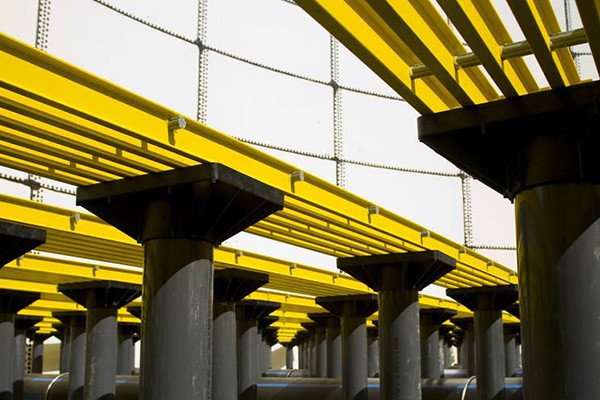
GRP cable trays stand out in the most demanding corrosive environments. The fiberglass reinforced plastic matrix resists damage from acids, seawater, and a broad range of industrial chemicals. Unlike any metal alternative, FRP/GRP trays are immune to galvanic corrosion and do not rust. Research published through the U.S. National Library of Medicine confirms that FRP composite materials offer superior and cost-effective corrosion resistance compared to traditional construction materials when proper resin selection and corrosion barrier design are applied.[1] An independent study on GFRP durability in seawater and corrosive media further demonstrates excellent resistance to acid and salt corrosion, validating long-term performance in marine and chemical applications.[2]
| Material | Corrosion Resistance | Suitable for Harsh Environments |
|---|---|---|
| FRP | Superior | Yes |
| GRP | Reliable | Yes |
| Stainless Steel | Excellent | Yes (selected grades) |
| Aluminum | Very Good | Moderate |
| Galvanized Steel | Good | Limited |
| PVC | Good | Mild environments only |
Strengths & Weaknesses
| Strengths | Weaknesses |
|---|---|
| Exceptional chemical and moisture resistance — does not rust | Higher upfront cost vs. galvanized steel |
| Lightweight — easier installation and handling | Lower load capacity than heavy-duty steel in some configurations |
| Non-conductive — improved electrical safety | UV protection needed for outdoor use (typically built in) |
| Minimal maintenance — no painting required | Can crack under extreme mechanical impact |
| Long service life (20+ years) |
Typical Applications
| Application Area | Main Benefit | Environment |
|---|---|---|
| Chemical Processing Plants | Chemical resistance | Acidic, corrosive |
| Power Generation | Electrical insulation | High temperature, humid |
| Water Treatment | Rust prevention | Wet, chemical |
| Marine / Offshore Platforms | Saltwater protection | Coastal, offshore |
| Transportation Infrastructure | Vibration resistance | Outdoor, transit |
| Data Centers / Commercial | Lightweight, low maintenance | Indoor |
05 PVC Cable Tray Material
Overview
PVC cable trays offer solid corrosion resistance against acids, alkalis, and saltwater without any metallic coating. They are non-conductive, lightweight, and generally 30–40% less expensive than metal alternatives — making them an attractive choice for budget-conscious, low-impact installations in wet or chemically mild environments.
| Strengths | Weaknesses |
|---|---|
| Corrosion-free across mild chemical environments | UV degradation limits outdoor use (without additives) |
| Lowest material cost (30–40% cheaper than metal) | Lower structural strength under heavy mechanical impact |
| Non-conductive — electrical safety advantage | Thermal expansion can cause dimensional issues |
| Easy to cut and install — no special tooling | Unsuitable for high-load industrial environments |
Typical Applications
| Application Area | Key Benefit | Environment |
|---|---|---|
| Water & Wastewater Treatment | Corrosion resistance | Wet, chemical |
| Food & Beverage Processing | Hygiene, easy cleaning | Clean, wet |
| Chemical Plants (mild) | Chemical resistance | Mildly corrosive |
| Underground / Concealed Installations | Moisture protection | Soil, concrete |
| Commercial Buildings | Easy installation | Indoor, dry |
| Telecoms & Data Centers | Non-conductive | Indoor, low impact |
06 Material Comparison: Corrosion Resistance, Cost & Durability
| Material | Corrosion Resistance | Durability | Initial Cost | Maintenance |
|---|---|---|---|---|
| FRP/GRP | Excellent | 20+ years | Higher | Minimal |
| Aluminum | Excellent | 30+ years | Moderate | Low |
| Stainless Steel | Exceptional | 25+ years | High | Minimal |
| Galvanized Steel (HDG) | Good | 5–30 years* | Low | Moderate |
| PVC | Good (mild envs) | 10–15 years | Lowest | Low |
*Lifespan varies significantly by environment — HDG can achieve 30+ years in mild conditions but far less in aggressive chemical or coastal environments.
Key environmental and safety factors to evaluate before making a final selection:
Temperature extremes and thermal cycling
Humidity and moisture levels
Chemical exposure type and concentration
UV radiation (especially for outdoor FRP/GRP and PVC)
Salinity — particularly for marine and coastal installations
Mechanical stress and required load capacity
Fire safety regulations applicable to your project
07 How to Choose the Right Cable Tray Material
Step 1 — Assess the Corrosive Environment
Match the material to the actual chemical risk level of your installation site. In lower-risk environments, galvanized steel or PVC may provide adequate protection at minimal cost. In high-risk zones — chemical plants, marine platforms, or wastewater facilities — FRP/GRP or stainless steel will deliver the durability and safety margins required.
Step 2 — Evaluate Load and Structural Requirements
Material thickness and structural design must support cable weight over the full span, accounting for potential corrosion-related thinning over time. Stainless steel and galvanized steel carry the heaviest loads; aluminum and FRP/GRP offer excellent strength-to-weight ratios for easier installation. For guidance on installation methods, see NHC's fiberglass channel installation guide.
Step 3 — Factor in Budget and Lifecycle Cost
| Material | Cost Tier | Key Properties | Best For |
|---|---|---|---|
| Aluminum | $$ | Lightweight, good corrosion resistance, excellent heat dissipation | Data centers, coastal buildings, telecom |
| FRP/GRP | $–$$ | Exceptional chemical & moisture resistance, lightweight, fire-retardant options | Chemical plants, wastewater, marine |
| Pre-Galvanized Steel | $ | Good cost-to-protection balance for indoor use | Dry indoor, light commercial |
| Powder-Coated Steel | $ | UV resistance, aesthetic appeal | Exposed areas, offices, hospitals |
| Fire-Rated Materials | $$+ | Circuit integrity maintained during fire | Life safety systems, emergency lighting |
Step 4 — Verify Compliance and Standards
Selecting a cable tray that meets recognised industry standards is non-negotiable for safety, insurance, and regulatory compliance. Key standards include:
| Standard | Applies To | Key Focus |
|---|---|---|
| NEMA VE 1[3] | Metal cable trays | Design, testing, load performance |
| IEC 61537[4] | All tray materials (metal & non-metal) | Performance, durability, testing |
| UL Certification | All tray materials | Fire and electrical safety |
| ASTM Standards | Material properties | Strength, corrosion resistance |
08 Summary Decision Table
| Material | Corrosion Resistance | Durability | Cost |
|---|---|---|---|
| FRP/GRP | Excellent | 20+ years | Higher initial, low maintenance |
| Aluminum | Excellent | 30+ years | Moderate, low maintenance |
| Steel (galvanized) | Poor in harsh areas | 5–10 years in corrosive settings | Low upfront, higher maintenance |
Selecting the best material for your environment prevents accidental disconnections, overheating, and unplanned downtime. For long-lasting cable tray installations, consult NHC for reliable GRP/FRP solutions and expert support.
Need a Corrosion Resistant Cable Tray for Your Project?
NHC's GRP/FRP cable trays deliver industry-leading corrosion resistance for chemical plants, marine platforms, power generation, and water treatment facilities. Lightweight, non-conductive, and built to international standards — with full accessories and after-sales support.
Request a Quote NowOr email us at angela.liu@nhcfrp.com | Tel: +86-15051813993Frequently Asked Questions
What is the most corrosion resistant cable tray material?
FRP/GRP cable trays offer the highest corrosion resistance — they do not rust and resist most chemicals. NHC's GRP/FRP cable trays are ideal for harsh environments including chemical plants, offshore platforms, and water treatment facilities.
Can FRP/GRP cable trays be used outdoors?
Yes. FRP/GRP trays resist UV rays, moisture, and saltwater. NHC's GRP/FRP trays include UV protection, making them suitable for marine, coastal, and industrial outdoor applications. Learn more about why FRP products excel in demanding outdoor environments.
Are aluminum cable trays suitable for chemical plants?
Aluminum provides good corrosion resistance but may not withstand strong acids or chlorides. For chemical plants with aggressive media, FRP/GRP or stainless steel (SS316L) are typically better choices.
What maintenance do corrosion resistant cable trays require?
FRP/GRP and aluminum trays require minimal maintenance — no painting or re-coating. Regular visual inspections ensure long service life. Galvanized steel trays require more attention, particularly if surface coating is damaged.
Do PVC cable trays support heavy loads?
PVC trays are lightweight and economical but have lower load capacity than steel or FRP/GRP alternatives. They are best suited to light-duty, low-impact applications such as telecoms and commercial buildings.
Are cable trays fire resistant?
Fire-retardant grades are available for FRP/GRP trays and some metal trays. Always verify product specifications against local fire safety codes. NHC offers GRP/FRP trays designed to meet strict fire safety standards.
Why choose NHC's GRP/FRP cable trays?
NHC's GRP/FRP cable trays deliver superior corrosion resistance, strength, and durability. They are lightweight, easy to install, and require minimal maintenance. NHC also provides a complete range of accessories and strong after-sales support for every project.
References & Further Reading
Environmental stress-corrosion cracking of fiberglass: lessons learned from failures in the chemical industry — U.S. National Library of Medicine / PubMed
Experimental Study on Durability and Bond Properties of GFRP Resin Bolts — PMC / National Institutes of Health
NEMA VE 1 — Metal Cable Tray Systems Standard — Cable Tray Institute
IEC 61537:2023 — Cable Management: Cable Tray Systems and Cable Ladder Systems — International Electrotechnical Commission (IEC)